MR Infinite Racing Equipment: Karts, Tracking, Media, and Operator Control
MR Infinite Racing should be bought around the race the venue intends to sell, not around a kart count. A mall seeking short family sessions needs a different operating arrangement from a leisure venue planning booked group races. Track visibility, player preparation, equipment availability, and staff control all affect whether the attraction can turn interest into completed paid sessions.
Karts, tracking, media, and operator control belong in the proposal because they support that commercial sequence. The buyer should ask what each element allows the venue to deliver and what work remains outside the equipment order.
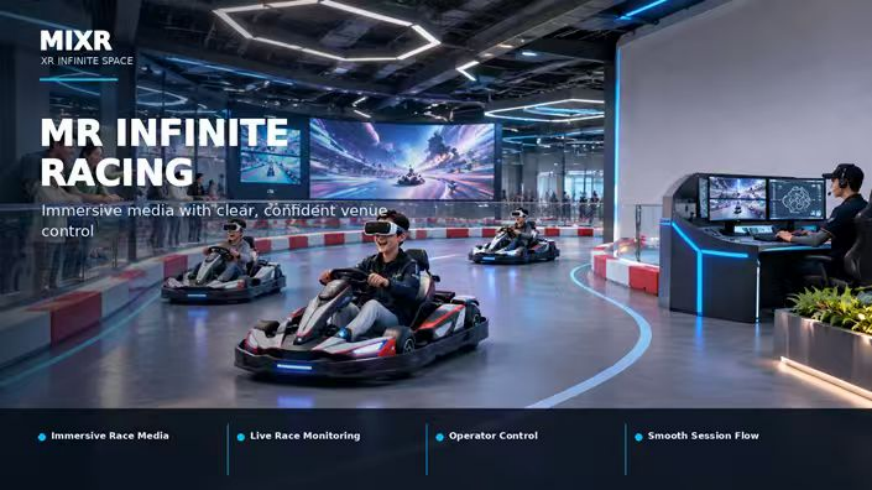
Give MR Infinite Racing a defined commercial role
A visible racing attraction may give a shopping venue a reason for families to stop. A resort may use it as an indoor activity when outdoor plans change. An entertainment center may build group events around a race and its result.
Choose the priority before specifying the configuration. Passing customers need a clear explanation and an accessible purchase point. Booked groups need an arrival process, briefing space, and a way to stay together. These are different demands on the same floor area.
MIXR’s MR Infinite Racing materials describe multiple participant configurations. They should be treated as planning options, not proof that any room can operate every configuration. The commercial brief and approved layout should determine the purchase.
Judge the kart package by available racing positions
A kart parked on the track does not establish a complete player position. Confirm the driving equipment, supported presentation and interaction, operator functions, and software access included in the quoted arrangement.
Ask the MR Go-Kart equipment manufacturer to distinguish active karts, replacement equipment, and optional stock. Establish how the venue removes a unit needing service and whether an approved substitute can join a later session without disrupting the attraction.
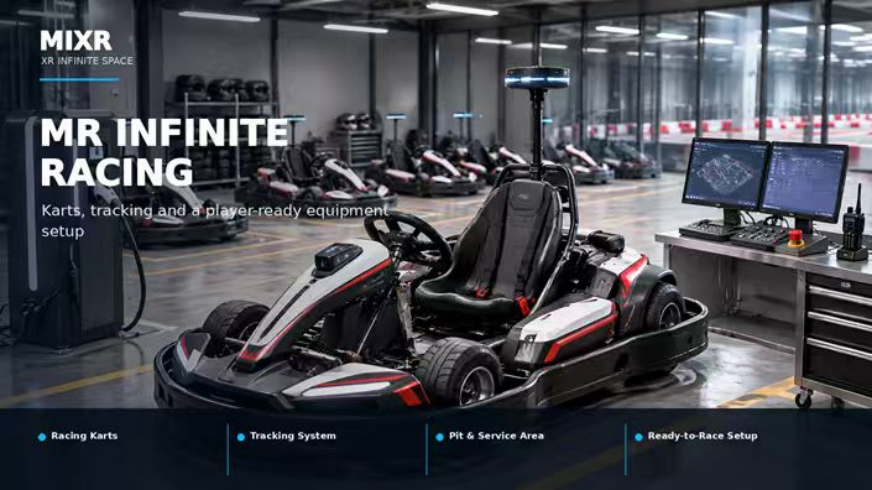
The pit area is part of that purchase. It needs to support the delivered system’s inspection, preparation, charging or equipment handling requirements. Do not design the entire room as racing surface and leave staff to service equipment beside waiting customers.
Compare configurations by their effect on paid availability. More karts may add capacity, but they also need a workable route, a loading sequence, staff oversight, and space when they are not in use.
Ask tracking questions in the finished environment
For the buyer, tracking is not a label to compare in isolation. It must support the approved driving experience under the venue’s actual conditions. The supplier should explain any requirements concerning lighting, surfaces, boundaries, and equipment placement.
Ask how physical obstacles and digital presentation are coordinated. Columns, barriers, entrances, and service positions need to appear in the review. A software demonstration elsewhere does not establish suitability for the measured room.
Also discuss later changes. Decorative installations, relocated equipment, or changes to lighting may require supplier review. The operating team should know what it can alter itself and when another check is needed.
MR Infinite Racing is a better fit for a controllable indoor zone than for a shared walkway that the venue cannot keep separate from racing activity. Site limitations should be addressed before the equipment quantity is finalized.
Purchase a repeatable race offer
The media and game functions determine what customers understand they are buying. State the included modes, languages, session functions, and result features, where offered. A public display should not be assumed to include timing, ranking, or tournament management unless those functions are specified.
For a family venue, clarity may matter more than a complicated competitive format. For group events, consistent rules and an understandable result may be central to the offer. The demonstration should match the planned use.
Content updates can help a venue change its proposition, but establish the actual update process and price basis. New media may require compatibility checks, control changes, or staff familiarization. Avoid budgeting as if any downloaded asset becomes an approved race experience.
Put the operator’s job into the quotation
Operator control should support preparation, the start of the race, supervision, and the approved response to interruptions. Review the desk location against the physical track, not just the convenience of a nearby power socket.
A MIXR quotation should connect the kart configuration and content with layout, installation, testing, and training. Request a responsibility schedule showing what that project scope includes and which floor works, barriers, utilities, and decorative construction remain with the venue.
Training should use the delivered interface. Staff need to understand both routine operation and the limits of their authority when equipment behaves unexpectedly.
Send a brief that produces comparable proposals
Ask each shortlisted MR racing equipment manufacturer to answer five questions:
- What complete session does this configuration allow the venue to sell?
- What room area supports racing, loading, waiting, and service?
- What staffing arrangement was used to develop the operating cycle?
- What happens when one kart or player unit leaves service?
- Which opening and post-opening services are included in the quoted price?
The useful proposal connects the race to the venue’s customer flow and operating budget. A kart subtotal becomes a purchase decision only when the buyer can see what keeps those karts earning through an ordinary day.