MR CS Equipment Configuration: Player Units, Control, Content, and Site Setup
An MR CS project should give the venue a multiplayer product that is easy to sell, easy to start, and possible to reset between groups. The number of headsets matters, but it does not define the attraction. Player units, content access, operator control, networking, charging, briefing, and the approved play area all determine what the venue can actually deliver.
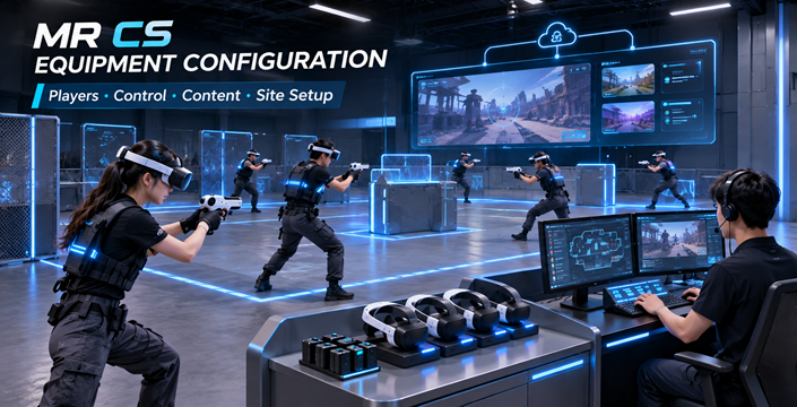
For a shopping mall, FEC, museum education project, or temporary event, the value may be different. One venue may want competitive repeat play. Another may want a short team activity with simple onboarding. The equipment configuration should be matched to that business use instead of presented as a generic box of VR CS shooting equipment.
What one player position needs to do
MIXR’s MR CS format is a no-backpack multiplayer system. That removes the backpack computer from the participant’s setup, but it does not remove fitting, charging, device checks, or staff support. MIXR can coordinate the player system, supported game content, site setup, installation, and training; the proposal should identify which items the venue must prepare locally.
The quoted player position should identify the headset, included accessories, supported interaction, software assignment, and any physical props. If the game depicts weapons, do not assume physical gun accessories or tracked controllers are included. Confirm what the player uses and what the supplier trains the staff to support.
An illustrative order of 8 active units and 2 spares is different from ten units that cannot be assigned under the same licence or device-management arrangement. Ask whether a spare can replace an active position during a live operating day.
Operator control affects turnover
The venue needs a way to prepare the group, assign the session, confirm readiness, start the match, and understand what happens when a unit disconnects. A control interface that only launches the game does not cover the full operating job.
Ask the supplier to demonstrate a late start, a device exchange, an interrupted match, and a normal reset. The exact behavior may depend on the delivered game version and operating mode, so the acceptance test should use the version planned for opening.
Separate the operator software from network hardware, shared computers, power, and installation. A no-backpack player system can still require important shared equipment. The proposal should identify who configures it and what the venue team receives at handover.
Content is part of the commercial offer
MR CS supports free-for-all and team-deathmatch modes, with individual and team-based play. Those modes create different customer offers. A competitive venue may need repeatable scoring and match variety. A museum or education project considering the attraction should first assess whether the combat theme fits its educational brief and audience; entertainment gameplay should not be presented as a certified training system.
The quotation should list included maps, modes, language versions, result functions, access terms, and update arrangements. A library shown in a demonstration may be broader than the package being purchased. Clarify whether content access is perpetual, subscription-based, time-limited, or otherwise restricted.
Content updates also affect future value. The buyer should know who supplies them, how they are reviewed, and whether new content requires changes to staff training or the venue’s promotional material.
Site setup is part of the equipment decision
MR CS can be considered for normal commercial ceiling conditions; it should not be presented as requiring a special tall hall by default. The room still needs a flat floor, even lighting without flicker, suitable clear player zones, and a layout that staff can supervise.
Columns, reflective finishes, temporary partitions, and changing decorative panels should be reviewed with the supplier where they affect tracking or visibility. Networking needs a venue-specific arrangement, including equipment positions, power, coverage, and configuration responsibility.
The supplier should provide a site plan showing the active area, briefing, equipment handling, control position, and exit. A headset count without an approved play area is not a complete equipment configuration.
What the venue must be able to operate
Before opening, staff should be able to explain the game, fit and check all active units, start a simultaneous match, monitor the group, handle an interruption, and prepare the equipment for the next session. The room should give them a practical place to do each job.
Charging, inspection, and approved cleaning procedures should distinguish ready, returned, and withdrawn units. A monitor showing the game view can help, but it does not by itself show the physical relationship between every participant and the room.
For an overseas or temporary installation, include transport, setup, staff training, remote support, spare-unit handling, and content support in the project discussion. The venue is buying an operating capability, not only headsets.
Accept the complete multiplayer product
Use a supplier-led test covering preparation, fitting, simultaneous play in each included mode, interruption, replacement, equipment return, and the next-group reset. Record the content version and the site conditions used during acceptance.
MR CS suits a venue with a validated arena and reliable shared-equipment routines. A public circulation area or a room whose obstacles cannot be accommodated by the approved content is a poor fit.
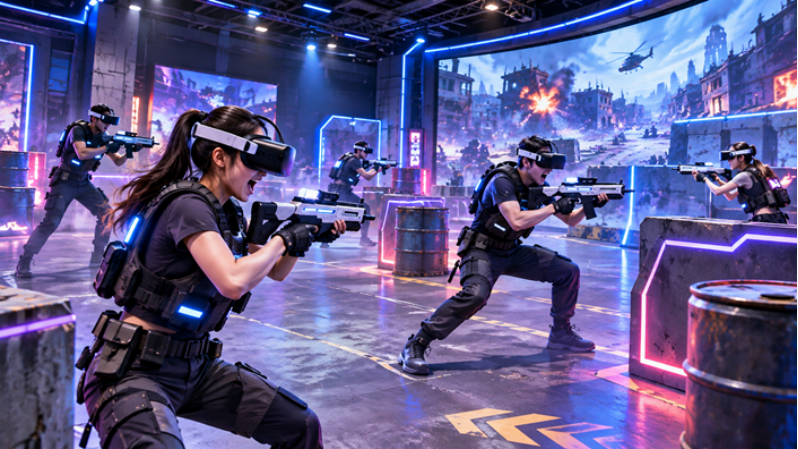
The purchase is ready to progress when every player unit can be connected to a licensed session, an operator function, an approved place to play, and a support process that continues after installation.