Sandbox Racing Equipment Configuration for Multiplayer Commercial Operation
Commercial Sandbox Racing is easy to underestimate because the cars are small. The visitor is buying a group competition built from several linked parts: driver controls, real miniature vehicles, onboard video, a visible circuit, session software, and staff support. If one link is missing, the venue may own attractive cockpits without a dependable multiplayer product.
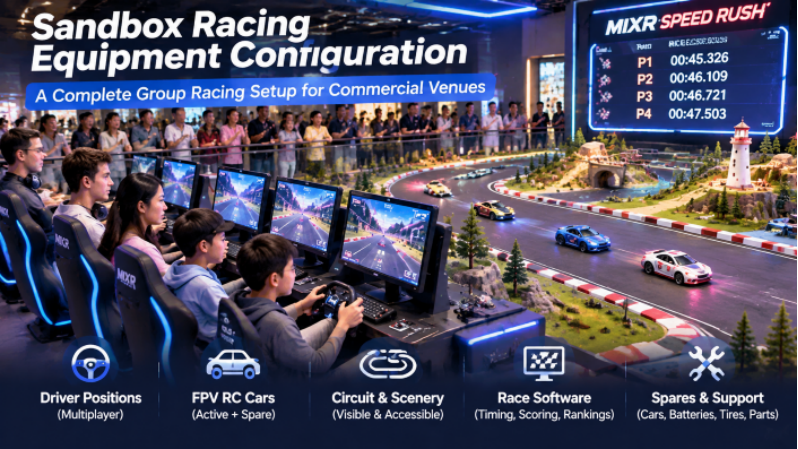
The Sandbox Racing equipment configuration should therefore be written around the session the venue wants to sell. Is it a quick family race, a repeatable competitive activity, a school or corporate group, or a visual feature inside a larger entertainment center? The answer affects the number of cars, the circuit, the service stock, and the operator tools.
What the attraction can add to a commercial venue
Unlike a screen-only racing game, an FPV RC format gives spectators something physical to watch. Real cars move on a miniature circuit while players drive from seated positions. That makes the attraction visible from a mall walkway and gives friends a reason to gather around one session.
The same physical quality creates work. Cars need recovery, batteries need handling, cameras and body parts may need replacement, and the circuit must remain clean and readable. A venue should value the attraction for its social and visual qualities without pretending that small equipment has no maintenance burden.
MIXR SPEED RUSH uses an FPV RC racing format with miniature drift cars and driver-view video. MIXR can bring the circuit, driving positions, system setup, and operator training into one coordinated project scope. The buyer should confirm the quantities and included service items in the quotation, particularly if the venue expects frequent races rather than occasional demonstration sessions.
Build the configuration around complete player positions
Each position should connect a control interface, a compatible car, the onboard camera and video path, and the player’s display. The quotation should show those relationships rather than listing separate quantities for screens and vehicles.
An illustrative order of 4 active cars plus 1 service spare is different from four cars total. The spare has value only if it is compatible with the delivered system and can be assigned to a session under the software and operating procedure.
Run all contracted positions together. A one-car demonstration does not show how the control link, video signal, interference environment, and staff workflow behave during a multiplayer race. The venue should see how a fault is identified and how one position is exchanged without resetting the whole attraction.
The circuit is part of the equipment, not decoration
The track needs a surface, boundaries, scenery, access points, and a recovery method. Cars should not disappear behind a decorative wall where staff cannot reach them. The layout should also let spectators understand the connection between the cockpit and the miniature circuit.
Ask which barriers, scenic pieces, cameras, and surfaces are included. A rendering may show a result display or a themed obstacle that is not part of the delivered package. The equipment schedule should make those exclusions visible.
If the venue wants tournaments or ranking displays, specify the included functions. Do not assume a screen can provide timing, scoring, or session records without the relevant software and control scope.
Use a short responsibility schedule when comparing packages:
| Commercial requirement | What to confirm in the package | Effect on the venue |
| Full multiplayer session | Every purchased position runs simultaneously | The advertised group size can be sold |
| Fast recovery | Compatible replacement car and trained staff | One stopped car need not end the race |
| Competitive offer | The contracted timing and result functions | Staff can explain exactly what a race includes |
Protect the positions that create revenue
Small parts can take a player position offline. Discuss manufacturer-identified wear items, spare cars, batteries, tires, body components, camera mounts, chargers, and tools before opening. The correct list depends on the delivered car model and should be confirmed by the supplier.
Create separate locations for ready equipment, returned equipment, and items awaiting inspection. Staff should not repair a car at the edge of the public circuit while the next group is waiting.
For an overseas venue, agree how parts are identified and reordered. A missing small component may remove one paid position; shipping uncertainty can turn a short repair into a long interruption.
What a complete supplier scope looks like
The project proposal should identify the car and control quantities, FPV video system, cockpit or driver positions, circuit construction, session or scoring software, operator controls, spares, installation, training, and after-sales support. It should also state which flooring, power, network, signage, and decorative work belongs to the venue.
This is where a turnkey supplier can be useful: not because every project needs the same package, but because the physical track, player positions, content or game functions, installation, and operating training can be reviewed as one deliverable.
Test the product as a group activity
Before acceptance, let the intended staff run a complete session. Assign players, start the race, manage an interruption, recover or exchange a car using the approved procedure, finish the result, and prepare the next group.
Sandbox Racing suits malls, FECs, and visitor venues that want a visible, social attraction and can provide daily handling. It is less suitable for a site with no staff access to the circuit or no room for spectators and service work.
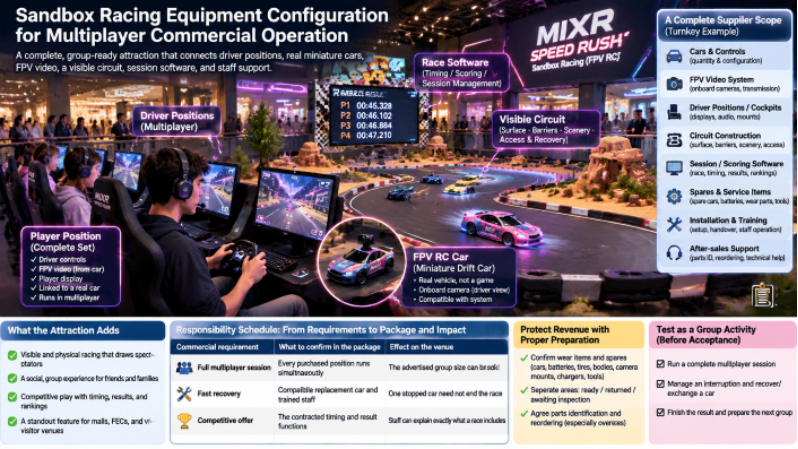
The configuration is commercially ready when the venue can keep the promised player positions available. A packing list is not enough.