MR Go-Kart Space Planning: Track, Queue, Pit Area, and Control Position
An MR Go-Kart attraction can give an indoor venue a visible racing activity with social appeal, but its value is measured by complete sessions, not by the track image alone. The venue needs a route that supports driving, a queue that converts passing visitors, a pit area that keeps equipment ready, and a control position that lets staff manage problems quickly.
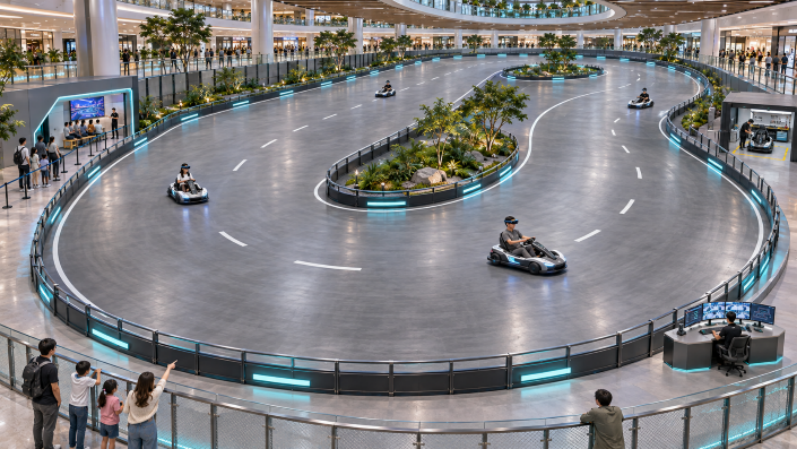
This is why MR Go-Kart site requirements should be reviewed as an operating plan. The same room must support racing, briefing, equipment handling, spectators, and the next group.
Decide what the attraction must do for the venue
A mall may want a visible activity that turns casual foot traffic into short paid sessions. An indoor entertainment center may need longer races, repeat visits, or small group events. A resort or tourism project may use the attraction as a family activity when outdoor conditions are poor.
Those business aims affect the track and the space around it. A quick casual session needs a clear public-facing queue and fast reset. A booked race needs briefing, belongings, results, and a more controlled arrival sequence.
MIXR’s MR Infinite Racing has 4-, 6-, 8-, and 10-person configurations for project planning. These are configuration choices, not a universal promise that every room can operate every kart count. Each option needs an approved track and loading plan.
Plan the footprint in four working zones
The track is the attraction’s visual core, but it should not consume every usable metre. Reserve space for:
- the driving route and its vehicle envelope;
- queue, briefing, and controlled entry;
- pit, inspection, charging or equipment handling as applicable;
- the operator position, communications, and service access.
An illustrative 300-square-metre unit cannot be priced as 300 square metres of track. Deduct the queue, pit, technical space, and circulation first. The remaining track area should still provide a route that suits the selected kart system rather than a decorative shape that looks fast but drives poorly.
Spectators matter. Family members should be able to watch and take photographs without stepping into a vehicle route. A visible track can sell the next session, but only if people can understand what the players are doing.
Let the kart define the course
Track width, corner geometry, boundaries, and permitted interaction need to follow the selected equipment. The supplier should show how drivers see the physical environment and the digital content, then verify that behavior under the venue’s actual lighting and surface conditions.
The market uses VR Go-Kart, MR Go-Kart, and XR Go-Kart inconsistently. The buyer should compare the demonstrated operating method, not just the label. A headset-led system, a physical kart with mixed-reality content, and a conventional kart simulation create different space and staffing needs.
Columns and irregular walls should be included in the route approval. Software cannot make a poor physical driving line comfortable or easy to supervise.
Give the queue and pit area a commercial job
The queue should explain the experience and keep waiting visitors away from moving karts. The briefing position needs enough room for instructions and belongings. Staff must be able to assist without standing on the live course.
The pit is where the attraction protects its earning capacity. Define where a kart waits for inspection, how equipment is exchanged, and how a withdrawn unit is removed. Follow the supplied system’s charging, battery, storage, and maintenance instructions.
The control position should provide the information and stop functions required by the system. A monitor showing a player’s digital view does not necessarily show the physical track. Review blind areas, staff sightlines, communications, and access before the desk is fixed in the interior design.
| Space decision | Operating consequence | Buyer check |
| More track and less queue space | Waiting groups may spill into public circulation | Test a busy changeover, not an empty room |
| No service bay | One withdrawn kart can obstruct loading | Demonstrate the removal route |
| Hidden operator desk | Staff may miss a physical interruption | Review sightlines with occupied karts |
What the supplier should deliver with the layout
MIXR can coordinate the kart and MR content configuration with the venue layout, system installation, testing, and operator training. The proposal should make the track, queue, pit, control position, and power or network interfaces explicit. It should also identify owner-supplied floor work, barriers, decorative construction, and building services. This division lets the buyer compare the delivered operating arrangement, not simply a price per kart.
Ask how the venue will handle a kart that needs service during a paid session. The answer should include the replacement or pause procedure, not just a promise that the hardware is reliable. Small interruptions become visible to customers when the operator has no spare position or recovery route.
Approve one complete operating cycle
Run the plan with staff and visitors in mind: arrival, briefing, loading, race, finish, unloading, equipment check, and next-group entry. The route works when these movements do not fight each other.
MR Go-Kart suits a venue that can maintain a controlled driving area and a repeatable loading process. It is a poor fit for a shared public walkway, an irregular room with no pit access, or a project that expects one staff member to watch every function from a hidden corner.
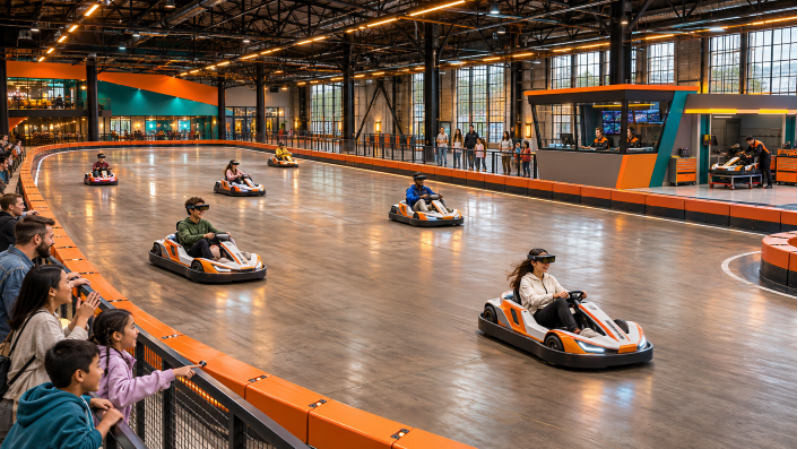
The useful output is a layout that explains what the attraction adds to the venue and what the supplier will install to keep that value available throughout the operating day.