What Should Be Included in a Holographic Glass Theater Equipment Package?
A Holographic Glass Theater package should give the venue an attraction it can open and operate, not a collection of display equipment waiting for someone else to finish the project. For a buyer comparing suspended Glass Theater equipment, completeness means knowing what visitors will experience, what construction remains, and who will support the attraction after handover.
That distinction matters whether the project is a scenic-area add-on, a museum experience, or a compact indoor attraction. A low equipment subtotal is not useful if content adaptation, structural coordination, installation, or operator training appears later as an unplanned purchase.
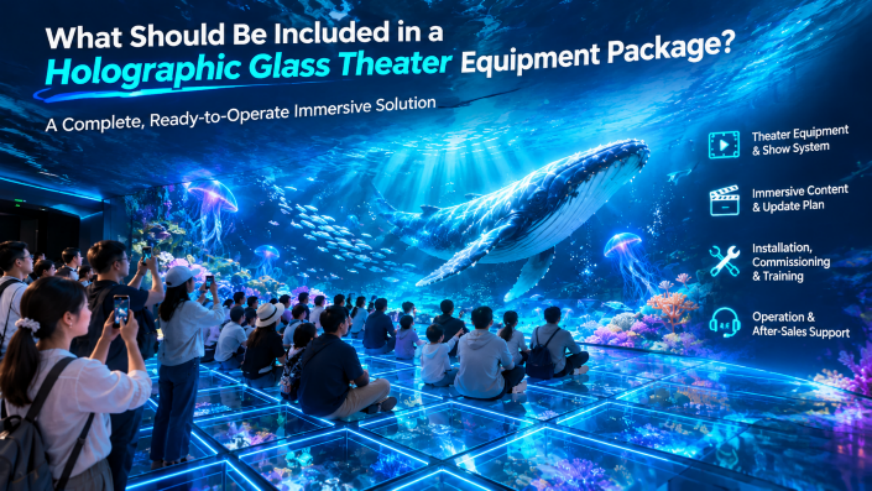
Specify suspended Glass Theater equipment around the visitor offer
Start with the attraction’s role. A scenic area may want a separately ticketed experience connected to a local story. A museum may include the theater in admission and judge it by visitor engagement. A commercial venue may need a short, easily explained activity that converts passing foot traffic.
These briefs require different entrance arrangements, presentation styles, and operating sequences. The package should identify the intended audience, group-handling method, included show, and staff tasks. Otherwise, equipment can be delivered correctly while the visitor product remains undefined.
MIXR’s right-angle Glass Theater is relevant where a venue wants a distinctive visual experience integrated with its visitor route. The right-angle technical solution should be the focus of the proposal, with content and viewing positions developed for that geometry. It is not enough to place a standard film inside an impressive enclosure.
Separate the attraction package from the building work
A useful quotation connects the visual system, glass viewing or bridge arrangement where applicable, audio, playback, show control, content, and installation. It should state which parts are supplied and which are only shown in concept images.
The same document needs an owner-supplied works schedule. Structural supports, floor preparation, electrical distribution, room finishes, access openings, and local construction should have named responsibilities. Do not assume that the word “suspended” confirms a particular structural arrangement or that the equipment manufacturer is responsible for the building design.
For a small immersive cinema equipment project, this division is particularly important. The equipment may fit the room while queueing, assistance, maintenance, and technical cabinets consume the space the venue intended to use for visitors.
Ask for a coordinated drawing that marks both public and service areas. Count the entire operating footprint when comparing the project with another use of the room.
Purchase content that is ready for this installation
The content schedule should identify the opening show, languages, commercial usage rights, and any venue-specific material. If local culture is part of the offer, agree who supplies the reference material, who writes the narrative, and who approves the finished presentation.
Right-angle image continuity deserves a specific review. Content should be evaluated from the proposed visitor positions, particularly where an image crosses the junction. A flat-screen preview is useful for editorial approval but does not establish the finished spatial experience.
Also distinguish an opening content package from future updates. A new show may require image adaptation, audio changes, programming, and testing. Ask whether those services are available, how they are ordered, and which existing assets can be reused.
This is a commercial question: the venue needs to understand how it can refresh the attraction without treating every update as a new construction project.
Include the work needed between delivery and opening
Delivery, installation, commissioning, training, and trial operation are different activities. A quotation should not compress them into a single unexplained line.
Request a schedule showing when the room must be ready, when equipment arrives, when content approval closes, and when venue staff begin training. An opening date based only on the shipping date leaves the operator carrying the uncertainty.
Training should cover the delivered interface and daily workflow: preparing a group, starting a show, assisting a visitor, stopping under the approved procedure, and preparing for the next group. The venue should also receive operating documents, a maintenance schedule, and an escalation contact.
MIXR can coordinate equipment, content, layout, installation, and training within one project discussion. The buyer should turn that coordination into a written scope rather than assume every service is included in every quotation.

Use four package checks before approving the order
Ask the shortlisted Glass Theater equipment manufacturer to demonstrate these four points:
- The proposed show and visitor route support the venue’s ticket or interpretation model.
- Supplier equipment and owner-supplied construction meet at clearly defined interfaces.
- The venue’s intended staff can run a complete group cycle using the delivered system.
- Content updates, technical support, and replacement parts have an identifiable process.
A missing answer is a scope gap to resolve, not necessarily a reason to reject the supplier immediately. The concern is whether it can be closed before purchasing commitments make changes expensive.
The format suits venues with a defined audience route, a clear story, and space for both visitors and service access. It is less suitable where public circulation must continue through the show area or maintenance would require repeated removal of finished scenery.
Before accepting the package, walk through the attraction with the actual operating team. The decisive question is whether everything required to welcome, serve, and release the next group has an owner.