How to Plan the Room and Route for an AGV Dark Ride
An AGV Dark Ride can give a theme park or indoor attraction a strong story vehicle without committing the project to a conventional fixed rail. That flexibility is useful, but it does not mean the vehicle can simply be sent through leftover floor space. The commercial value comes from a complete ride cycle: guests load, the vehicle moves through a readable story, staff can supervise it, and the next group can enter without delay.
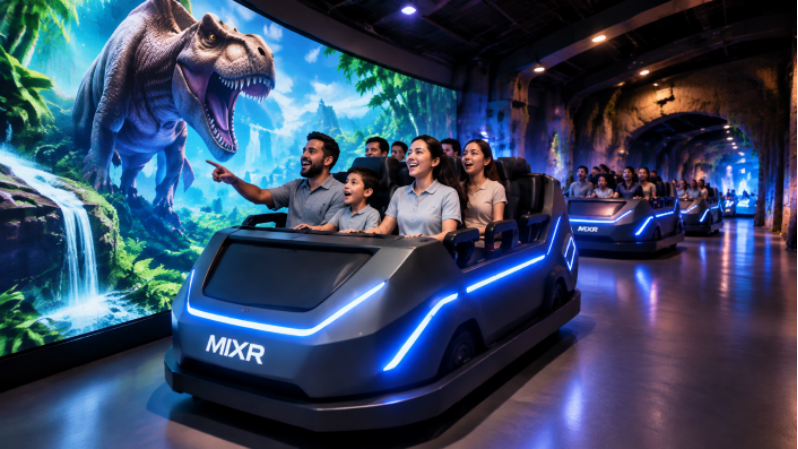
The room plan should therefore be judged by what it changes for the operator. Does the attraction improve throughput? Does it create a memorable route that can carry local content or a new IP? Can staff recover a stopped vehicle without dismantling the scenery? These questions belong in XR Dark Ride equipment procurement from the first drawing.
What an AGV Dark Ride adds to a venue
An AGV system can support a themed route that is easier to adapt than a fully fixed track arrangement, depending on the selected vehicle and control system. It may help a project reuse a large room, create several scenes, or combine physical scenery with XR and interactive media.
That flexibility has a commercial limit. A route that changes too often can be difficult for staff to understand and maintain. A route with too many narrow turns may reduce the very throughput that attracted the buyer. The project needs a controlled operating concept rather than a promise of unlimited movement.
MIXR’s XR Dark Ride combines AGV movement, a motion platform, seating, XR presentation, and interactive content. MIXR can coordinate the route proposal, ride-media integration, installation, and training around the venue’s chosen story. Content customization and future changes should be scoped separately so the operator knows what can be refreshed without altering the physical attraction.
Plan the visitor changeover before the scenic route
Begin at the loading position. Staff should be able to check seats and restraints, help visitors, and keep the next group outside the active vehicle area. If guests must cross the vehicle path to board, the arrangement will be difficult to explain during a busy session.
Show loading, travel, show positions, transition space, and unloading on the same plan. The route should also indicate where staff stand and how they reach the vehicle if a guest needs assistance. A dramatic entrance is not useful if it creates a queue beside a moving vehicle.
For a commercial project, the queue is part of the earning area. It can hold potential customers, explain the story, and display the attraction. It should not become a place where staff improvise traffic control because the original plan left no waiting zone.
Design around the full vehicle envelope
A centerline shows direction but not clearance. The supplier should provide the vehicle dimensions, turning behavior, body overhang, motion envelope, and relevant passenger clearances. The building team should check columns, scenery, walls, technical cabinets, and emergency access against that complete envelope.
The site may look open when the vehicle is parked and crowded when the vehicle is moving. The difference should be visible in the drawing. Scenic work must not narrow the route after the equipment has been approved.
The visual content also needs to match the physical route. If the headset or screen shows acceleration, turning, or a sudden stop, the media and vehicle program should be reviewed together. A compelling virtual scene cannot compensate for a route that does not support the intended timing.
Throughput is a promise the layout must support
Consider an illustrative 4-seat vehicle with a 6-minute show route. A simple division suggests ten trips per hour, but the venue still needs time for unloading, boarding, checks, dispatch, and holding. If the complete cycle becomes 10 minutes, the theoretical result is 24 visitors per hour for that vehicle.
This calculation is not a product specification. It is a way to compare proposals using the same assumptions. When suppliers quote different capacities, ask whether they are counting show time or the full operating cycle. Adding vehicles may not multiply throughput if they share one loading point or wait at the same show position.
Plan for the least convenient breakdown
Ask what happens when a vehicle stops at the far end of the route. Staff need a defined access path, communication method, and approved recovery procedure. The project team must coordinate that response with emergency access and evacuation planning.
Charging, isolation, storage, and service positions should also appear in the proposal. The venue should know when a vehicle leaves service, where technicians work, and how a withdrawn vehicle is moved without taking the attraction offline for an unreasonable period.
These details affect operating cost more directly than a decorative facade. They also show whether the supplier has thought about delivery and support after the opening day.
What to request during equipment procurement
Before signing off the XR Dark Ride equipment procurement, ask for:
- A route plan showing loading, show positions, unloading, and the full vehicle envelope.
- A capacity model based on complete group cycles rather than show duration alone.
- A media and motion integration plan for the selected content.
- A recovery, maintenance, and technical-access method.
- A clear division between supplier equipment and owner-supplied scenery or construction.
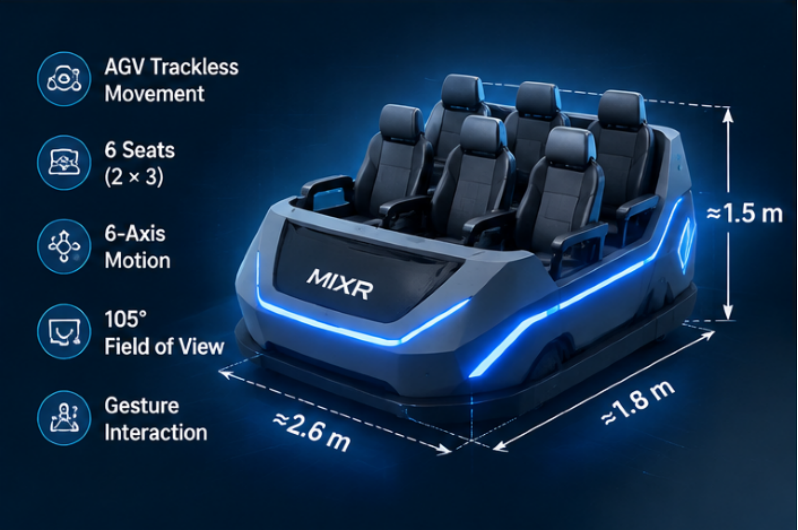
An AGV Dark Ride suits a venue prepared to coordinate a controlled ride route with content and building work. It is not a shortcut for turning an unsurveyed room into a theme-park attraction. The best proposal makes clear what the vehicle changes for the visitor and what the supplier will do to keep that change operating.