How Much Space Does a Commercial Sandbox Racing Attraction Need?
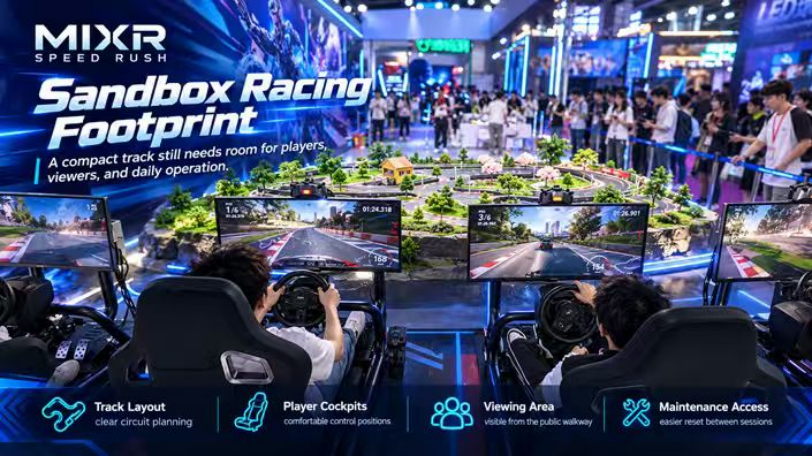
Sandbox Racing Footprint is often misunderstood because the visible race track is only one part of the attraction. A commercial layout needs the miniature circuit, driver cockpits, displays, staff access, waiting space, and a clear view for people who are not currently driving. The race itself can fit into a compact area, but the venue still has to plan the complete visitor experience.
Start With the Circuit, Not the Whole Room
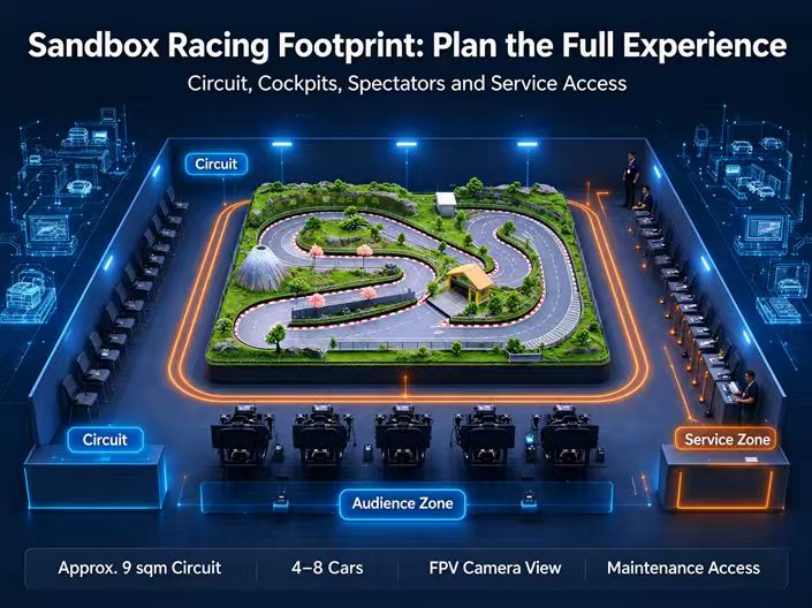
MIXR SPEED RUSH FPV RC Car Racing uses 1:24 RC drift cars, 2.4 GHz control, and 5.8 GHz FPV video. The documented system can run 4 to 8 cars in a session, and circuit planning begins at approximately 9 square metres depending on the layout.
That figure should be treated as a circuit planning reference rather than the total venue requirement. A compact track may work for a small indoor attraction. A wider layout can improve overtaking, drifting, viewing angles, and scenic detail, but it will need more room and more careful barrier placement.
| Space element | Why it is needed | What to measure |
| Circuit | Driving and recovery | Track outline |
| Cockpits | Controls and displays | Row depth and access |
| Audience zone | Waiting and viewing | Public walkway |
| Service zone | Charging and repairs | Staff clearance |
The buyer should decide whether the attraction is meant to feel like a quick family activity, a serious miniature racing experience, or a visual feature inside a larger entertainment center. The answer affects track length, cockpit arrangement, and how much of the room is dedicated to spectators.
Cockpits Need Their Own Planning Zone
The driver is seated at a full-size cockpit while controlling a miniature car and watching the first-person camera view. The cockpit row therefore needs comfortable spacing, cable management, screen visibility, and enough room for staff to help a new player.
If the venue chooses 4 to 8 cars per session, it should not place the cockpits so close together that staff cannot reach one without disturbing the others. The rear of the cockpit bank may also need access for power, signal, and maintenance.
The relationship between cockpit and track matters. Players should be able to understand where their cars are on the circuit, while spectators should have a reason to watch. A good layout gives the attraction a visible front rather than hiding the track behind equipment.
The Audience Area Changes the Space Requirement
Sandbox Racing Space Requirements include more than player positions. Families may stand behind the drivers. Friends may record the race. Staff may need to explain the controls before the session and show the result afterwards.
The waiting area should not block the entrance or force visitors to walk through the active driving zone. A small result display, lap-timing screen, or visible control point can help the activity make sense from outside. These elements also help staff manage the next group without raising their voices across the room.
Where the attraction is placed in a mall or family entertainment center, the layout should be judged from the public walkway. People need to see the miniature track and understand that the cockpits are connected to real moving cars.
Track Design Affects Maintenance Access
The track surface, barriers, scenic pieces, cameras, and car recovery points should be planned together. A layout that looks dense in a rendering may be difficult to clean or reach when a car stops behind a barrier.
The 1:24 drift cars require routine handling. Tires, body shells, batteries, and small control components may need attention during daily operation. Spare cars and chargers should have a defined storage position. Staff should be able to reach the circuit without dismantling the visitor-facing environment.
The venue should also check floor level, lighting, nearby power, and delivery access before confirming a Custom Sandbox Racing Venue. A small attraction still needs a practical installation path.
Leave Room for Small Repairs
Miniature racing equipment is approachable because the cars are small, but that also means staff will handle many small parts. The footprint should leave a service position for changing a battery, replacing a tire, recovering a stopped car, or checking an FPV camera. If every square metre is filled with scenic detail, routine work becomes slower and the attraction loses time between sessions.
The same principle applies to the cockpit row. Operators need a place for chargers, spare controllers, cleaning materials, and a short conversation with a visitor who needs help. These modest areas often make the difference between a compact attraction that feels organized and one that feels crowded.
How to Confirm the Final Footprint
Ask the supplier for a scaled layout showing the circuit, cockpit row, staff position, queue, audience area, equipment storage, and service access. Confirm whether the proposed dimensions describe the track only or the complete room arrangement.
MIXR’s SPEED RUSH FPV RC Car Racing can be planned around different circuit shapes and group sizes. The best Sandbox Racing Footprint is not the smallest possible drawing. It is the layout that lets drivers play comfortably, spectators understand the activity, and staff reset the attraction without wrestling with the room.