MR Go-Kart Equipment Cost: What Buyers Should Include Beyond the Karts
MR Go-Kart equipment cost is not determined by the karts alone. The working attraction also needs headsets, tracking, content, control software, safety planning, charging, staff procedures, and a room that allows real vehicles and virtual scenes to operate together. Buyers who compare only the kart line may receive a low-looking quotation that does not describe the complete visitor experience.
The Vehicle Is the Physical Base
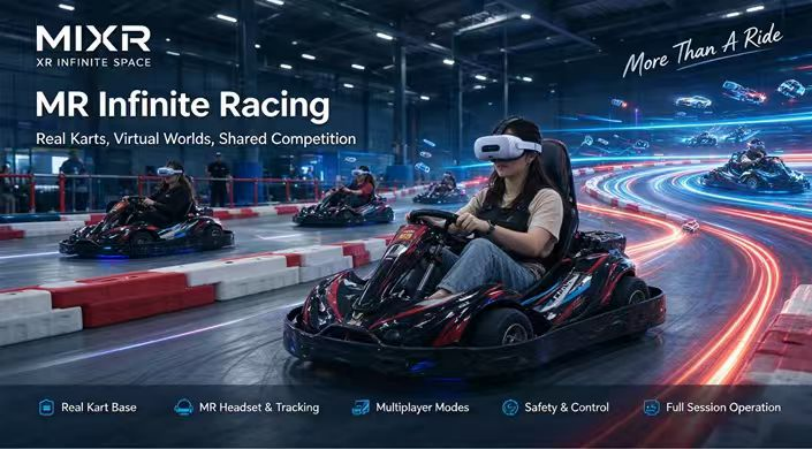
MIXR’s MR Infinite Racing format combines real go-karts with MR or VR content. Documented configurations include 4, 6, 8, and 10 participants, allowing the project to be matched to different venue sizes and operating patterns.
The quotation should identify the kart quantity, vehicle control, charging arrangement, spare units or parts, and the physical race area. It should also explain how the karts are started, stopped, assigned to players, and checked between sessions.
A larger configuration can support more visitors per round, but it creates a wider operating picture. The entry area, lane separation, staff visibility, recovery process, and battery management all need to scale with the number of vehicles.
Headsets and Tracking Change the Experience
The MR Go-Kart Price should include the headset and tracking system that connect the real kart to the virtual race. Without that connection, the venue has a conventional karting activity with a screen added around it. The attraction becomes mixed reality when the participant can drive a physical vehicle while seeing and responding to a virtual environment.
The buyer should ask how headsets are stored, cleaned, charged, assigned, and checked. Tracking equipment also needs a defined installation position and a clear operating area. If the venue adds scenery or advertising structures later, those changes should not interfere with tracking or staff sightlines.
Comfort matters for mixed groups. The briefing should be simple, and the equipment should be manageable for first-time visitors. A technically advanced system still needs a calm handover process.
Content Determines the Repeat Use of the Room
Content is a major part of the MR Go-Kart Quotation because it affects what visitors do during each session. MIXR’s documented play concepts include boss cooperation and competition, an ice-and-snow race, and a spray-party mode. These examples show why the content is not just a background scene. It defines the rules, objectives, and reasons to return.
The buyer should confirm which modes are included, how long each session lasts, whether the modes share the same physical layout, and how scores or results are presented. If custom content is requested, the quotation should explain story, visual development, interaction, testing, and revision.
Multiple modes can help a venue serve families, groups of friends, and competitive players, but only if staff can select and reset them without a complicated procedure.
Safety and Room Preparation Are Part of the Cost
The room needs clear driving boundaries, safe separation, suitable flooring, lighting that supports the system, and a route for staff to intervene. The venue should also consider where people wait while another group is driving and how the karts are moved during cleaning or maintenance.
Electrical supply and ventilation should be checked before installation. Charging equipment, computers, networking, and the physical vehicles all need a practical place in the venue. A quotation that excludes room preparation may still be accurate for the equipment and incomplete for the project.
Staff training should cover briefing, fitting, launch, emergency stop, visitor assistance, cleaning, charging, and daily inspection. These tasks influence both throughput and the life of the equipment.
The Revenue Discussion Needs a Session Model
A buyer does not need a guaranteed return figure to review the commercial logic. The venue should know how long fitting, briefing, driving, unloading, cleaning, and reset take in one cycle. That cycle is more useful than the nominal play time when estimating daily throughput.
The model should also separate peak periods from ordinary days. A ten-kart configuration may be attractive for a busy family venue, while a smaller format may be easier to keep active throughout the week. MIXR’s content and control discussion can then be matched to the actual schedule rather than to a theoretical maximum.
It is useful to record the assumptions in the quotation itself: expected group size, session length, staff positions, and the number of operating modes. Those notes keep the commercial discussion connected to the installed system and give the venue a better basis for comparing proposals from different suppliers.
What a Complete Review Should Show
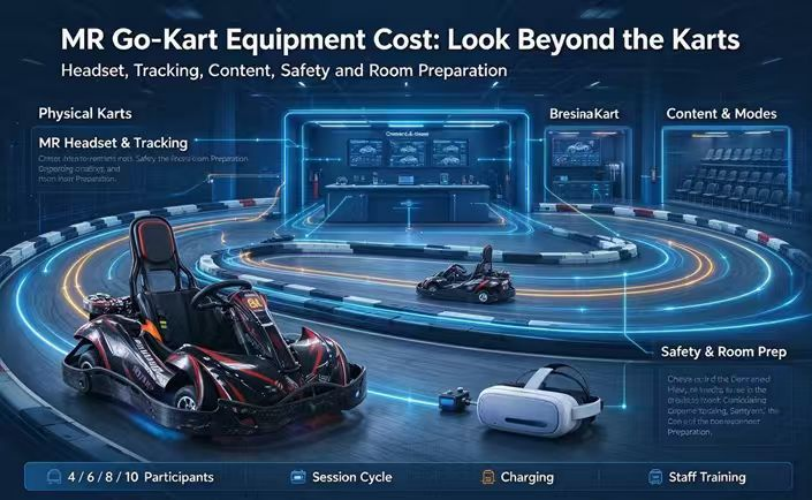
The MR Infinite Racing Price should be reviewed through a complete scope: karts, headsets, tracking, content, control system, room preparation, safety, installation, training, and after-sales support. Buyers should ask the supplier to identify optional items separately from the operating core.
MIXR can provide a project discussion around the physical kart system, MR content, and venue integration. The right budget is the one that explains how the attraction will be loaded, driven, reset, and ready for the next group. That is where the cost becomes meaningful for a commercial operator.
1. Confirm the physical kart count and charging plan.
2. List headset, tracking, content, and control items.
3. Calculate a full session cycle, not only driving time.