Case Study: A VR Large Space Attraction That Became the Main Revenue Driver of an FEC
A VR Large Space attraction can become the main revenue driver of a family entertainment center, but it does not happen just because the room is bigger. In this anonymized case, the FEC needed a signature product. It already had small games, machines, and short experiences, but nothing that made families or youth groups choose the venue on purpose.
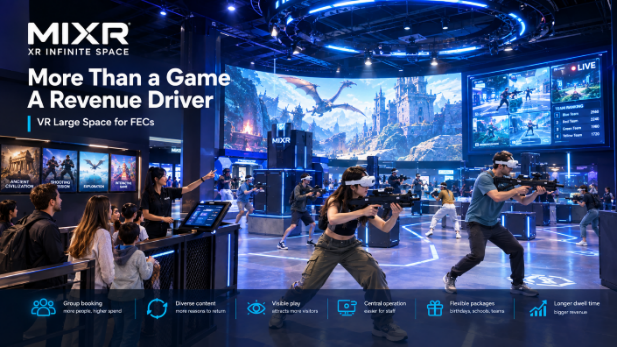
The operator built the new offer around MiXR’s XR Infinite Space, used here as a VR Large Space / free-roam attraction. The product supported multiplayer movement, themed missions, visible play, a central operation system, and content variety. The FEC stopped treating VR as an extra corner and made it the center’s main group experience.
Why the old FEC mix was not enough
The center had traffic, but much of it was shallow. Visitors came in, tried a few activities, and left. Birthday parties needed a stronger anchor. Teenagers wanted something social. Parents wanted a product that felt more memorable than another machine token.
This is where VR Large Space can help. It creates a scheduled session that groups can book, talk about, and repeat. It gives the sales team one clear product to promote. It also gives the venue a reason to design packages rather than waiting for walk-ins to spend randomly.
Why MiXR’s XR Infinite Space fit the FEC
MiXR’s XR Infinite Space is built for location-based multiplayer entertainment. The product materials describe free roaming, real-time scene interaction, gesture recognition in selected content, a director/broadcast operation system, and multiple themes such as cultural exploration, shooting missions, and playful simulation games. Some standard content is around 20 minutes, depending on the theme and operating setup.
MIXRs materials describe years of XR development, content copyrights or software works, regular content updates, and a number of landed large-space projects. For an FEC owner, those points matter because the attraction needs more than opening-day novelty. It needs content rotation, staff operation, promotion material, and supplier response when the business enters normal weeks.
The Speed Rush file adds another FEC-relevant product: MIXR Speed Rush FPV Car Racing, a cockpit-based live FPV system using physical RC cars, race/free-drive modes, automated race control, leaderboards, device management, and operational data. It is positioned for commercial destinations, tourism/theme parks, FECs, esports venues, and science museums, with a project footprint across Spain, Russia, Kuwait, the United Arab Emirates, India, Kenya, Brazil, Thailand, Vietnam, the Philippines, Malaysia, and Indonesia. For an FEC, it could sit beside the group XR room.
For the FEC, this was long enough to feel like a real event and short enough to schedule. The attraction could support families, birthdays, friend groups, school outings, and corporate team activities. It did not require the venue to explain complicated hardware. Staff could sell it as a mission: go in together, complete the task, compare the result.
The room was planned around revenue, not decoration
The operator designed the room around check-in, briefing, equipment fitting, play, exit, cleaning, and reset. That operating loop matters more than many first-time buyers expect. A beautiful room can lose money if the reset takes too long or staff cannot manage groups calmly.
The broadcast screen was placed where waiting visitors and parents could watch. That turned every active session into marketing. People outside the room saw movement, teamwork, and reaction. The attraction looked alive, which helped the next group decide.
How the product became the main sales tool
The FEC changed its sales language. Instead of selling “VR equipment”, it sold group experiences. Birthday organizers could book several sessions. Teenagers could choose competitive missions. Families could choose exploration or adventure content. Schools could frame the session as teamwork or technology experience.
This changed the role of the attraction. It was no longer one activity among many. It became the reason visitors came to the venue, while other games supported the rest of the visit.
The commercial value came from four places
- Group booking: one organizer could bring several paying visitors at once.
- Repeat content: different themes created reasons to return.
- Visible play: the broadcast screen attracted passers-by and waiting families.
- Manageable operation: a central control workflow helped staff run sessions.
- Package design: birthdays, school visits, and friend groups could be sold differently.
- Dwell time: visitors stayed longer because the session had a clear start and finish.
The FEC did not depend on one busy weekend. It built the attraction into its normal sales calendar.
Why content variety mattered
Free-roam XR can become stale if every group plays the same mission forever. MiXR’s product family gives operators different content directions: exploration, ancient-civilization journeys, shooting arenas, and playful interactive scenarios. The FEC used this variety to segment customers.
Younger visitors liked active competition. Families preferred missions they could understand together. Repeat visitors were offered another theme rather than the same experience. This is how a VR Large Space attraction becomes a revenue driver instead of an opening-month novelty.
Where the FEC had to be disciplined
The operator trained staff to keep the briefing short. It set cleaning and charging routines. It checked whether players understood the mission before entering. It monitored which content produced rebooking and which content created confusion. These small management details protected the attraction’s earning power.
MiXR’s director/broadcast system supported this discipline because staff could monitor player screens, manage secondary display content, and use the attraction for promotion. A supplier cannot run the business for the owner, but a better product system can make good operation easier.
When VR Large Space is the right FEC choice
VR Large Space is suitable when the FEC has enough room, enough group demand, and a need for a signature attraction. It works in shopping malls, family entertainment centers, commercial entertainment zones, and some tourism retail spaces. It is especially useful when the operator wants repeatable group sessions rather than one-person novelty.
It is weaker when the venue has very low traffic, no staff discipline, no group-sales plan, or a room that cannot support safe movement and clean reset. A small arcade corner may be better served by simpler equipment. A scenic destination seeking passive group viewing may prefer Flying Theater.
FEC buyer checklist
- Identify the main group customers before choosing room size.
- Plan visibility from outside the attraction.
- Build packages for birthdays, families, friends, schools, and team events.
- Confirm briefing, session, exit, cleaning, and reset time.
- Use content rotation to support repeat visits.
- Track bookings, repeat customers, staff workload, and downtime.
What the case proves
The attraction became the FEC’s main revenue driver because the operator built a business around it. MiXR’s XR Infinite Space supplied the product foundation: multiplayer free roaming, themed content, interaction, broadcast operation, and a format suitable for commercial venues. The FEC supplied sales focus, scheduling, staff training, and package design.
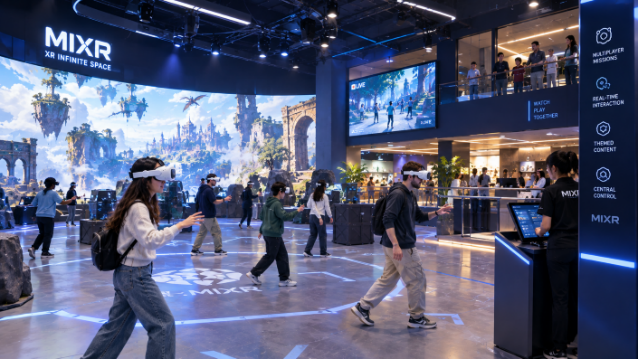
That is the combination other operators should study. VR Large Space is not valuable because it uses more space. It is valuable when that space creates group energy, repeatable sessions, and a product customers can explain to their friends.