Dark Ride ROI Analysis
Dark Ride ROI is not a single payback number. It is the result of traffic, ticket design, attraction capacity, content life, staff discipline, and downtime control. When a buyer asks me whether a Dark Ride can make money, I usually ask where it will be installed, who will ride it, and what the visitor is expected to do before and after the ride.
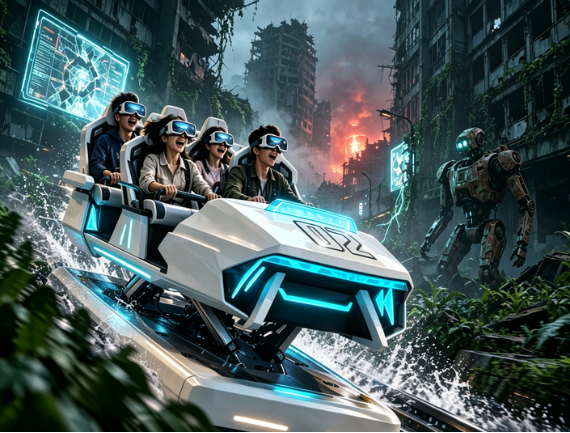
MiXR’s XR Dark Ride gives operators a useful product format because it combines AGV movement, six-axis motion, XR or naked-eye visual content, route-based scenes, and interaction. That combination can create higher perceived value than a simple VR room. It also means the ROI model has more moving parts. The attraction can be profitable, but only when the site treats it as an operating system.
The first ROI driver is existing traffic
A Dark Ride should not be asked to create all demand by itself. It performs better when it captures traffic that already exists: theme park visitors, scenic area tourists, mall families, student groups, or visitors moving through a larger entertainment district. The attraction then turns that traffic into a paid experience, longer dwell time, or a stronger reason to revisit.
For a cultural tourism site, the product can transform a local story into an immersive route. For a theme park, it can provide indoor capacity when outdoor rides are limited by weather. For a commercial entertainment center, it can become a premium attraction that families can understand quickly. The site should be able to point to a real customer group before investing.
The second ROI driver is the ticket role
The same MiXR Dark Ride can support different ticket strategies. It may be a separate premium ticket. It may be bundled with a park pass. It may be part of a VIP route, school package, night-tour product, or indoor entertainment package. Each choice changes how ROI should be measured.
If the ride is a separate ticket, direct conversion matters. If it is included, the owner should measure capacity, satisfaction, dwell time, and whether the ride helps sell higher-priced packages. If it supports group sales, the key number may be booking volume rather than walk-in purchase. A single ROI formula is too blunt for this product category.
The third driver is real hourly capacity
Capacity is where many models become too optimistic. A route-based ride has a show length, but it also has boarding, restraint check, instructions, exit, reset, and occasional staff intervention. The operator should test the full cycle. If the project assumes every group moves perfectly, the model is already fragile.
MiXR’s Dark Ride uses a controlled route and vehicle system, so the owner can plan guest flow more predictably than in a fully open free-roam space. That is an advantage. Still, the venue needs enough queue room, a clean loading point, trained staff, and simple safety messaging. A good ride system cannot compensate for a badly planned entrance.
The fourth driver is content life
Content decides whether visitors talk about the attraction and whether local marketing has something to sell. A generic ride may open well but lose attention quickly. A Dark Ride tied to the destination’s story, seasonal event, or IP theme can be easier to promote. MiXR’s product materials describe customizable tracks, vehicles, and themed content, which gives buyers room to design around the venue instead of forcing the venue around a fixed game.
Refresh does not always mean rebuilding everything. Sometimes a new mission, a seasonal campaign, a different pre-show message, or a revised ending is enough to support repeat visits. The buyer should ask what content can be updated later and what changes would require route or hardware work.
A useful ROI scoring method
- Traffic fit: Does the site have enough ordinary-day visitors, not just holiday peaks?
- Product fit: Does Dark Ride solve a real venue problem such as indoor capacity, story conversion, or premium ticketing?
- Space fit: Can the room support queue, loading, exit, service, and staff sight lines?
- Content fit: Does the theme match the audience and the destination?
- Operation fit: Can the attraction run with a stable staff process?
- Refresh fit: Can the content or campaign be renewed without major reconstruction?
Score each item from 1 to 5. A project with high traffic but low space fit is still risky. A beautiful room with weak traffic is also risky. Dark Ride ROI depends on the combination, not on one strong factor.
Where MiXR’s product capability affects ROI
The product value is not only the AGV vehicle. The value is the package: XR experience design, route logic, motion vehicle, visual content, interaction, installation, commissioning, and training. If these pieces come from unrelated teams, the owner becomes the integrator. Some owners can handle that. Many cannot.
MiXR’s experience in XR entertainment products, from XR Infinite Space to Flying Theater and Dark Ride, gives the company a broader understanding of venue operation. The updated catalogue raises the evidence level with 300+ global XR project references, a director and content team, and global case logos such as Songcheng, CINESPHERE, Grozny Mall, Cine Metaverso, EVOLT XR, Mettacity, GLORY, and Shenzhen Science and Technology Museum. I would still ask for a room-specific plan. The right supplier should say when another attraction type is more suitable.
What the product should bring to the venue
A well-planned Dark Ride can bring several types of value. It can absorb visitors into an indoor area. It can give families a shared experience. It can turn a cultural or science-fiction theme into a ride rather than a static display. It can support rainy-day and evening operation. It can give sales teams a strong attraction to package.
That is the standard I would use for MiXR’s Dark Ride. Do not judge it as a headset product. Judge it as a route-based immersive attraction that must move people, tell a story, and support commercial operation.
The practical ROI answer
Dark Ride ROI is strongest when the product is placed where people already move, built around a clear story, and operated with a disciplined cycle. It becomes weak when the owner buys an impressive system and then leaves visitor flow, ticket packaging, and content refresh to chance.
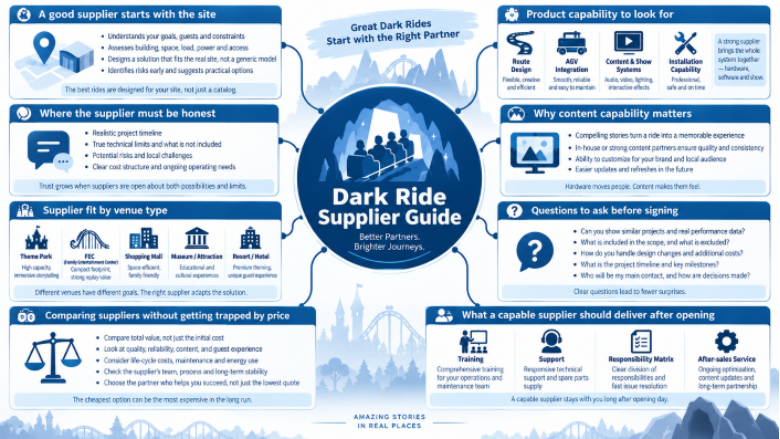
The attraction can be a serious revenue tool. But the real investment is not only in hardware. It is in the operating model that lets the hardware earn.