Case Study: Transforming a Traditional Museum into an Interactive Digital Museum
A traditional museum becomes an interactive digital museum only when the technology improves interpretation. Screens and headsets alone do not do that. In this anonymized case, the museum wanted children, families, and school groups to understand scientific and cultural subjects more directly. The old exhibition had useful information, but visitors moved through it passively. Guides had to work hard to keep attention.
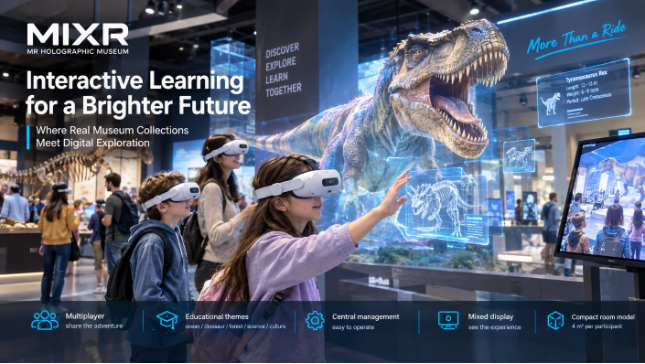
The project introduced MiXR’s MR Holographic Museum format. It used mixed-reality headsets, short themed content, a central control system, real-time mixed display, and a room layout that kept the activity connected to the real museum environment. The goal was not to turn the museum into an arcade. The goal was to make invisible or distant subjects easier to see, discuss, and remember.
Why MR was a better fit than ordinary VR
Museum visitors often need awareness of the physical space. Teachers need to supervise groups. Parents want to see what children are doing. Guides need to connect the digital scene to the real exhibit. Mixed reality helps because the participant can see digital content while remaining connected to the real environment.
MiXR’s MR Holographic Museum materials describe parent-child and multiplayer interaction, mixed display for spectators, central device management, and themed content such as ocean, dinosaur, and forest scenes. The product is designed for science education, study tours, family venues, bookstores, schools, and cultural education spaces. That makes it more suitable for museums than a fully isolated thrill VR product.
The case evidence should be used carefully but not ignored. MIXR’s MR materials include education-oriented references such as kindergarten, school, and bookstore-style installations, while the new catalogue shows Shenzhen Science and Technology Museum among global case references and lists science museums and education centers as suitable Speed Rush application venues. Those examples matter because museum technology has a different success standard from arcade entertainment: supervision, short sessions, mixed display, guide control, and teaching value all have to be considered before opening.
The museum chose short, teachable sessions
The team planned the MR experience as one stop in the visitor journey. It did not ask children to wear a headset for half an hour. MiXR’s materials describe short sessions around 5-7 minutes and content chapters that can be organized by theme. That fit the museum’s rhythm. School groups could rotate. Families could understand the offer without committing too much time.
Short sessions also protect learning. Children can be amazed by digital content and still miss the point. A focused chapter gives the guide a better chance to ask questions before and after the experience.
Where the product was implemented
The museum used an existing room near the education route. The basic planning rule was not “fill the room with devices”. It was to keep entry, instruction, play space, mixed display, device storage, charging, and exit clear. MiXR’s product information refers to about 4 square metres per participant in a basic experience setting, so the museum could plan capacity without treating the room like a large ride hall.
The mixed display was placed where waiting visitors could see what the active participant was experiencing. That small decision helped parents, teachers, and other children understand the value of the activity. It also reduced the feeling that the headset wearer had disappeared from the group.
How the digital museum improved visitor flow
The MR area gave guides a scheduled activity point. Instead of moving from wall text to wall text, groups had a moment of active participation. The museum could use the room for school visits, family weekends, holiday events, and education workshops. The product did not replace the traditional exhibits. It created a bridge between explanation and experience.
This is where an interactive museum can bring commercial value. It can increase dwell time, support paid education programs, make school packages easier to sell, and create a visible activity that encourages families to stay longer. The value is not only ticket income. It is also the museum becoming easier to use.
Product capabilities that mattered most
- MR headsets that allow digital content while keeping awareness of the physical room.
- Themed chapters that can support ocean, dinosaur, forest, science, or cultural topics.
- Central management for starting content, checking devices, and managing sessions.
- Mixed display so outside viewers can follow the experience.
- A compact room model suitable for museums, schools, bookstores, and study-tour spaces.
- Training and deployment support so educators can operate the system confidently.
MiXR’s X-DECK-style central control workflow is important in this environment. A museum educator should not have to become a technician every time a group arrives. Device management, battery checks, content start, and session control need to be simple enough for daily operation.
How the museum kept education in charge
The museum wrote guide prompts around each digital chapter. Before the ocean scene, children were asked what they expected to see in deep water. After the dinosaur scene, the guide connected the virtual animal to a fossil, model, or timeline. After the forest scene, the group discussed habitat and behavior.
This may sound like a teaching detail, but it affects whether the attraction is accepted by schools and parents. A digital museum should not only impress visitors. It should give educators a better tool.
What the project avoided
The team avoided long sessions, loud game language, and a dark arcade-style room. It also avoided making every museum zone digital. Physical exhibits still carried the museum’s authority. MR was used where it solved a real explanation problem: scale, movement, environment, or historical reconstruction.
That boundary matters. Too much digital content can make a museum feel less credible. The product should highlight the subject, not compete with it.
Checklist for museum buyers
- Map each MR chapter to a learning goal.
- Keep sessions short enough for group rotation.
- Plan staff sight lines, device storage, charging, and cleaning.
- Use mixed display so teachers and parents can follow the session.
- Train guides to connect the virtual scene to the real collection.
- Review visitor feedback before adding new themes.
What changed for the museum
The museum gained an interactive digital product that could serve school groups, families, weekend activities, and study-tour programs. Children participated more actively. Teachers had a clearer teaching moment. Parents could see the experience through the mixed display. The venue also gained a product that could be introduced in marketing without abandoning its educational identity.
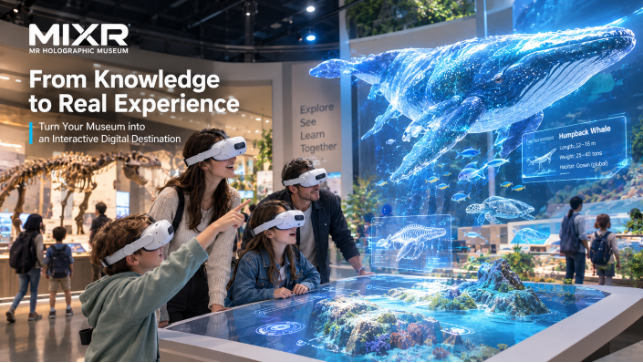
MiXR’s MR Holographic Museum worked because it was treated as a museum technology solution, not a game machine. The product brought MR content, central management, short themed sessions, and a visitor-friendly layout. The museum brought teaching purpose and collection context. That combination is what made the transformation believable.