Dark Ride Price Breakdown
Dark Ride price should be discussed after the owner knows what kind of visitor movement the attraction must create. If the project only asks, “How much is a Dark Ride?”, the quotation will almost always hide the real decision. A route-based XR attraction is not a boxed machine. It is a mix of vehicle system, show control, story content, scenic space, installation work, staff routine, and future content use.
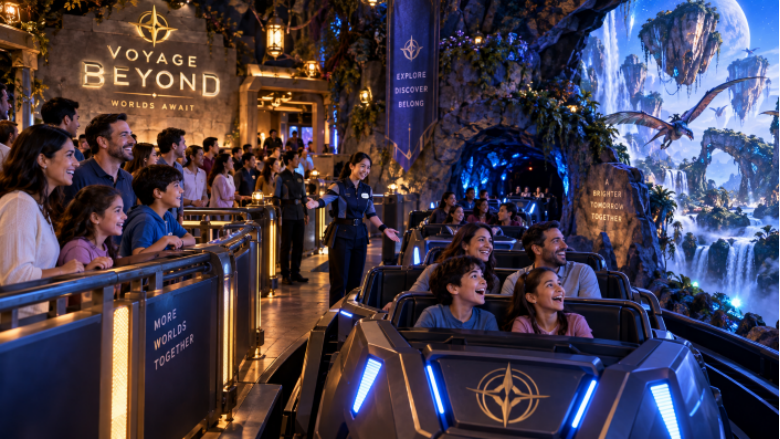
MiXR’s XR Dark Ride is a good example of why the price has to be broken down this way. The product is built around XR visual content, an AGV-based motion vehicle, six-axis movement, interactive scenes, themed route design, and optional naked-eye 3D or headset-based modes. For a theme park, tourism destination, or indoor entertainment zone, that combination can become an anchor attraction. For a small low-traffic room, it may be too much project for the business.
The updated MIXR catalogue gives stronger proof. It presents MIXR in 2017, with 300+ global XR project references and a 700 square metre self-operated venue. It places AGV Dark Ride inside a product family including Flying Theater, XR Infinite Space, XR Theater, MR-Go Kart, Infinite Ark, and Speed Rush. Use those references as delivery evidence, not as a reason to skip scope checking.
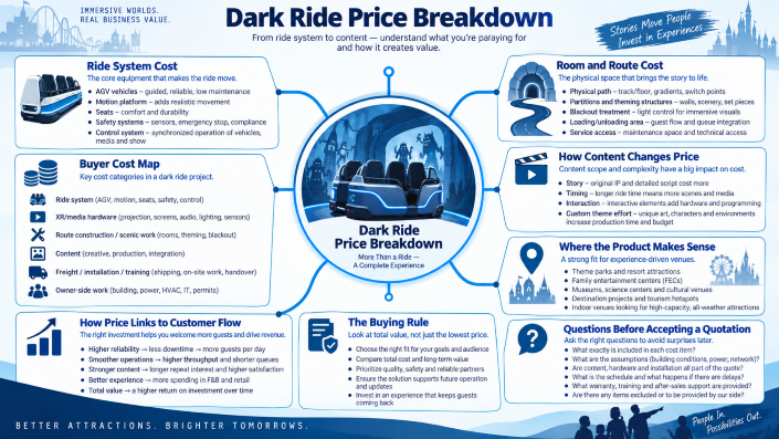
The first cost is the ride system
The ride system usually receives the most attention because it is easy to see. Vehicles, seats, safety belts, vehicle doors, motion platforms, AGV movement, control computers, and headset or display equipment all belong here. In a MiXR Dark Ride, the AGV vehicle and motion platform are not only transport. They are part of the storytelling. A vehicle can slow down before a scene, rotate toward an effect, or use movement to make a short route feel larger.
That is why two Dark Ride quotations can look different even when both mention “vehicles”. One supplier may be quoting a simple carrier. Another may be quoting motion, route control, themed shell, interactive logic, and a more complete operating system. Buyers should ask what is standard and what is custom: seating layout, exterior vehicle shape, route behavior, vehicle quantity, and maintenance access.
The second cost is the room, not the brochure
A Dark Ride needs a physical path. That path may require partitions, black-out treatment, power distribution, floor preparation, service doors, equipment storage, queue rails, lighting points, sound treatment, and a loading area. These items are not cosmetic. They decide whether the attraction can run calmly on a busy afternoon.
I would rather see a shorter route with clean operations than a long route that becomes painful to reset. In real projects, the costliest mistakes often sit in dull places: a narrow service corridor, a loading area with poor staff visibility, a corner that makes vehicles difficult to recover, or a ceiling full of conflicts with lighting and effects.
A simple cost map for buyers
- Ride vehicles, restraints, motion platform, and AGV guidance.
- XR headsets, display units, control computers, tracking, and show-control hardware.
- Route construction, scenic facade, lighting, sound, and themed decoration.
- Content production, interaction design, testing, and revisions.
- Freight, installation, commissioning, staff training, and spare parts.
- Owner-side work such as power, network, room preparation, signage, and local compliance handling.
This list is not meant to make the project look heavier. It makes the quote comparable. A low price that excludes half of the room work is not automatically cheaper. It may simply move the bill to the owner.
Content changes the price in a quieter way
Dark Ride content is not just a video file. It is timing. It is how the scene opens as the vehicle approaches. It is where a visitor should look, when the sound cue starts, and whether the interaction is understandable to a first-time rider. If the attraction uses a local cultural story, an IP theme, or a branded adventure, the content budget should allow enough time for script, visual design, interaction logic, and on-site adjustment.
MiXR’s Dark Ride materials describe customizable track, vehicle, and themed content options. That is useful for parks and scenic destinations because a generic fantasy ride rarely carries the same value as a ride tied to the site’s own story. A coastal destination may want deep-sea or storm content. A culture park may want historical adventure. A mall may want a shorter, louder, more repeatable mission. Each direction affects content effort and scenic design.
Where the product makes sense
Dark Ride is strongest when the venue already has traffic and needs a higher-value indoor attraction. Theme parks can use it as a weather-resistant ride. Cultural tourism sites can use it to turn local stories into ticketed movement. Large commercial venues can use it as a destination product rather than another small VR room. It also works when the operator wants visitors to travel through a sequence, not stand in one place.
It is weaker when the project has no clear story, no room for queue and loading, or no staff plan. A Dark Ride can attract visitors, but it will not rescue a site that cannot feed the ride with enough people or keep the system running steadily.
How price links to customer flow
The reason operators consider Dark Ride is not only novelty. It gives the venue a scheduled product. Visitors queue, ride together, exit through a visible area, and talk about the scenes. That creates a traffic loop. The attraction can support premium tickets, package tickets, school groups, tour groups, or indoor night-time operation.
The price should therefore be judged against the role of the attraction. If it is meant to be a headline ride, the budget must support a strong entrance, reliable vehicle flow, and content that photographs and explains well. If it is a supporting ride, the route and effects can be tighter, but the operating process still has to be clean.
Questions before accepting a Dark Ride quotation
- Which parts of the quote are equipment, and which parts are site construction?
- What visitor capacity is realistic after boarding, safety instruction, unloading, and reset?
- Is the content standard, customized, or partly customized?
- Who handles local power, network, floor, wall, ceiling, and signage work?
- What training, spare parts, and post-launch support are included?
- Can the attraction be refreshed later without rebuilding the entire room?
The buying rule I would use
A serious Dark Ride price breakdown should read like a project map. It should tell the owner where the attraction can be installed, how visitors will move, why the format fits the site, and which product capabilities are being delivered. MiXR’s Dark Ride has value because it combines XR content, motion vehicle, route design, interaction, and delivery work. The buyer’s job is to make sure all of those pieces are actually included in the price being compared.
When the quotation only lists equipment names, slow down. The final cost of a Dark Ride is usually decided by the parts between the equipment: the route, the content, the operation, and the handover.