How to Evaluate the Commercial Feasibility of an XR Attraction Project
Commercial feasibility starts with traffic and existing spending habits, not with the attraction render. A project can look strong in a deck and still fail if weekday demand is thin, the room is awkward, or the operating burden is too heavy. MiXR’s Flying Theater, Dark Ride, XR Infinite Space, and VR Arena all have a place somewhere, but feasibility decides which one belongs where. The real question is whether the business can support the attraction after the launch energy fades.
My quick check is simple. Can the site feed the attraction? Can the room support it? Can the staff run it? Will the content still feel worth paying for after opening month? If two of those are weak, I slow the project down. That sounds conservative, but it is a lot cheaper than opening a pretty failure. Feasibility is not about optimism. It is about whether the site can live with the decision.
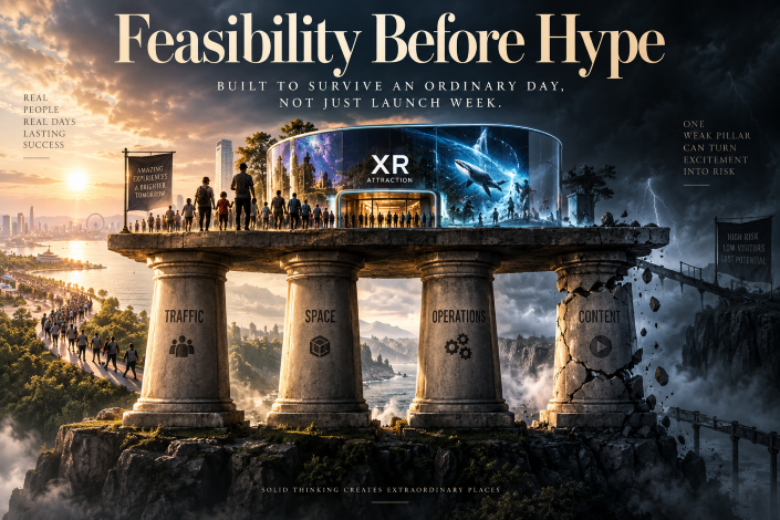
The four filters I use
- Traffic: does the site have enough weekday and weekend flow?
- Space: can the room support the chosen format without awkward compromises?
- Operations: can normal staff keep the attraction moving calmly?
- Content: does the experience still feel worth paying for after the novelty fades?
How I score a site
I look at the project in pieces instead of trusting one big yes or no. If the traffic is strong but the space is poor, the site may still fail. If the space is good but the content feels generic, the attraction may open and flatten quickly. If the plan needs special staff that the venue cannot keep, the model becomes fragile. Feasibility is really a balance between demand, room, and operating discipline.
That is why budgets get distorted when the owner focuses on capex and ignores the operating life of the attraction. Training, maintenance, content refresh, local utilities, and reset time all shape the real return. A project with a fair opening budget can still be hard to defend if the daily costs are too high or the content becomes stale too soon. The spreadsheet only works when the daily reality works too.
Where budgets get distorted
The distortion usually starts when the owner assumes the attraction will run itself. It will not. Every format has a daily rhythm and a support burden. Some need more content work. Some need more room adaptation. Some need more careful staffing. If the budget does not account for that, the owner is underpricing the life of the attraction before the first guest arrives.
Go / no-go checklist
- Can the site feed the attraction on ordinary weekdays?
- Can the chosen format fit the room without awkward workarounds?
- Can the staff run it after the supplier leaves?
- Can the content stay relevant after the first month?
- Does the operating model survive a realistic slowdown, not only a peak holiday?
Feasibility is easier to judge when the owner is honest about the business model. If the attraction needs holiday spikes to survive, say so. If it needs strong weekday group sales, say so. A good project can still work with a narrow demand pattern, but only if the operating plan matches that pattern instead of pretending it does not exist. If the answer to several of those questions is no, I would pause the project rather than force a launch.
A simple scoring method
I like to score the project in four buckets: traffic, space, operations, and content. If any one of those is weak, the project can still work, but the owner needs to understand the trade-off. Two weak buckets usually mean the concept is not ready yet. Three weak buckets usually mean the operator is asking the attraction to do too much. That is the point where a redesign is cheaper than a disappointment.
- Traffic: does the site have enough flow to support the attraction?
- Space: can the room carry the chosen format without awkward compromises?
- Operations: can normal staff keep it moving without special pressure?
- Content: does the experience still feel worth paying for after novelty fades?
Feasibility is finally about honesty. A site with strong traffic but limited space may still work if the concept is lean. A site with good space but weak weekday demand may need a smaller format or a more flexible operating model. A site with strong traffic and space can still fail if the content is thin. The owner has to know which side of the business is doing the heavy lifting. Once that is clear, the decision becomes much simpler.
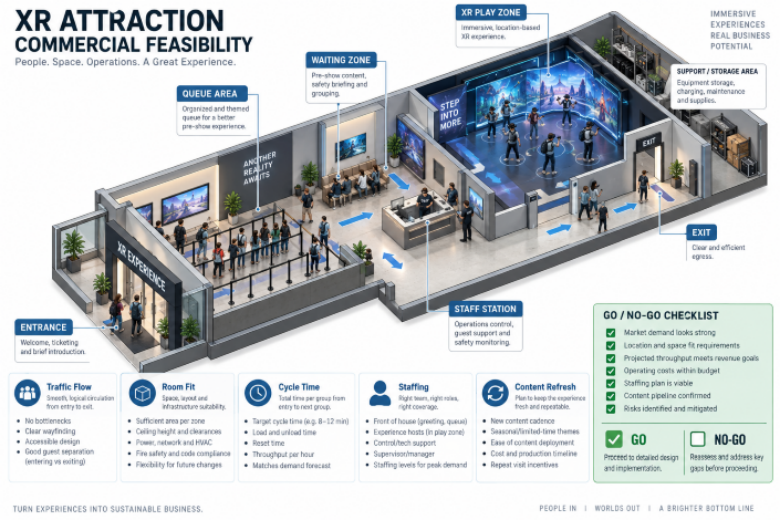
My go / no-go framework
If I were advising a buyer, I would ask for one more pass before approval: what would make this project easy to run on an ordinary day? If the answer is unclear, the project is not ready. The best feasibility checks are plain. They tell you whether the attraction can live in the site without constant extra effort. That is where real commercial value shows up.
- Go when traffic, space, operations, and content all line up reasonably well.
- Pause when one or two of those factors need major compromise.
- Stop when the project only works on paper or only works during holiday peaks.
That is the standard I would use before signing off on an XR attraction of any size. If the project can survive a normal weekday, a slower month, and a team that is still learning the routine, it has a chance. If it only survives the presentation, it is not commercial yet. At that point the smart move is to rework the plan instead of pretending the numbers will save it.