Dark Ride Cost Guide
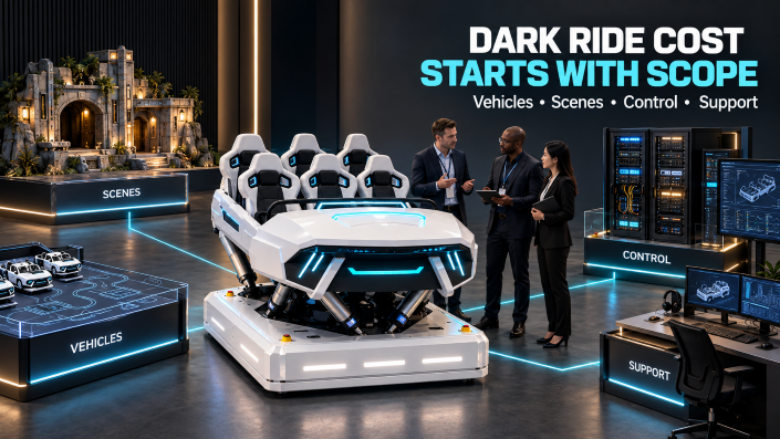
Dark ride budget starts with scope, not a number. The bad habit is asking for a price before the route, scene count, story ambition, and operating rhythm are settled. Then the owner ends up comparing numbers that do not describe the same thing. MiXR’s Dark Ride should be priced as a project, because the vehicle package, the scenic build, the control system, and the support work all move the budget in different directions.
The visible piece is usually not where the budget lives. The route, utilities, site adaptation, and commissioning can quietly push the number around more than the headline vehicle package. A project with more scenes, more interaction, or more demanding architecture often costs more to build and to run. That is not a surprise to operators who have done this before, but it still catches first-time buyers off guard.

Where the budget really goes
Route and vehicles
The ride system is the obvious line item, but it is only part of the picture. Vehicle count, loading method, route length, and motion behavior all change the budget and the operating rhythm. A tighter route can look cheaper on paper and still create bottlenecks if the guest flow is poor. A more ambitious route may cost more up front but behave better if the park needs real throughput instead of a novelty lane.
Scenes and scenic build
The scenery is where many budgets expand without warning. More scenes mean more construction, more paint and finish work, more lighting, more audio, more reset labor, and more time in commissioning. If the project wants a richer environment instead of a few painted walls, the budget has to follow that ambition. This is usually where a cheap-looking proposal and a real attraction start to separate.
Show control and utilities
Control hardware, networking, power distribution, and utility work are easy to underestimate because they are not visible to the guest. They are still there, and they still cost money. The more complex the show, the more carefully these pieces need to be planned. If the building needs adaptation, the hidden work can become a major part of the final number. That is normal. It is only a problem when nobody said so early.
Content and opening support
Content production, training, handover, and early support shape the budget in a different way. A ride that opens without enough operational support often becomes expensive after the ribbon is cut. The owner then pays for the missing work in a more painful form: downtime, staff confusion, or weak guest response. I would rather see a clear package with plain assumptions than a low number that depends on luck after opening.
What cheap quotes usually leave out
- Enough training for normal staff, not only technical staff.
- Spare parts and a realistic replacement plan.
- Content support after launch instead of only during launch.
- Maintenance access that keeps the ride serviceable over time.
- Local contractor work that the buyer still has to coordinate.
The cheapest proposal is often the one that leaves out the messy parts. It may not include enough training, enough content support, enough spare parts, or enough room for maintenance access. That makes the first quote look attractive and the opening month look expensive. I would rather see a complete scope with plain assumptions than a low number that depends on luck.
A budgeting rule that helps
My rule is simple: if the scope can only survive by trimming installation, training, or content, the quote is not actually a quote. It is a sales teaser. A cleaner estimate is better than a comfortable lie. That sounds severe, but it keeps the project from collapsing under hidden work later. For a dark ride, that is usually the better deal because the real cost is not just the ride system. It is the full path to a ride that still runs after the opening photos fade.
How to keep the budget from drifting
The easiest way to lose control is to keep adding scene ideas after the scope should already be frozen. Every extra prop, finish layer, light effect, or interaction point has a ripple effect. It changes the electrical work, the maintenance load, the commissioning time, and often the contractor schedule. I would rather see the team lock the essential experience early and leave a few nice-to-have items outside the first phase than watch the budget sprawl until nobody can explain the number.
A sensible budget also needs some honest contingency. Not because the project is doomed, but because theme park and attraction work almost always exposes one or two site realities that were not obvious in the first drawing. That may be a utility reroute, a tighter access path, or a support task the owner assumed was included. The point is not to pad the estimate. The point is to keep the project from breaking when ordinary surprises show up.
A sanity check before asking for a quote
Before asking suppliers for pricing, I would lock the route idea, the scene ambition, the operating assumption, and the support expectations. A quote is only useful when it is comparing the same scope. If one supplier thinks the project is a lean family route and another thinks it is a fully themed custom show, the numbers will not help the buyer make a decision. The owner ends up comparing shapes, not prices.
I would also ask the finance team to think in phases. Sometimes the right move is to build the core ride first and reserve a later refresh budget for stronger theming or content updates. That is not weakness. It is discipline. A project that opens on time and can be improved later is usually better than a project that keeps growing until it misses the market window.