Dark Ride Applications for Theme Parks
Theme parks use dark rides in more places than people admit. Yes, they work as an indoor anchor. But they also rescue awkward buildings, provide rainy-day capacity, bridge outdoor lands, and create a family zone that does not rely on a headset or a simulator. MiXR can place Dark Ride logic in that kind of role because the format is more about controlled storytelling than about one gadget. The park gets a route, a mood, and a reason for guests to stay inside for a while.
The best use is often the least obvious. A park with a blank indoor shell can turn that shell into a revenue room. A resort park can use a dark ride to hold guests during weather. A city theme park can use it to create a destination piece that is easy to market in day and night campaigns. In all three cases, the ride works because it gives the park a clear indoor reason to exist. That is a practical outcome, not a decorative one.
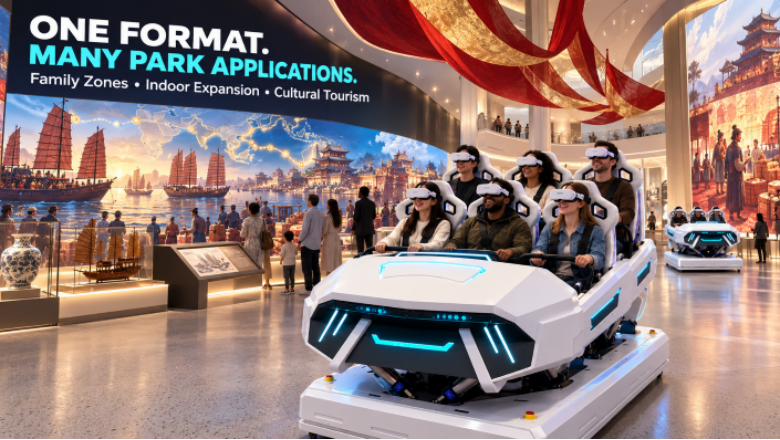
Where the format fits best
- Family zones that need a shared experience with broad age appeal.
- Indoor expansion areas that are too valuable to leave underused.
- Buildings that already sit inside the park but are not producing enough return.
- Cultural tourism sites that want a narrative journey instead of an arcade feel.
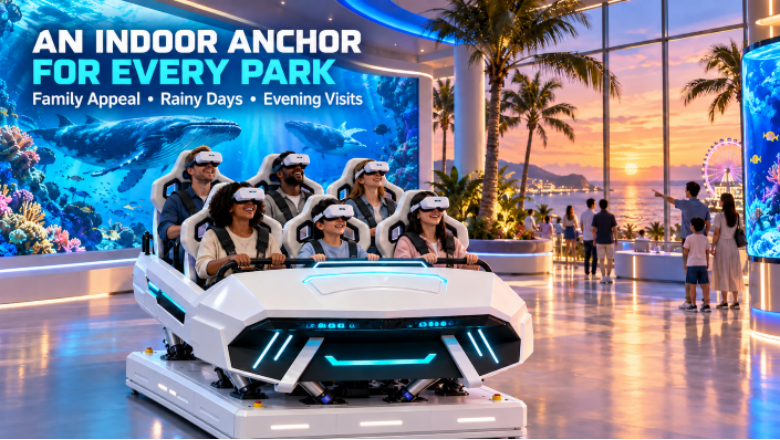
- Resort or city parks that need a clear rainy-day or evening anchor.
Those sites have one thing in common: they need control. The park wants to decide exactly what the guest sees and how long the guest stays inside that story. A dark ride gives the operator that control. It can be compact or expansive, quiet or energetic, but it has to be designed around the site rather than copied from another park. MiXR’s Dark Ride delivery makes more sense when the route logic and the operating routine are mapped together from the start.
What the building must give you
The route has to make sense, and the utility work has to be planned before the scene design gets too far ahead. That means floor load, access for maintenance, queue space, show control, and staff movement all need to be thought through early. A dark ride can be beautiful on paper and still awkward in operation if the back-of-house work is ignored. The building has to support the ride after opening, not just during the announcement period.
The operator also needs to think about how the ride sits beside the rest of the day. If the attraction becomes the only indoor reason to stay, it will carry too much load. If it fits into a wider path of food, retail, and other indoor stops, the ride can do its job without being asked to do everything. That is usually the better commercial arrangement, because one attraction should not have to save the whole site.
When I would not build one
If the site is tiny, the story is shallow, or the budget only covers a half-finished version of the concept, I would step back. A dark ride needs enough substance to justify the ride itself. Without that, it becomes a costly room with moving parts. Theme parks do not need more moving parts for their own sake, and a weak concept only makes the maintenance load more obvious.
A practical planning order
- Define the story role first, not the ride system.
- Check whether the route can actually fit the building without awkward compromises.
- Map the operating workflow before choosing scene detail.
- Ask how the attraction will be refreshed after the opening phase.
- Only then start comparing supplier proposals.
That order keeps the project honest. The moment the hardware is chosen before the story, the budget starts drifting in the wrong direction. Dark rides can do a lot, but only if the park gives them a clear job. If the job is fuzzy, the ride becomes expensive decoration. If the job is clear, the attraction becomes one of the most useful pieces in the park.
What to plan before construction begins
Before a park starts building, it should already know where the queue will sit, where maintenance access will go, where the operator will stand, and how the route connects to the rest of the building. Those details sound basic because they are basic. They also decide whether the dark ride feels calm or chaotic once people begin moving through it. The attraction should not force the staff to work around the building every day.
- Queue placement that does not interfere with nearby guest traffic.
- Back-of-house access that stays practical after opening.
- A route that leaves enough room for scenic work and service access.
- A daily workflow that normal staff can repeat without special instructions.
Operational consequences nobody likes to talk about
Once the attraction opens, every small planning miss becomes a daily operating tax. A queue that is in the wrong place creates crowd pressure. A route that is too tight makes maintenance awkward. A service door that looks fine on the drawing can become a headache once the team has to use it under pressure. These are not dramatic failures, but they are the kind that wear a staff team down. The best dark ride layouts avoid that slow drain.
That is why I prefer theme parks to think in terms of working days, not launch photos. If the route can be cleaned, checked, and reset without a complicated dance, it is more likely to stay in service and keep its shine. When the day-to-day flow is smooth, the attraction feels more expensive than it is. When the flow is awkward, even a well-built ride starts to feel fragile.