XR Infinite Space vs VR Arena: Which Is Better for Your Venue?
XR Infinite Space and VR Arena get compared too casually. They are related, but they do not sell the same visit. XR Infinite Space is usually the better fit when the venue wants a bigger shared environment, more room for content variation, and a stronger location-based feel. VR Arena works better when the operator wants a tighter competitive format and a simpler session rhythm. MiXR’s two products sit in the same family, but they serve different business models.
That matters because some buyers assume they need a huge special-build space before either product is realistic. They do not. Both can run in a normal commercial room, and neither one needs backpack gear to make the idea work. The layout, circulation, and player flow matter more than brute force. If the room is planned well, ordinary commercial ceilings are usually enough. The real question is not whether the venue looks impressive on paper. It is whether the session feels smooth on the floor.
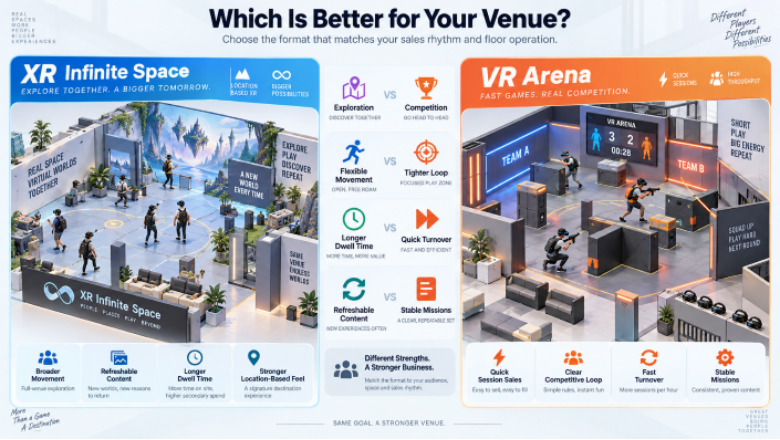
How the formats feel on the floor
XR Infinite Space feels broader. It suits multiplayer movement, changing missions, and a venue that wants to keep the content fresh without rebuilding the room every time. The guest feels more like they are moving through an environment than just starting a match. That makes the format useful when the business wants exploration, group play, and a slightly longer dwell time. It gives the venue room to breathe.
VR Arena feels tighter and more immediate. It is usually easier to explain at the counter because the guest understands the competitive loop very fast. The session is clearer, the session goal is clearer, and the sales script is shorter. That simplicity can be a real advantage in places that sell birthdays, student groups, team play, or combat-style sessions. The venue gets faster turnover and a more direct product story.
Room reality matters more than the brochure
What matters on site is not the label but the rhythm. A normal commercial room is usually enough if the circulation is planned properly. The staff need to move people in and out without bottlenecks, and the content has to match the footprint instead of fighting it. Because there is no backpack gear to manage, the operational burden is lower than many buyers expect. That is useful, but it does not remove the need for smart layout planning.
I would also be careful with buyers who think bigger means better. A larger-feeling concept can still be a poor match if the room is awkward or the staff team is thin. I have seen smaller VR Arena setups outperform larger concepts simply because the operations were cleaner and the sales story was tighter. The room does not have to be dramatic. It has to be usable.
Which venue suits which product
- Shopping malls that want group traffic and easy session sales often lean toward VR Arena.
- Family entertainment centers that want a quick competitive loop also fit VR Arena well.
- Tourist attractions that want broader exploration and a stronger location-based feel often fit XR Infinite Space better.
- Mixed-use venues that want refreshable content and longer dwell time can get more out of XR Infinite Space.
- Youth-heavy venues should look at which format their staff can explain faster and keep cleaner.
A quick selection check
- Is the business trying to sell exploration or competition?
- Does the room support flexible movement or a tighter loop?
- Will the content need frequent refresh or mostly stable missions?
- Can the staff run the format without special technical dependence?
- Does the venue need longer dwell time or quick turnover?
I would also ask how often the content needs to change. Some venues want a product they can refresh seasonally. Others need a stable crowd-pleaser. That answer matters more than the technical label because it decides whether the operator is buying variety or buying rhythm. If the answers point toward quick sessions and clear competitive energy, VR Arena may be the better fit. If they point toward broader group play and room-based flexibility, XR Infinite Space should move up the list.
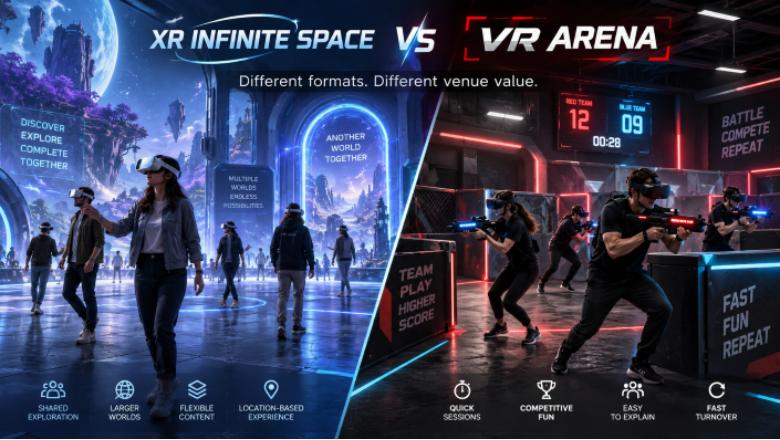
How I would decide in practice
If the venue needs a faster sales script, shorter sessions, and a format that feels obvious to walk-in visitors, I lean toward VR Arena. If the venue is built around longer dwell time, more room movement, and content that can evolve without forcing a complete reset, XR Infinite Space is usually the better fit. Both can work in ordinary commercial space. The difference is the kind of demand they attract and the kind of operation they create.
I would also pay attention to who is actually running the floor. A team that is comfortable with session rhythm and quick turnover can handle VR Arena with less friction. A team that wants more exploratory play and more room-based flexibility may prefer XR Infinite Space. The better product is the one that matches the venue’s sales behavior and the staff’s working style.
What the venue should optimize for
A venue should optimize for the business model it actually has, not the one it wishes it had. If most of the revenue comes from quick, high-volume visits, VR Arena is often easier to manage. If the venue is trying to hold groups longer and offer something that feels more like a shared world, XR Infinite Space is stronger. The product choice should support how the venue already sells, staffs, and refreshes content.
- Choose VR Arena when speed, clarity, and turnover matter most.
- Choose XR Infinite Space when exploration and room flexibility matter most.
- Choose the format that the team can explain and operate with the least friction.