Turnkey Solution vs Equipment-Only Purchase: Which Option Is Better?
A turnkey solution is usually better for owners who need an attraction to open and operate as a business. An equipment-only purchase can be better for experienced operators who already control design, content, installation, and maintenance. That is the plain answer. In 2026, this choice matters because XR attractions are no longer simple novelty machines. A Flying Theater, XR Infinite Space, Dark Ride, Hyper XR Theater, Glass Theater, or Holographic Museum has too many connected parts for a buyer to treat the purchase casually.
What Turnkey Really Means
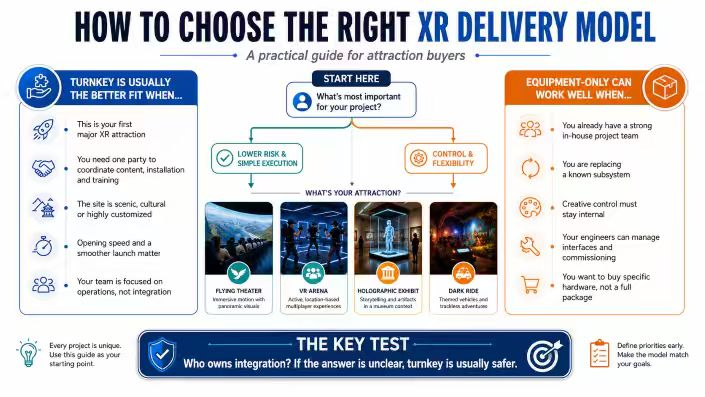
Turnkey should mean a defined project scope: planning support, equipment, content, system integration, installation, commissioning, training, and handover. It does not mean the supplier handles every local construction detail forever. It means the main attraction package is coordinated so the owner is not left to connect unrelated vendors.
For a Flying Theater, turnkey may cover the motion platform, enclosed visual system, film, effects, show control, audio, installation, and staff training. For XR Infinite Space, it may cover playable area planning, tracking, headsets, multiplayer software, content, safety flow, and operating guidance. For Holographic Museum, it may lean more heavily on content interpretation and interactive exhibit design.
What Equipment-Only Really Means
Equipment-only is exactly what it sounds like: the buyer purchases hardware or a defined technical subsystem and handles the rest. This route can work. A large theme park may already have designers, show-control consultants, construction teams, and a maintenance department. For that buyer, equipment-only can preserve control and avoid paying for services they already have.
It becomes risky when the buyer does not have those internal resources. A scenic area buying its first immersive attraction may underestimate content, installation, training, and support. A mall operator may discover that a VR room needs more operational design than expected. The equipment may be fine. The project can still feel unfinished.
The hidden cost of equipment-only is usually coordination time. Someone must translate the creative brief into technical requirements, chase drawings, check interfaces, review content, organize site access, and decide what to do when two vendors disagree. If that person is experienced, equipment-only can be efficient. If that person is a general manager already running the venue, the project may consume far more attention than expected. This is why the cheapest purchasing route is not always the lightest route for the owner’s team.
A Simple Decision Matrix
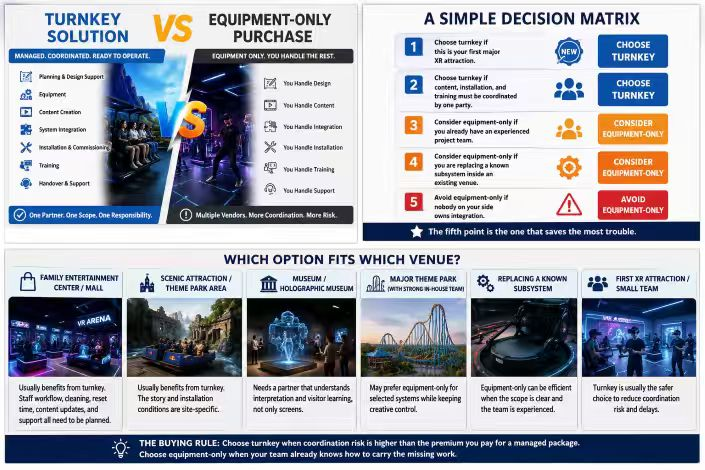
- Choose turnkey if this is your first major XR attraction.
- Choose turnkey if content, installation, and training must be coordinated by one party.
- Consider equipment-only if you already have an experienced project team.
- Consider equipment-only if you are replacing a known subsystem inside an existing venue.
- Avoid equipment-only if nobody on your side owns integration.
The fifth point is the one that saves the most trouble.
Where MiXR Fits In The Choice
MiXR is relevant when the owner wants an immersive entertainment project rather than a loose equipment purchase. The company can discuss product categories such as Flying Theater, VR Arena, XR Infinite Space, Glass Theater, Dark Ride, and Holographic Museum under a broader solution model. That does not mean turnkey is always the correct choice. It means the buyer can ask for one coordinated scope and compare it against managing the pieces internally.
Which Option Fits Which Venue
A family entertainment center or mall usually benefits from turnkey if the team is new to location based VR. Staff workflow, cleaning, reset time, content updates, and support all need to be planned. A scenic attraction often benefits from turnkey because the story and installation conditions are site-specific. A museum may need a partner that understands interpretation and visitor learning, not only screens. A major theme park with strong in-house resources may prefer equipment-only for selected systems while keeping creative control.
The Hidden Risk In Both Options
Turnkey can go wrong if the scope is vague. The word itself does not protect the buyer. Ask what is included, what is local, what is optional, and what happens after opening. Equipment-only can go wrong if the owner assumes integration will somehow happen later. It will happen, but usually with delays, extra meetings, and added budget.
The contract should make the split visible. I would ask for a scope table before final approval: supplier deliverables, owner preparations, exclusions, acceptance standards, and support contact path. It does not need to be beautiful. It needs to be blunt. That table will be more useful during installation than a long sales presentation.
The Buying Rule
Choose turnkey when coordination risk is higher than the premium you pay for a managed package. Choose equipment-only when your team already knows how to carry the missing work. The better option is the one that matches your internal capability, not the one that sounds cheaper in the first meeting.