Flying Theater Manufacturer Comparison
Flying Theater manufacturer comparison should begin with project responsibility, not with a list of seats and screens. Many suppliers can show a convincing video. Fewer can explain how the theater will be designed, installed, tested, staffed, and supported under real visitor pressure. In 2026, that gap is more visible because theme parks and cultural tourism buyers are no longer satisfied with a one-time visual upgrade. They want attractions that can carry ticket revenue, absorb crowds, and still feel fresh after launch. A manufacturer such as MiXR should be compared as a system partner, not simply as a hardware source.
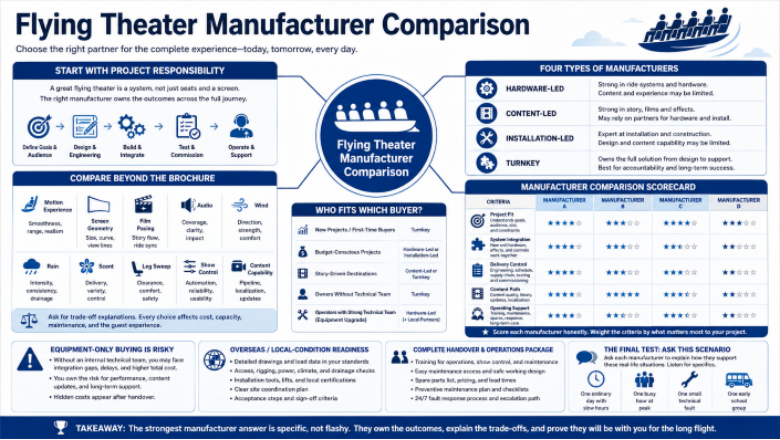
Four Types Of Manufacturers You Will Meet
The first type is hardware-led. These manufacturers talk mainly about platforms, screens, projection, and control systems. They may be strong on mechanics but weaker on content and guest experience. That can work if the owner already has a media team and project integrator. Many owners do not.
The second type is content-led. They may produce strong films or visual concepts, but the equipment and installation details need outside support. This route can work for a high-budget themed project, but only if the technical partner is clearly assigned.
The third type is installation-led. These teams are practical and may be good at making equipment fit a building. The risk is that the attraction becomes technically functional but emotionally flat.
The fourth type is turnkey. This is the category many attraction owners actually need: equipment, film, effects, installation, testing, and training in one managed scope. It is not always the cheapest quote, but it can reduce coordination risk.
What To Compare Beyond The Brochure
Compare the motion experience, but do not stop there. A six-axis flying platform can sound impressive, yet guests will judge the whole ride, not the machine. Screen geometry, film pacing, audio, wind, rain, scent, leg sweep effects, and show control have to land at the right moment. If one part is late or excessive, the illusion breaks.
Compare the manufacturer’s content ability. A destination project needs the film to carry the local story. A theme park may need stronger fantasy or branded scenes. A city tourism center may need recognizable landmarks. If the manufacturer can only offer a generic show, the attraction may still run, but it may not belong to the place.
Compare the handover. This is where weak manufacturers expose themselves. Staff training, maintenance access, spare parts planning, and fault response matter more after the first month than they do during the pitch.
Pay attention to how the manufacturer answers trade-off questions. If you ask for a shorter cycle, do they explain what that does to film pacing and guest comfort? If you ask for more effects, do they talk about service access and operating discipline? If you ask for a cheaper scope, do they identify what has been removed? A serious manufacturer can say, “That version is possible, but here is the operational consequence.” That sentence is worth more than another polished rendering. It tells you the team understands the room after opening, not just the sale before signing.
A Manufacturer Comparison Scorecard
- Project fit: Does the manufacturer understand the site’s audience and story?
- System integration: Are platform, screen, media, audio, and effects planned together?
- Delivery control: Is installation and commissioning inside the supplier’s scope?
- Content path: Can the film be original, customized, or refreshed when needed?
- Operating support: Can local staff run and maintain the theater with confidence?
Give each item a score from 1 to 5. A low equipment price should not cover a weak score in delivery or content.
Which Manufacturer Fits Which Buyer
A large theme park with an in-house creative team may accept a specialist manufacturer and manage the rest internally. A scenic area or commercial tourism owner usually needs a broader package because the team may not have ride integration experience. For that buyer, MiXR’s Flying Theater offer is relevant because the project can be discussed as a complete attraction: motion system, enclosed visual environment, film, effects, installation, and operation training.
Equipment-only buying is risky when the owner has no internal technical team. It can still work for buyers who already have designers, contractors, show control specialists, and maintenance staff. Most first-time attraction owners should be careful with that route.
Also compare how each manufacturer talks about local conditions. Overseas projects often involve different contractors, languages, building habits, customs timing, and on-site decision speed. A manufacturer does not need to control every local task, but it should know which drawings, access checks, installation tools, and acceptance steps have to be prepared before the team arrives. When that preparation is loose, the attraction loses days in the least enjoyable way: small missing details, repeated calls, and people waiting beside unopened crates.
A Useful Final Test
Ask every manufacturer to explain the same ordinary day: three slow hours, one busy hour, a minor technical fault, and a school group arriving early. The strongest answer will rarely sound the flashiest. It will sound specific. That is the manufacturer you keep on the shortlist.