How to Compare Quotations from Different Attraction Suppliers
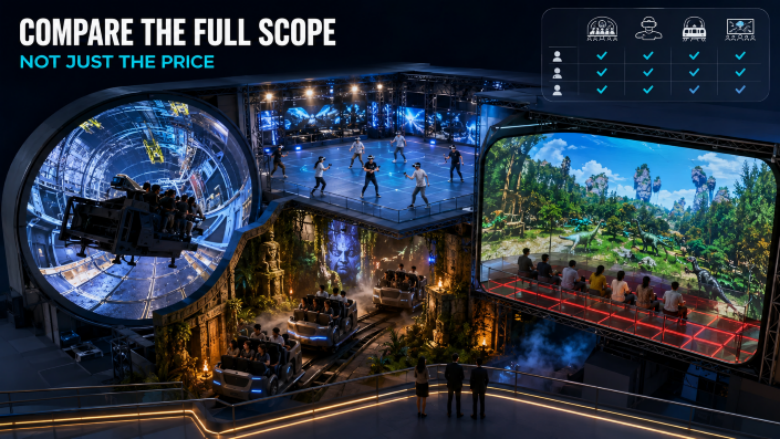
Comparing quotations from attraction suppliers is dangerous when the buyer treats every number as if it covers the same scope. It rarely does. One supplier may include content, installation, commissioning, and training. Another may only quote equipment. A third may hide local site work in a note that nobody reads closely. In 2026, this matters because XR entertainment projects are more integrated than they look. A Flying Theater, XR Infinite Space, Dark Ride, Glass Theater, or Holographic Museum cannot be compared by price line alone.
Start By Forcing The Same Brief
Before asking for quotations, give every supplier the same project brief. Include the site type, available area, ceiling condition, expected daily traffic, target audience, opening schedule, content direction, and whether you need a turnkey immersive attraction solution or an equipment-only package. If the brief changes from supplier to supplier, the quotations will be impossible to compare.
For example, a VR Arena in a mall needs different assumptions from a Flying Theater in a scenic area. A Holographic Museum for a study base needs different content labor from a Free Roam VR shooter. If the supplier is guessing, the quotation will be full of hidden assumptions.
The brief should also state what the owner will provide. Local civil work, decoration, power distribution, air-conditioning, ticketing system connection, queue barriers, and staff uniforms are often outside an overseas supplier’s quotation. That is normal, but it has to be visible. I have seen quotation reviews go sideways because one supplier priced a full installation role while another assumed the owner had a local contractor ready. On paper the second quote looked cleaner. In practice, the buyer had simply moved the cost into another folder.
Break The Quotation Into Real Buckets
The cleanest comparison separates the scope into practical buckets: concept and design, hardware, software, content, installation, commissioning, training, logistics, warranty, support, and optional refresh. That looks basic, but it quickly exposes differences. A low number often becomes less attractive when content, training, or installation is outside the scope.
MiXR should be evaluated in this same format. If its proposal combines hardware integration, original content, installation, and operation training, compare that full scope against other suppliers’ full scope. Do not compare a complete project package against a bare equipment list and call the second one cheaper.
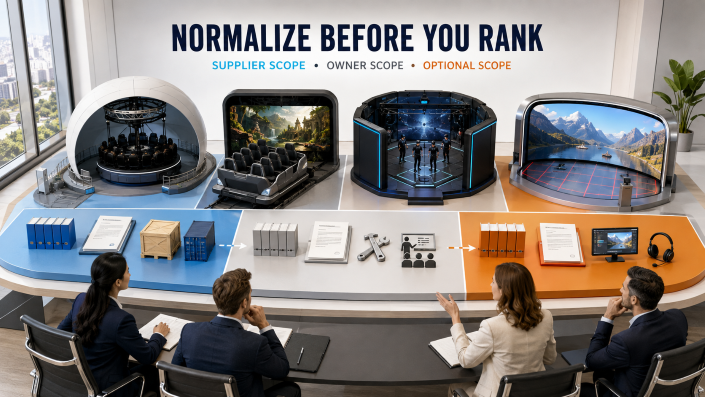
Currency, shipping terms, taxes, and on-site accommodation can also distort the comparison. A quote may look similar until the buyer checks whether logistics stop at the port, the site door, or final installation. For international attraction projects, I would place every cost under one of three headings: supplier scope, local owner scope, and optional scope. This simple sorting method prevents a common argument later, where both sides believe the other side “must have included” a necessary item.
A Quotation Comparison Checklist
- Does each supplier quote the same attraction type and same capacity target?
- Is content included, licensed, customized, or excluded?
- Who handles installation, commissioning, and staff training?
- Which site works are the owner’s responsibility?
- Are after-sales support, spare parts, and updates described clearly?
- Are assumptions written down, or only discussed in calls?
If a supplier cannot answer these points, the quotation is not ready for final comparison.
Watch The Language Around “Turnkey”
The word turnkey gets used loosely. In a real project, it should mean the supplier can carry the buyer from planning through public operation with a defined handover. It should not mean “we ship the main equipment and you figure out the rest.” Ask what is included in layout coordination, content alignment, technical testing, and staff practice. If those items are missing, the word has little value.
Equipment-only can still be the right choice for experienced operators. A large theme park with its own creative team, engineering consultants, and maintenance department may prefer buying selected systems and managing integration internally. A first-time scenic area or mall operator usually needs more supplier responsibility.
Product Category Matters
A Flying Theater quotation should clarify platform type, screen system, film scope, environmental effects, show control, audio, installation, and training. A Dark Ride quotation should show ride route, vehicle system, scene package, interactive triggers, lighting, audio, media, and safety logic. XR Infinite Space should clarify playable area, tracking, headsets, software, content, cleaning flow, and multiplayer management. Holographic Museum should separate display hardware from interpretive content and interaction design.
These categories should not be blended casually. The cheapest quote in one category may still be unsuitable if the venue needs a different kind of attraction.
The Rule I Use Before Shortlisting
Normalize the quotations before you rank them. Add back missing content, missing installation, missing training, and missing support. Then ask which proposal leaves the fewest operational gaps. The strongest supplier is not always the lowest number. It is the one whose quotation tells the truth early enough for the owner to plan.