How to Estimate ROI Before Investing in a Theme Park Attraction
You cannot estimate ROI for a theme park attraction by copying another park’s numbers. The audience, ticket policy, seasonality, queue location, staff cost, and content fit are different. In 2026, that matters more because attraction owners are approving fewer vague projects and asking harder questions before they spend. A Flying Theater, Dark Ride, Hyper XR Theater, XR Infinite Space, or Glass Theater can all make sense in a theme park. They can also fail if the ROI model is built on hope instead of operating detail.
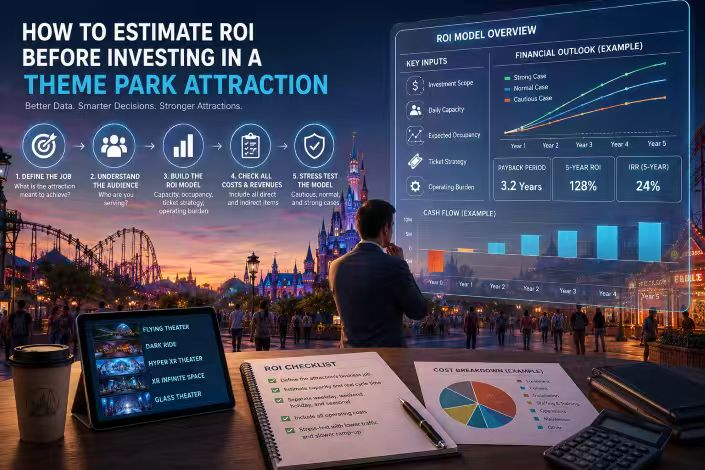
Start With The Job The Attraction Must Do
Before any spreadsheet, define the job. Is the attraction meant to absorb peak crowds? Create a premium ticket? Extend night-time visits? Add indoor capacity during rain? Increase repeat visits for local families? Each job leads to a different ROI model.
Flying Theater is often used when the park wants a broad indoor anchor with a clear story and strong visual impact. Dark Ride is better when physical scenes and narrative route matter more. XR Infinite Space or VR Arena can support multiplayer activity and repeat play. Hyper XR Theater may fit interactive group storytelling. If the product does not match the job, the math will look clean and the operation will feel wrong.
Build The First ROI Model
A practical model usually starts with five inputs: investment scope, daily capacity, expected occupancy, ticket strategy, and operating burden. Do not use one best-case number. Build cautious, normal, and strong cases. For a show-based attraction, calculate the full cycle, not only the media length. For a multiplayer VR attraction, include cleaning, reset, and briefing. For a Dark Ride, include scene maintenance and ride supervision.
The first model does not need to be perfect. It needs to reveal whether the project is in a reasonable range. If the attraction only works at peak occupancy every day, it is too fragile.
Use local operating history where you can. If the park already has a cinema, haunted house, simulator, boat ride, or paid museum zone, study its conversion before trusting a supplier’s forecast. The new attraction will not behave exactly the same, but the old numbers show how visitors at that site make paid add-on decisions. Where no history exists, keep the first model modest and add a ramp-up period. A new attraction often needs staff practice and market education before it reaches a steady rhythm.
ROI Estimation Checklist
- Define the attraction’s business job before choosing the product.
- Estimate capacity using real cycles, loading time, and reset time.
- Separate weekday, weekend, holiday, and seasonal assumptions.
- Include staffing, utilities, maintenance, content, and support.
- Stress-test the model with lower traffic and slower ramp-up.
This checklist saves owners from approving a ride that only works in the sales deck.
What Revenue Lines Are Easy To Miss
Direct tickets are the obvious line. Packages are less obvious. A park may bundle a Flying Theater with evening admission, school programs, VIP routes, or festival events. A VR attraction may support birthday groups or team-building packages. A Holographic Museum may contribute to education programs and cultural tourism value rather than pure walk-in sales.
Be careful with secondary revenue. It can help, but it should not be used to hide a weak core attraction. Merchandise, photos, food traffic, and social media exposure are useful only if the visitor experience is strong enough to create demand.
What Costs Are Easy To Miss
The first missed item is content. A generic show and a custom destination film are not the same. The second is training. Staff turnover means training is not a one-time event. The third is downtime. If an attraction stops during a peak period, the loss is larger than the repair bill. The fourth is refresh. Even a strong attraction needs some plan for keeping the experience relevant.
This is where a turnkey supplier such as MiXR can reduce coordination risk, because the owner can discuss equipment, content, installation, training, and support inside one scope. The buyer still has to challenge the assumptions. A turnkey package is not a substitute for a realistic model.
The model should also include a bad month. Many owners test normal days and holiday peaks, then skip the period that hurts most: poor weather without enough indoor demand, school schedules changing, or marketing taking longer to work. If the project can still be managed during that kind of month, the investment is much easier to defend.
Fit And Non-Fit
A theme park attraction investment makes sense when the site has traffic, the product solves a clear visitor problem, and the operating team can support it. It is not suitable when the owner is buying only because competitors installed something similar. Copying another park rarely works cleanly.
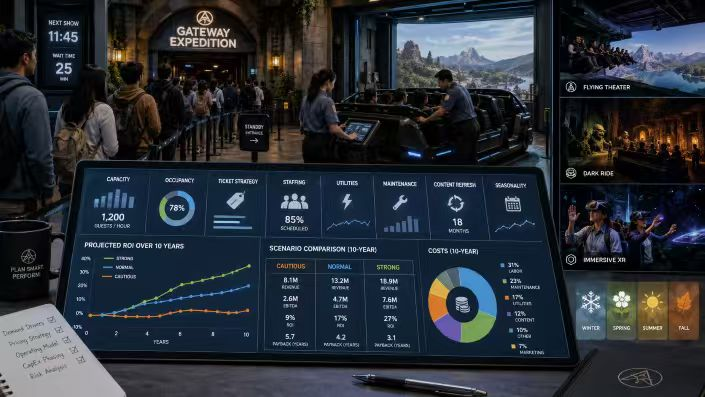
A Better Way To Approve The Project
Approve the attraction only after the cautious case looks acceptable. The strong case is useful for upside. The normal case is useful for planning. The cautious case tells you whether the project can survive real life.