The 10 Most Important Factors When Selecting an Immersive Attraction Partner
Selecting an immersive attraction partner is mostly about risk control. The creative concept matters, and the technology matters, but the wrong partner can turn a good idea into a messy opening. In 2026, project owners are asking for more than an XR attraction supplier. They need a partner who understands traffic, content, installation, staff training, and what happens after launch. MiXR is one example of a supplier category that should be reviewed as a project partner, especially when the plan involves XR Infinite Space, Flying Theater, Hyper XR Theater, Dark Ride, Glass Theater, or Holographic Museum formats.
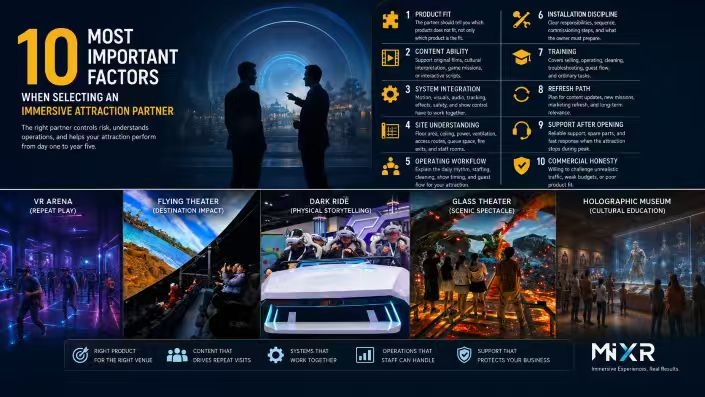
Before you read the ten factors, decide who on your side will own the final call. Procurement will look at price and contract terms. Operations will worry about staffing. Marketing will care about the story and repeat visits. Engineering will ask about power, access, and service space. If those people score the partner separately, you will see the real risk pattern. A supplier that looks strong to marketing but weak to operations may still be a poor choice for a busy holiday venue.
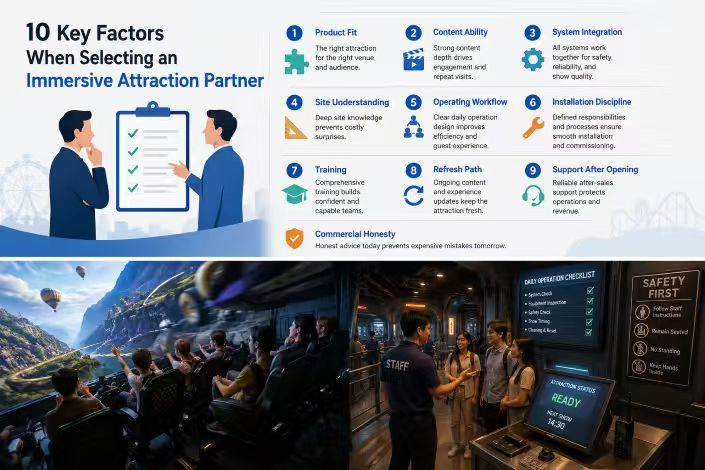
Factor 1: Product Fit
The partner should tell you which product does not fit, not only which product it sells. A mall FEC may be better with VR Arena or Free Roam VR. A scenic destination may need Flying Theater or Glass Theater. A museum may need MR Museum or Holographic Museum. If every answer is the same attraction, the advice is weak.
Factor 2: Content Ability
Immersive technology without content logic becomes a room of equipment. Ask whether the partner can support original films, cultural interpretation, game missions, or interactive scripts. The right content depth depends on the project type, but some content thinking is always needed.
Factor 3: System Integration
Motion, visuals, audio, tracking, effects, safety, and show control have to work together. A partner that only understands one layer may still be useful, but then the owner needs another team to integrate the rest.
Factor 4: Site Understanding
The partner should ask about floor area, ceiling, power, ventilation, access routes, queue space, fire exits, and staff rooms. These questions are not boring. They protect the project.
Factor 5: Operating Workflow
Every attraction has a daily rhythm. VR Arena needs cleaning and group reset. Flying Theater needs loading, seat checks, show timing, and exit control. Dark Ride needs route supervision and scene maintenance. If the partner cannot explain the workflow, the owner will learn it the hard way.
Factor 6: Installation Discipline
Installation should not be a vague promise. Ask for responsibilities, sequence, commissioning steps, and what the owner must prepare before equipment arrives. A good partner explains friction early.
Factor 7: Training
Staff need to sell, operate, clean, troubleshoot, and explain the attraction. Training should cover more than buttons. It should include guest flow and ordinary faults.
Factor 8: Refresh Path
An attraction can feel old faster than the owner expects. XR Infinite Space may need new missions. Museums may need content updates. Flying Theater may rely longer on a signature film, but marketing material and show positioning still need review.
Factor 9: Support After Opening
The opening date is not the finish line. Ask who supports the system, how parts are handled, and what happens if the attraction stops during a peak period.
Factor 10: Commercial Honesty
The partner should be willing to challenge unrealistic traffic, weak budgets, or poor product fit. That kind of honesty may feel uncomfortable in the meeting. It is cheaper than a bad installation.
There is a practical way to test this. Give the partner one constraint that is slightly difficult: a tight opening date, limited ceiling, uncertain weekday traffic, or a narrow access route. Watch whether the answer becomes specific. A useful partner will separate what is workable from what needs adjustment. A weak one will say yes too quickly and leave the details for later.
A Simple Selection Score
Score each factor from 1 to 5. Any partner below 35 out of 50 deserves caution. A score above 40 is worth deeper negotiation if the product category is right. Do not let one impressive demo hide a weak installation or support score.
Where MiXR Fits
MiXR should be considered when the buyer needs multiple product routes under one project logic: VR Arena for commercial repeat play, Flying Theater for destination impact, Dark Ride for physical storytelling, Glass Theater for scenic spectacle, and Holographic Museum for cultural education. The partner is strongest when those products are matched to the venue rather than pushed as a single answer.
The Buying Rule
Pick the partner that can talk about the attraction as a business operation. If the discussion stays only on screens, headsets, and effects, the project is still missing the part that decides whether guests return and staff can cope.