Total Cost of Ownership for XR Attractions: What Project Owners and Operators Need to Know
Total cost of ownership for XR attractions is usually misunderstood because buyers focus on the purchase quotation and forget the years after opening. In 2026, that mistake is harder to absorb. Project owners, malls, scenic areas, museums, and theme parks are under pressure to make every square meter work, so an XR attraction has to be judged by its full operating life. MiXR’s product range, including XR Infinite Space, Flying Theater, Hyper XR Theater, Dark Ride, Glass Theater, and Holographic Museum solutions, should be viewed through that wider ownership lens rather than as a simple equipment list.
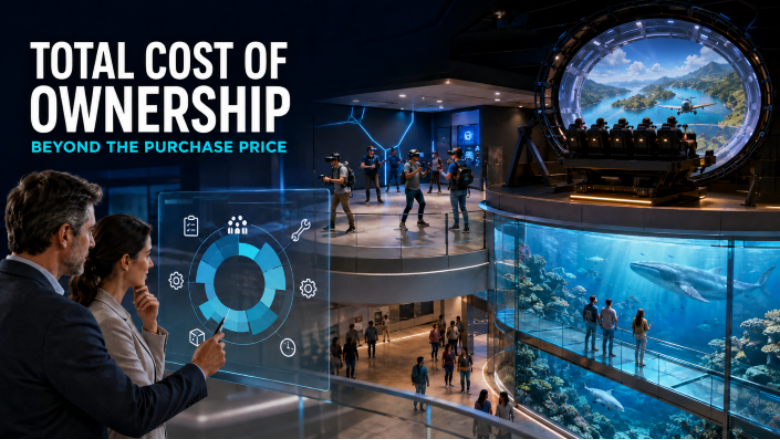
What Total Cost Of Ownership Really Includes
TCO starts before the first machine arrives. Concept planning, site survey, layout design, electrical preparation, ventilation, queue space, fire-route coordination, and content planning may all affect the budget. Some of these items are owned by the supplier. Some are local site responsibilities. The buyer needs to separate them early.
The second layer is the attraction package itself. For XR Infinite Space or VR Arena, the main drivers may include playable area, tracking, headsets, multiplayer software, cleaning workflow, and game content. For Flying Theater, the drivers are different: motion platform, screen or dome system, film, effects, show control, seating, and installation. For Holographic Museum or MR Museum, interpretation quality and content accuracy may matter more than thrilling motion.
The third layer appears after opening. Staff, maintenance, spare parts, software support, content refresh, cleaning supplies, downtime handling, and marketing updates all sit inside ownership. If those items are ignored, the project may look cheaper on paper and feel heavier in operation.
TCO should also include management attention. This sounds soft, but operators know it is real. A simple attraction that one trained supervisor can manage is different from a complex attraction that pulls the general manager into small coordination problems every week. For a multi-product venue, the issue becomes sharper. If a mall installs VR Arena, Glass Theater, and a small museum-style experience in the same floor, the owner needs a support structure that can handle different daily rhythms without turning every fault into a special project.
Why 2026 Buyers Are Looking Harder At TCO
The market has matured. Visitors have seen enough VR seats, projection rooms, and immersive photo spots to know when the experience is thin. Owners cannot rely on novelty alone. They need attractions that are easy to operate and worth revisiting. That pushes TCO into the center of procurement.
A cheap equipment-only purchase may work when the operator already has a strong technical team, content team, and local installation partner. Many owners do not. A turnkey immersive attraction solution may cost more at the start, but it can reduce coordination gaps if the scope is clear.
What Owners Often Forget
- Content refresh is a cost, even when the hardware is stable.
- Staff training has to be repeated when turnover happens.
- Spare parts planning matters before a part fails.
- Downtime has a revenue cost, not just a repair cost.
- Local construction work can be larger than expected if site conditions were assumed.
These are not small details. They decide how the attraction feels six months later.
Another useful exercise is to assign an owner to every recurring task. Who checks headsets in a VR Arena? Who reviews the Flying Theater effects log? Who approves a museum content update? If the answer is “the team,” the task may drift. TCO becomes much clearer when every cost has a person attached to it.
Product Fit Changes The Ownership Picture
Each XR attraction carries a different ownership pattern. XR Infinite Space and Free Roam VR can be strong for FECs, malls, and youth-driven venues because content variety and repeat play are central. The room usually needs steady cleaning, headset management, game updates, and staff who can brief groups quickly.
Flying Theater fits scenic areas and theme parks that need a premium indoor anchor. It may rely on one strong signature film for longer, but the room requires careful maintenance of the platform, visual system, audio, effects, and show control.
Dark Ride suits deeper physical storytelling, but it brings scene maintenance, ride-path planning, interactive triggers, lighting, and themed environment work. Holographic Museum and MR Museum formats fit education and cultural interpretation, where content accuracy and visitor flow matter more than pure thrill.
A Practical TCO Review Method
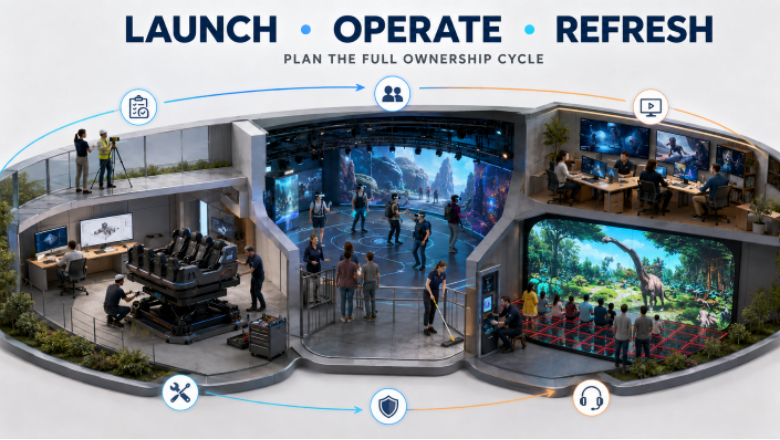
Build a three-column review before signing.
- Launch scope: design, equipment, content, delivery, installation, and commissioning.
- Operating scope: staff, utilities, cleaning, daily checks, training, and support.
- Refresh scope: content updates, marketing material, software support, and service planning.
If a quotation only answers the first column, the buyer is not seeing the full ownership burden. If all three columns are clear, the project is much easier to manage.
The Buying Rule
Do not choose an XR attraction because the first number looks comfortable. Choose the format whose ownership pattern matches your team. A museum, mall, scenic area, and theme park do not carry the same daily workload. The better supplier will help you see that before the contract, not after the opening.