Flying Theater Price Breakdown
A Flying Theater quote should be read as a bundle of line items, not a single number. That is where many buyers get lost. They hear one total and assume they have compared three suppliers fairly. They have not. One quote may include content and installation. Another may leave them out. One may cover training and spare parts. Another may treat those as extra. MiXR’s Flying Theater proposals are easier to judge when the buyer asks what is actually inside the package.
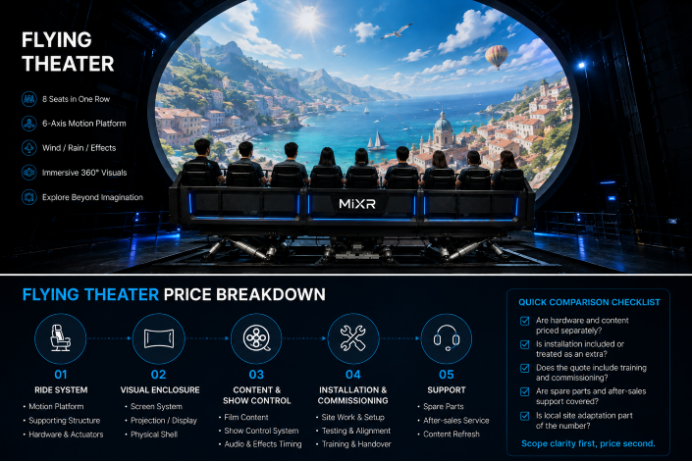
The main buckets
The first bucket is the ride system itself. That includes the motion platform, supporting structure, and the hardware that makes the physical flight cue possible. This is usually one of the heaviest parts of the build because it defines the experience and the engineering load.
The second bucket is the visual enclosure. Screen system, projection or display logic, and the physical shell all matter here. A Flying Theater is only as good as the environment the audience sees. If the screen is poorly matched to the motion, the illusion weakens fast.
The third bucket is content and show control. This is where the story, pacing, audio, trigger timing, and effects sequence live. Buyers often underestimate this part because it does not look as heavy as steel or seats. In practice, it can shape the whole guest experience.
The fourth bucket is installation and commissioning. This includes site work, setup, testing, alignment, training, and handover. A system that cannot be installed cleanly is not a real quote. It is a draft.
The fifth bucket is support. Spare parts, after-sales service, and refresh planning do not always show up in the first number, but they matter once the venue opens.
Which bucket surprises buyers most
Content and installation are the usual surprises. Buyers often compare only the visible hardware because that is the easiest thing to point at. Then the project starts requiring story development, effect timing, and on-site coordination. That is when the quote changes shape. It is also when some suppliers look cheaper than they really are and others look expensive for reasons that were hidden earlier.
Another surprise is local adaptation. A theme park, scenic spot, or mall can all need different site work. The more custom the room, the more the price moves away from the brochure version.
How to read a quote properly
Look for scope clarity. Does the price include design, production, delivery, installation, testing, and training? Does it assume a ready room or a finished room? Does it include the first content package or only the equipment? If the answer is vague, the price is not yet useful.
You should also ask which part of the package is standardized and which part is custom. That helps you understand where the budget is firm and where it can move. A clear supplier will not hide that.
A quick comparison checklist
1. Are hardware and content priced separately?
2. Is installation included or treated as an extra?
3. Does the quote include training and commissioning?
4. Are spare parts and after-sales support covered?
5. Is local site adaptation part of the number?
If the answer to most of those is no, the number is not a true comparison. It is just a starting point.
The buyer’s rule
Flying Theater price should be read as the cost of launching a functioning attraction, not the cost of buying machinery. That is the difference that keeps a project honest.
How to compare two numbers properly
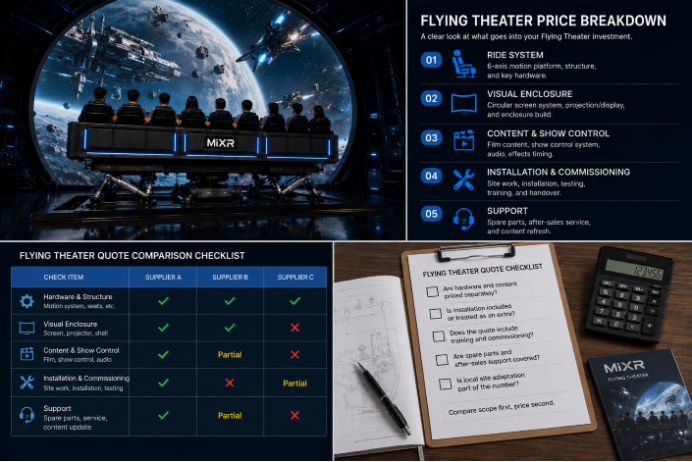
If one quote sounds far lower than the rest, the buyer should ask which part of the experience was stripped out. Content, installation, training, and local adaptation are the usual places where the scope gets thin. A fair comparison only starts when those items are listed side by side. Until then, the numbers are not really comparable.
The same caution applies to support. A low number can be attractive only until the venue needs help after opening. If the supplier has not made the service terms clear, the true cost is still hidden. Buyers often discover that the cheapest-looking quote is only cheap because it pushed the later work into a different bucket.
That is why the best comparison sheets read almost like a procurement checklist. They ask what is included, what is optional, what is local, and what depends on the final site conditions. Once those four questions are answered, the buyer can stop comparing fantasy prices and start comparing real deliverables.
That last point matters because a Flying Theater is easy to misread on paper. The equipment may look similar, but the service shape is often very different. One vendor may be selling a launch package, while another is selling a longer operating relationship. Those are not the same thing.
Even a small difference in support terms can change the real number.