Flying Theater Cost Guide
Flying Theater cost depends less on the word “theater” and more on how the project is built. The size of the room, the motion platform, the screen system, the content package, the effects, the site conditions, and the handover standard all push the budget in different directions. If a buyer looks only at the equipment tag, the final number usually comes back higher than expected. That is especially true in 2026, when operators are expected to launch stronger attractions with tighter capital discipline. MiXR’s Flying Theater approach matters because the buyer is not just shopping for hardware. The buyer is building a ticketed attraction.
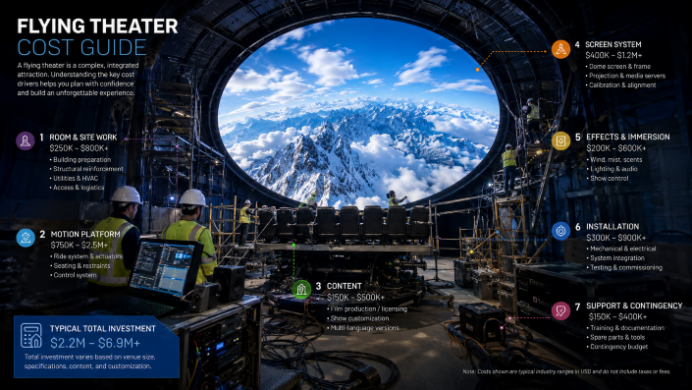
What actually drives the budget
The first driver is scale. Bigger rooms do not just need more materials. They need more structural planning, more enclosure, more control coordination, and often more site work. The second driver is motion. A higher-spec platform and a more complex show sequence naturally shift the project upward. The third driver is content. Custom film development, especially when the venue wants a specific story or brand feel, can move the budget more than the screen itself.
The fourth driver is integration. This is the part buyers often miss. A ride that needs careful matching between platform, visuals, effects, and safety systems is not the same as buying a few separate machines. The more customized the ride logic, the more the budget behaves like a project budget rather than an equipment budget.
What people undercount
They usually undercount the room itself. Civil work, utilities, airflow, access clearance, and finishing can add up fast. They also undercount installation and commissioning. A Flying Theater is not something you simply unpack and switch on. Another overlooked line is after-sales. Spare parts, staff training, and the first round of support matter because the ride has to keep earning after the opening rush.
That is why a cheap-looking quote can be misleading. If it leaves out the parts that make the attraction usable, the buyer is not saving money. The buyer is just postponing the bill.
How to compare quotes without fooling yourself
Do not ask only for the total. Ask what the total actually includes. Does it cover design, equipment, content, installation, testing, and training? Does it include local site adaptation? Does it include the first round of support? If two quotes look far apart, the difference is often hidden in those answers rather than in the platform itself.
You should also ask what kind of content is included. A project with a generic film is not the same as a project with original storytelling and stronger brand fit. If the quote does not make that clear, the numbers are not comparable yet.
A short buying rule
1. Treat Flying Theater as a project, not a purchase.
2. Compare scope first, price second.
3. Separate hardware cost from content and site cost.
4. Ask what the quote leaves out.
5. Make sure the supplier can still support the room after launch.
The practical view
A good Flying Theater budget is not the cheapest one. It is the one that matches the site’s scale, traffic, and long-term operating plan. If the project is too small, the attraction will feel weak. If the project is too ambitious for the site, the numbers will be hard to defend. The goal is not low cost at any price. The goal is a room that can actually work as a business.
How to keep the budget honest
The simplest discipline is to ask what would break if one line was removed. If the answer is “the show would still work”, the item may be optional. If the answer is “the attraction would no longer feel complete”, it belongs in the real budget. That question usually clears up the difference between a serious quote and a cheap-looking one.
Buyers should also separate build cost from operating cost. The first number tells you how hard the project is to launch. The second tells you whether it can stay healthy after opening. If the content rights, site work, training, or service terms are buried inside the quote, the budget is not clean enough yet. That is usually where the surprises live.
The safest budgeting habit is to treat the quote as a scope document first and a price document second. If the room needs custom civil work, special media coordination, or a heavier effect package, those lines should be visible early. That does not make the project expensive by default. It just keeps the owner from discovering late that the cheap number was never the real number.
A small line item can matter more than a big one if it controls uptime, training, or support. That is why the cheapest budget is often the one that leaves the fewest blanks, not the one with the lowest first number.