Flying Theater Installation Guide
The installation is where a Flying Theater project starts telling the truth. You can buy good equipment and still end up with a weak attraction if the room, access, power, and workflow were guessed instead of checked. In real projects, installation is rarely a single day on site. It is a chain of decisions that should start before the equipment leaves the factory. MiXR’s Flying Theater projects make the most sense when the installer, content team, and operator are talking early, not after the civil work is already finished.
Before the order is placed
The first job is site verification. The buyer needs to know the actual room dimensions, the load-bearing conditions, the access path for large equipment, and the available power and ventilation. If any of those are vague, the schedule will drift later. That is not pessimism. It is normal project life.
This is also the point to check the guest flow. Where do people queue? Where do they wait? How do they enter and exit without crossing staff routes? If the audience path is awkward on paper, it will be worse in a live operation. A good Flying Theater installation plan starts with movement, not decoration.
Site preparation
Once the layout is fixed, the site has to be prepared with the ride in mind. Structural work, mechanical positioning, electrical routing, network access, and environmental control all need to line up. A room that looks ready but still needs late changes is a room that is not ready. That sounds blunt, but it saves money.
The fit-out should also leave room for maintenance. Equipment that can only be reached after a laborious teardown will become a long-term operating headache. The installer should leave access paths, service clearance, and clear label logic so the team can inspect and reset without guessing.
Installation sequence
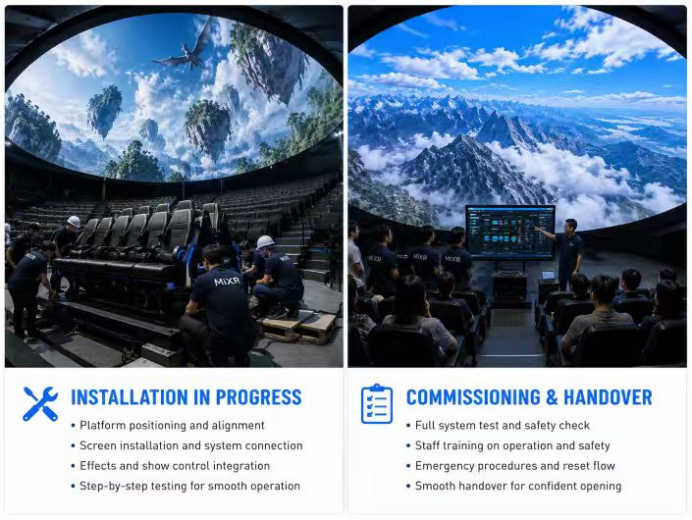
The cleanest sequence usually runs like this: receive the equipment, position the main platform and structural elements, install the screen or enclosure, connect the show control, test the effects, and then run the full system in stages. You do not want to rush directly to the final ride sequence. Intermediate tests catch a lot of avoidable trouble.
During this phase, the supplier and operator should be checking alignment, safety logic, audio balance, and effect timing together. A good installation is not only about making the hardware stand up. It is about making the attraction feel consistent from the first ride to the fiftieth.
Commissioning and handover
Commissioning is where the project becomes a business asset. The team should test loading speed, reset timing, emergency procedures, cleaning routines, and basic troubleshooting before opening to the public. If staff training is left until the end, the opening week will become the training week. That is a bad trade.
The handover should also include a refresh path. Content, spare parts, service contacts, and operating checklists should be clear enough that the venue can keep going without chasing answers every day.
Common mistakes
The biggest mistake is treating installation as a technical finish line instead of an operating transition. Another mistake is underestimating access routes. Large equipment can be hard to move through a mall, museum, or park building if the path was not checked early. A third mistake is leaving the content test to the last minute. If the show is not ready when the hardware is ready, the schedule slips and everyone starts improvising.
Five checks that should never be skipped
1. The room dimensions and access path are verified.
2. The power and ventilation plan are confirmed.
3. The platform, screen, and effects are aligned.
4. Staff are trained before public opening.
5. The maintenance and spare-parts plan is in writing.
If those five are done well, the installation has a real chance of ending as a smooth opening instead of a last-minute scramble.
The last step before opening
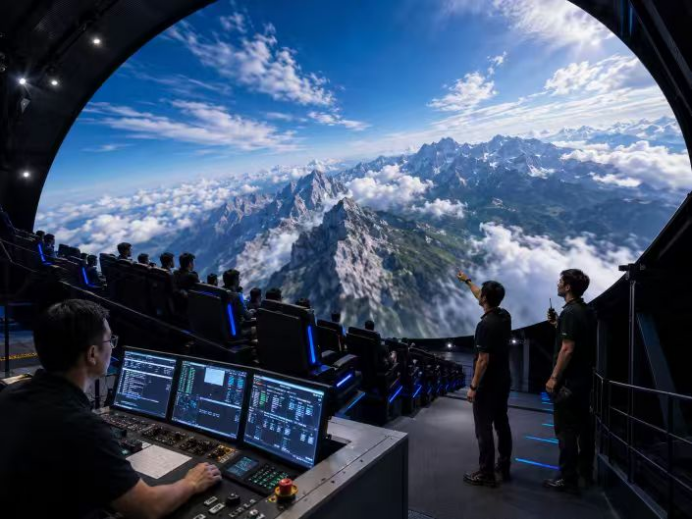
Commissioning should include a real staff dry run, not just a hardware check. The team needs to load, unload, reset, and clean the room under time pressure before the public ever sees it. If that rehearsal is skipped, the attraction will teach the staff on opening day, and that is the expensive way to learn.
The same applies to safety and show timing. The crew should test the stop routine, the guest exit path, and the exact sequence of effects while the room is still closed. If the installer treats those as minor details, the opening date may still arrive, but the first week will be spent fixing problems that should have been caught earlier.
Utilities and finishing also need one last review. Power, ventilation, network access, and access panels tend to create trouble when they were assumed rather than checked. A clean installation is usually the result of boring discipline: the same check repeated before handover, before soft opening, and before the first paid guests walk in.