Flying Theater Equipment Explained
A Flying Theater is not one machine. It is a stack of systems that has to behave like one ride. Buyers often focus on the platform or the screen and miss the part that makes the whole attraction work: integration. In a serious project, MiXR’s Flying Theater package should be judged as a complete system, not as a pile of disconnected equipment. That matters because a good ride is usually won or lost in the handoff between motion, image, content, effects, and control.
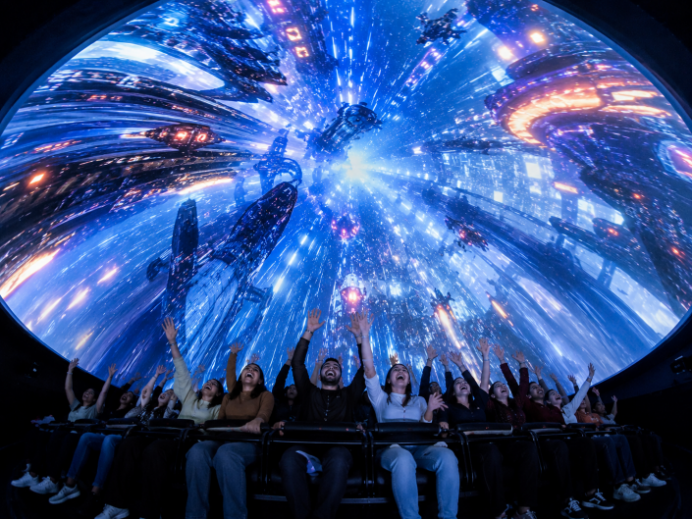
What the core system usually includes
The first piece is the motion platform. This is what gives the guest the physical flight cue. A six-axis platform is common in this category because it can move in a way that lines up with the screen action and the ride narrative. The platform does not need to be the most extreme part of the project. It needs to be smooth, stable, and believable.
The second piece is the visual enclosure. Many Flying Theater projects use an enclosed dome screen or a similar wraparound visual setup. The screen is not decoration. It is the environment. If the image and motion do not match, the illusion weakens immediately.
The third piece is the film or show content. Some buyers underestimate this because they see the hardware first. That is a mistake. The content determines pacing, emotion, and guest memory. A self-developed 8K film can matter more than a bigger screen if the story and framing are stronger.
The fourth piece is the effects layer. Wind, rain, leg sweep, scent, and similar cues turn a visual sequence into a fuller ride. You do not need every effect in every project. You need the right ones for the story and audience. Too many effects can become noise.
Why integration matters more than individual specs
A Flying Theater can look impressive on paper and still feel weak if the system pieces are not aligned. The motion platform has to match the visual timing. The show control has to trigger the effects in the right sequence. The loading flow has to fit the room. Maintenance access has to be built in from the start. None of that is visible in a screenshot, which is why a lot of equipment-only comparisons miss the real issue.
This is where a turnkey supplier earns its keep. MiXR is relevant because the attraction is not sold as a box. It is sold as a combined ride system with content, equipment, installation, and support tied together. That is much closer to how operators actually buy.
What to ask before you sign
1. What kind of motion platform is included, and how is it matched to the content?
2. Is the visual system an enclosed dome, partial enclosure, or another format?
3. Is the film original, licensed, or custom-developed for the venue?
4. Which effects are standard, and which ones are optional?
5. How will the operator access, clean, and maintain the equipment after opening?
If the supplier cannot answer those clearly, the project is still fuzzy. And fuzzy projects become expensive.
What buyers should remember
Flying Theater equipment is not about collecting the largest list of parts. It is about building a believable flight experience that the venue can maintain. A smaller, cleaner system that the staff can run well is usually better than a heavier package that looks impressive in a quotation and frustrating in daily life.
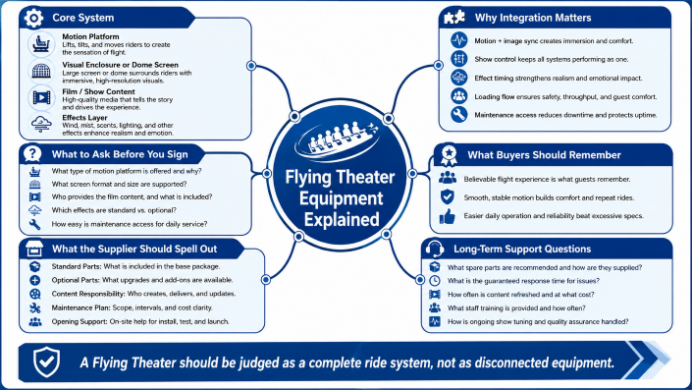
What the buyer should ask the supplier to spell out
The cleanest equipment list is the one that makes responsibilities clear. Which parts are standard, which parts are optional, who handles the film, and what maintenance access looks like after the opening should all be visible before the contract is signed. When those answers are vague, the project starts to look cheaper than it really is. That is usually a bad sign.
This is also the point where buyers should ask about the handoff. If the supplier disappears after the equipment lands, the venue inherits a machine instead of a working attraction. A good package should explain who tunes the show, who trains the staff, and how the first round of support works once the room is live. That is the difference between a spec sheet and a usable project.
It is equally important to ask how fast common parts can be replaced and how the content can be refreshed later. A Flying Theater that is easy to maintain but hard to update will age in a different way from one that has a smooth support plan from day one. Buyers should know both stories before they commit, because the equipment only starts earning after the opening lights come on.
Even a short answer on spare parts and response time is useful. If the supplier cannot say how the room stays alive when something wears out, the package is not complete yet.