XR Entertainment ROI Explained
XR Entertainment ROI Explained: The Numbers That Matter After Opening Day
XR entertainment ROI is not decided by how advanced the equipment looks. It is decided by paid conversion, real capacity, ticket price, repeat demand, and operating discipline. In 2026, many buyers understand that immersive entertainment can bring new revenue to shopping malls, tourist attractions, museums, and theme parks. Fewer buyers build a realistic model for the months after opening.
The useful question is not “How fast can this pay back?” The better question is “Which assumptions must be true for this project to pay back?”
What ROI Means for an XR Attraction
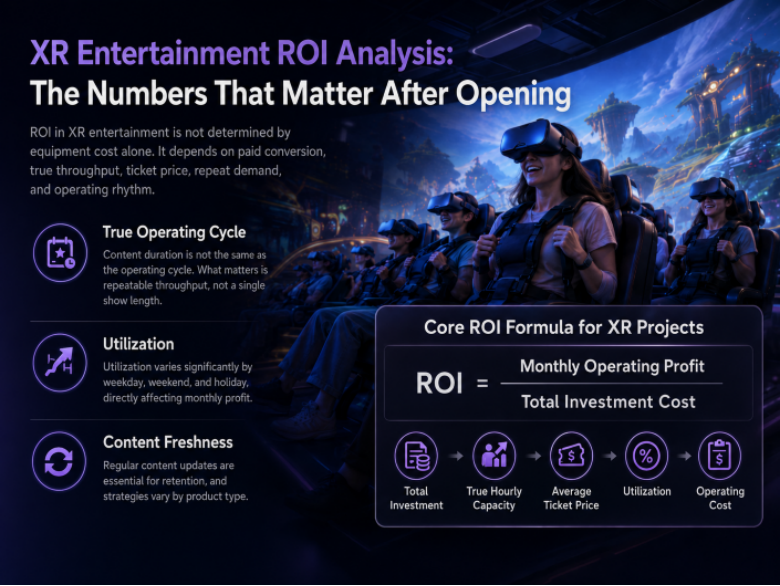
Return on investment for an XR attraction usually compares total project investment with monthly operating profit. That sounds simple, but the inputs are often messy. A location based VR project may have strong weekend demand and weak weekdays. A Flying Theater in a scenic area may perform well during holidays and school breaks. A Holographic Museum may generate value through group visits, education programs, and cultural branding, not only walk-in tickets.
A clean ROI model needs:
- Total project cost.
- Real capacity per hour.
- Average paid ticket.
- Utilization by day type.
- Staff and rent cost.
- Maintenance and content update cost.
- Marketing cost.
- Expected useful operating period.
If one of these numbers is guessed, mark it clearly. Do not hide guesses inside a beautiful spreadsheet.
Why 2026 Makes ROI Harder and More Important
Visitors are more familiar with VR, AR, and immersive entertainment than they were a few years ago. A simple headset experience no longer feels special by itself. At the same time, offline entertainment has recovered in many markets, and landlords are looking for attractions that can lift dwell time.
This creates a stricter market. An XR entertainment solution must be operationally useful, not only technologically interesting. The content must be strong enough for paid demand. The hardware must handle daily use. The supplier must support installation, training, and updates.
That is where turnkey immersive attraction solutions have value. A supplier such as MiXR can package XR Infinite Space, Flying Theater, Hyper XR Theater, Glass Theater, Dark Ride, or Holographic Museum formats with content and delivery support. The buyer still needs to check the ROI model, but the integration burden is lower than managing many vendors separately.
The Three ROI Drivers Most Buyers Underestimate
1. Real Operating Cycle
Content duration is not the same as cycle time. A 5-minute flying cinema film may need several extra minutes for boarding, safety checks, and exit. A VR shooting arena may require rule explanation, equipment adjustment, and cleaning. Use the full cycle.
2. Utilization Rate
Do not calculate every day as a holiday. A practical model separates low, normal, peak, and event days. In many projects, the gap between a 25% and 45% utilization assumption changes the entire payback story.
3. Content Freshness
Repeat visitors need new reasons to return. XR Infinite Space can benefit from multiple missions or seasonal content. Flying Theater can rely on a strong signature film for longer, but destination projects may still need media refresh or marketing updates. Museums need content that stays educationally relevant.
A Simple XR ROI Scoring Tool
Score each factor from 1 to 5 before committing:
- Location traffic quality: Are visitors already in a paying mindset?
- Visibility: Can people understand the attraction from outside?
- Capacity: Can the system handle peak flow without bad waiting?
- Ticket strength: Is the price acceptable for the audience?
- Staff efficiency: Can trained staff run the attraction smoothly?
- Content depth: Will customers recommend it after trying?
- Refresh plan: Is there a clear update path after launch?
- Maintenance risk: Are spare parts and support available?
A total score below 26 out of 40 means the project needs redesign before investment. A high score does not guarantee success, but a low score is a warning.
Which Products Create Which ROI Pattern
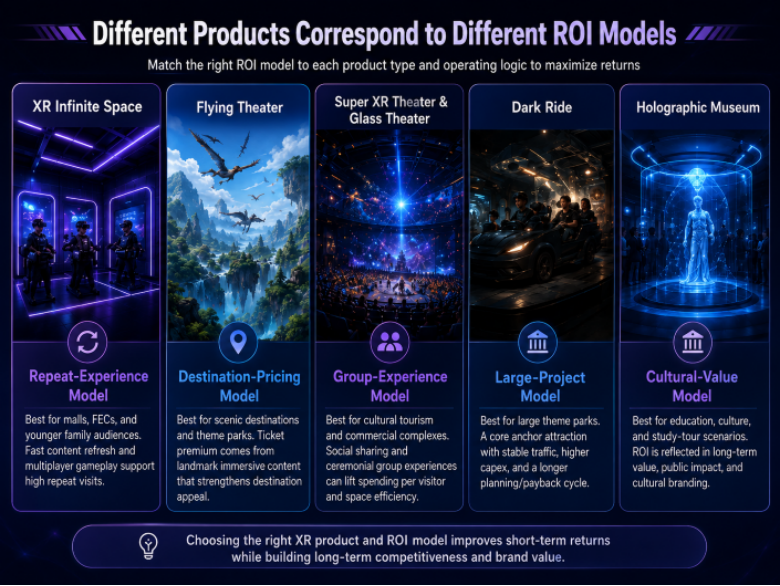
XR Infinite Space usually fits a repeat-play model. It works well when group visitors, teenagers, families, and mall traffic can return for different missions. VR Arena and multiplayer VR experience formats often depend on visibility and local marketing.
Flying Theater fits a destination-ticket model. It is stronger when the attraction can become a signature experience for a scenic area or theme park. Ticket value can be higher, but investment and installation conditions require more planning.
Hyper XR Theater and Glass Theater fit sites that want spectacle and group experience without building a full dark ride. They can work for cultural tourism, events, and commercial entertainment floors.
Dark Ride fits larger theme park projects. ROI may be attractive when traffic is stable, but capital cost, maintenance, and planning complexity are higher.
Holographic Museum fits education, culture, and study-tour revenue. Its ROI may include group bookings and institutional value, not only individual ticket sales.
A Better Way to Read Supplier ROI Claims
When a supplier gives a payback estimate, ask what assumptions are behind it. How many operating days? What ticket price? What hourly capacity? What utilization? How many staff? Are content updates included? What happens during low season?
A professional supplier should be comfortable discussing these questions. If the answer is only “many clients earn money quickly,” keep asking. Good XR entertainment ROI is not magic. It is the result of matching product, site, audience, operation, and content with enough honesty before the project opens.