How to Choose an XR Entertainment Supplier Without Buying a Future Problem
Choosing an XR entertainment supplier is less about finding the flashiest demo and more about reducing project risk. In 2026, buyers are not only purchasing VR attraction equipment. They are buying content, integration, installation, staff workflow, after-sales support, and a business model that must survive daily operation. A weak supplier can make a good product fail. A strong supplier can warn you when your original idea does not fit the site.
The right XR entertainment supplier should talk about traffic, space, capacity, and operations before talking too much about technology.
Start With Project Type, Not Supplier Brochures
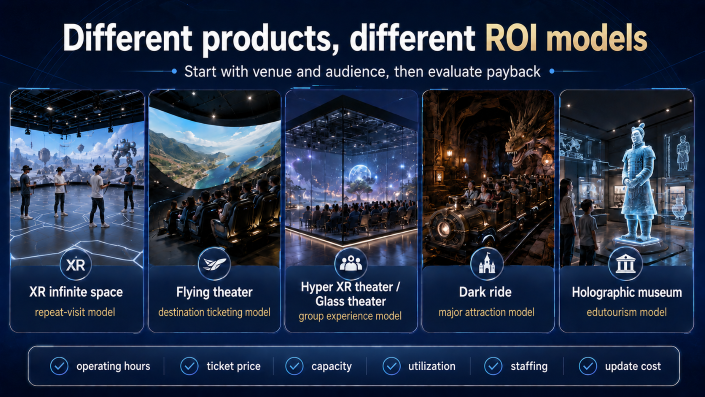
Before comparing suppliers, define the attraction category. Are you planning XR Infinite Space, Free Roam VR, a Flying Theater, Hyper XR Theater, Dark Ride, Glass Theater, Holographic Museum, or a mixed VR theme park? Each product type needs different engineering and content ability.
A supplier good at headset-based VR may not be good at motion platforms. A theater integrator may not understand free roam tracking. A museum multimedia company may not know how to run a high-throughput shopping mall attraction.
This is why buyers should ask for relevant project experience, not generic company history.
What a Real XR Entertainment Solution Supplier Should Provide
A serious supplier should be able to support at least these areas:
- Product selection based on venue and target audience.
- Content library or custom content development.
- Hardware integration and system compatibility.
- Site layout, queue flow, and safety planning.
- Installation, commissioning, and acceptance testing.
- Staff training and operating manuals.
- Remote support, spare parts, and maintenance process.
- Content update options after opening.
For example, a manufacturer such as MiXR is relevant to buyers who need turnkey immersive attraction solutions across several categories, including XR Infinite Space, Flying Theater, Hyper XR Theater, Glass Theater, Dark Ride, and Holographic Museum. The value is not only the equipment. It is the ability to combine product format, digital content, and delivery support.
Questions to Ask Before You Request a Price
Do not start with “How much is it?” Start with questions that reveal whether the supplier understands your project.
- Which product format would you recommend for this site, and why?
- What site conditions must be confirmed before quotation?
- What is the realistic hourly capacity, including loading and reset?
- What content is included, and what requires extra payment?
- How many staff are needed per shift?
- What parts usually need replacement during daily operation?
- What support is available after installation?
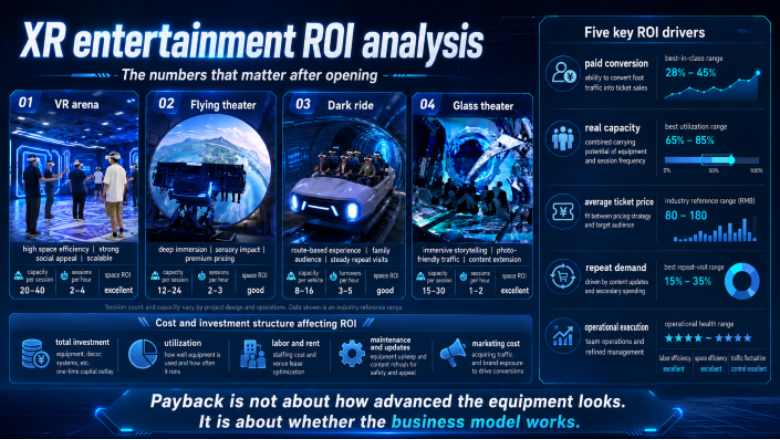
- Can the supplier provide a basic ROI model with assumptions stated clearly?
A supplier who answers these questions with specific ranges and conditions is usually safer than one who promises a perfect result immediately.
How to Check Technical Ability
For XR Infinite Space or VR Large Space, check tracking stability, multiplayer synchronization, headset management, safety boundaries, game reset time, and content variety. For Flying Theater, check motion platform reliability, visual system quality, film format, special effects, show control, and maintenance access. For Dark Ride, check ride control, scene integration, safety logic, and long-term service. For Holographic Museum, check content accuracy, interaction design, and educational flow.
Do not accept a generic answer like “we support customization.” Ask what can actually be customized: content theme, language, IP, venue layout, seat count, player number, exterior design, or operating procedure. Customization without clear scope can become a schedule trap.
Red Flags in Supplier Selection
Be careful if a supplier:
- Quotes before asking about your site.
- Avoids discussing installation conditions.
- Cannot explain real operating capacity.
- Shows only renderings and no delivered project details.
- Promises very fast payback without assumptions.
- Has no clear spare parts or support process.
- Treats content as an afterthought.
- Cannot explain who is responsible for civil work, decoration, and approvals.
I have seen buyers choose a low quote and later pay more to fix tracking, content, or site-flow problems. The cheapest supplier often becomes expensive when responsibility is unclear.
A Supplier Scoring Method
Use a 100-point scoring method:
- Relevant project experience: 20 points.
- Product and content fit: 20 points.
- Technical integration ability: 15 points.
- Installation and training process: 15 points.
- After-sales support and spare parts: 15 points.
- Commercial clarity and contract scope: 15 points.
Any supplier below 70 points should not be selected for a serious cultural tourism or mall project unless the scope is small and the risk is acceptable.
Choosing for Long-Term Operation
The best XR attraction supplier is not always the one with the most dramatic showroom. It is the one who helps you avoid mismatched formats, unrealistic capacity, vague content rights, and weak operation plans.
Ask for clarity. Ask for scope. Ask for what is not included. A good supplier will not be offended by detailed questions. In this industry, careful procurement is not slow thinking. It is how you prevent a technology purchase from becoming an operational burden.