XR Infinite Space ROI Analysis
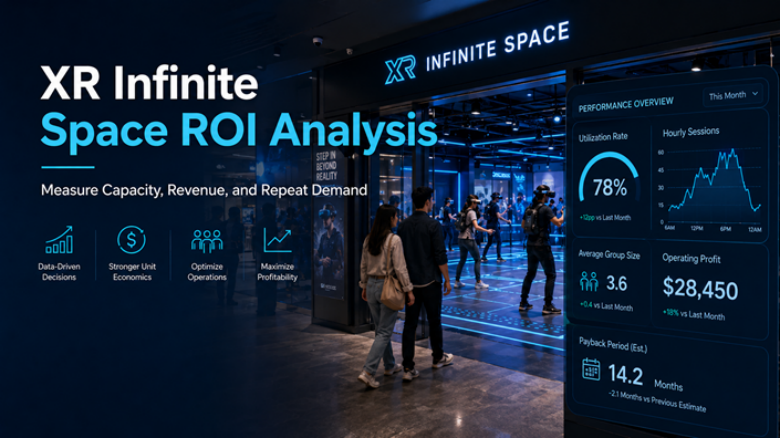
XR Infinite Space ROI analysis begins with a simple question: how many paid groups can the venue handle on a normal day, not just during launch week? A good opening crowd is encouraging, but it does not prove the business model.
This type of attraction can create strong group demand in shopping malls, FECs, tourist commercial zones, and indoor entertainment centers. Players move inside a mapped space, share a mission, and leave with a group memory. That social layer is the reason XR Infinite Space can support a higher ticket than basic VR. The numbers still need discipline.
The Revenue Side
The revenue model usually depends on four variables:
- Players per session.
- Ticket price per player or per group.
- Real sessions per hour.
- Utilization rate across different day types.
Do not treat all days equally. Weekday afternoons, Friday nights, school holidays, weekends, and national holidays behave differently. A serious analysis should split them.
For example, a venue may have strong weekend performance but weak weekday traffic. That does not mean the project fails. It means the operator may need birthday packages, school group sessions, corporate team play, or bundled mall campaigns to strengthen non-peak periods.
The Cost Side
Operating cost includes more than rent and electricity. Staff time is a major factor. XR Infinite Space needs onboarding, safety guidance, equipment fitting, cleaning, reset, and basic troubleshooting.
Other costs may include:
- Content license or update fees.
- Spare parts and consumables.
- Battery and device replacement.
- Local marketing.
- Technical support.
- Payment system and platform fees.
If these are ignored, the ROI looks cleaner than reality.
Capacity Is Usually the Sensitive Number
Small changes in cycle time can change the whole model. If a mission lasts 12 minutes, but the real cycle is 20 minutes, the venue may run three groups per hour rather than five. That gap affects revenue more than many buyers expect.
This is why the supplier should explain real operating capacity. A good answer includes player onboarding, briefing, cleaning, and reset. A weak answer only repeats the game length.
MiXR and the ROI Conversation
MiXR’s XR Infinite Space is relevant here because it is sold as a commercial multiplayer attraction rather than a loose set of VR devices. The ROI value comes from the system working as a package: space planning, multiplayer content, tracking, installation, and operating guidance.
For buyers, the question is not only “How much does it cost?” The better question is “How many paid sessions can staff run without friction?”
A Simple ROI Calculation
Operators can start with this structure:
- Hourly gross revenue = players per session x sessions per hour x average ticket price x utilization.
- Daily gross revenue = hourly gross revenue x operating hours.
- Monthly gross revenue = weekday revenue + weekend revenue + holiday revenue.
- Monthly operating profit = gross revenue – rent – staff – utilities – maintenance – marketing – content updates.
- Payback period = total project investment / monthly operating profit.
Use conservative assumptions first. If the conservative case is still acceptable, the project has a stronger foundation.
What Improves ROI After Opening
Some of the best ROI improvements are not technical. Clear storefront messaging, visible gameplay, fast payment, staff scripts, clean equipment, and group packages can all increase conversion.
Content refresh also matters. If the venue depends on local repeat visitors, the attraction needs new missions, seasonal events, or competitive modes. A tourism site may rely more on first-time visitors, but even there, strong launch materials and staff guidance affect conversion.
When ROI Is Likely to Be Weak
XR Infinite Space ROI is likely to be weak when:
- The attraction is hidden from natural traffic.
- The venue has too little space for safe movement.
- Staff cannot manage sessions smoothly.
- The content is too complex for first-time players.
- The site has no plan for repeat demand.
- The ticket price is copied from another market without local testing.
The attraction can be impressive and still underperform if these points are ignored.
ROI analysis should feel a little uncomfortable. It should expose weak assumptions before money is spent. That is better than discovering them after the opening campaign has ended.

What a Good ROI Review Should Include
A useful ROI review should include both numbers and field observations. The numbers show ticket sales, utilization, labor cost, and maintenance. The field observations explain why those numbers happened.
For example, weak weekday revenue may not mean the attraction is wrong. It may mean the mall needs group packages, school cooperation, birthday bookings, or stronger storefront visibility. A low repeat rate may point to content depth. A slow hourly capacity may point to staff training or layout problems.
XR Infinite Space is a social attraction, so the operator should also watch group behavior. Do people laugh after leaving? Do they take photos? Do they ask about another mission? These signals are not a substitute for revenue data, but they help explain whether the attraction has repeat potential.