XR Infinite Space Cost and ROI Guide for Attraction Operators
XR Infinite Space cost and ROI should be calculated from real operation, not from the length of the game video. That sounds obvious, but many attraction operators still build the first model too cleanly. They multiply players by ticket price and forget loading, instructions, cleaning, reset, staff work, and slow hours.
For shopping malls, FECs, tourist commercial blocks, and indoor entertainment venues, XR Infinite Space can be a strong paid attraction. It gives visitors a reason to enter as a group, play together, and come back for another mission. The ROI works only when the cost plan, hourly capacity, and visitor flow fit the site.
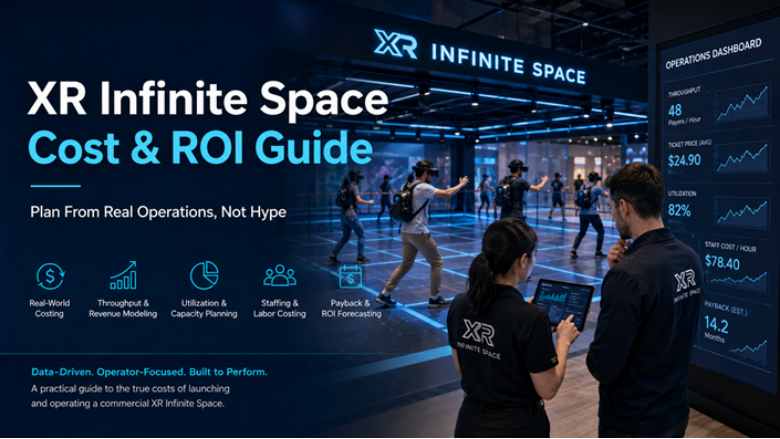
Start With Total Project Cost
The total cost is more than the XR system itself. A proper project budget should include:
- Headsets, tracking, computing, and network equipment.
- Multiplayer content and software license.
- Playable area planning and safety design.
- Decoration, storefront, queue space, and storage.
- Installation, testing, and staff training.
- Spare parts, cleaning tools, and maintenance plan.
- Launch marketing and future content updates.
If a quotation only lists hardware, it is not enough for ROI analysis. The operator needs to know how much money must be spent before the first paid visitor enters.
Build ROI From Throughput
Throughput is the heart of the model. A game may last 10 minutes, but a full operating cycle may be 15-20 minutes after onboarding, headset fitting, safety briefing, exit, cleaning, and reset.
A simple ROI model should include:
- Players per session.
- Real cycle time.
- Sessions per hour.
- Average ticket price.
- Utilization by weekday, weekend, holiday, and low season.
- Staff cost per shift.
- Rent or revenue share.
- Maintenance and content update cost.
This model will look less exciting than a sales estimate. That is useful. A conservative model prevents poor investment decisions.
Ticket Price and Audience Fit
XR Infinite Space usually performs better when visitors arrive in groups. Friends, families, birthday parties, youth customers, and tourists are easier to convert than lone passersby.
The ticket price should match the local entertainment market. If the price is too low, payback becomes slow. If it is too high, visitors may try once and not return. In many projects, the better approach is to create packages: single mission, group ticket, birthday package, or repeat-player discount.
MiXR’s XR Infinite Space in an ROI Context
MiXR’s XR Infinite Space should be judged as a complete attraction system: playable space planning, multiplayer content, hardware integration, installation support, and operation guidance. This matters for ROI because every weak operating detail reduces real capacity.
A strong system is not just the one with better graphics. It is the one staff can run repeatedly during busy periods without confusion.
Common ROI Mistakes
Operators should watch for these mistakes:
- Counting media duration instead of full cycle time.
- Assuming every day behaves like a holiday.
- Forgetting staff cost and rent.
- Ignoring content refresh after the first few months.
- Placing the attraction where visitors cannot understand it from outside.
- Buying a system too large for the actual traffic.
One problem I have seen more than once: the project gets a good opening crowd, but no one planned the second content push. After the first curiosity wave, repeat demand drops.
A Practical Payback Rule
Before signing, run three ROI cases:
- Conservative weekday case.
- Normal weekend case.
- Peak holiday case.
Then calculate whether the attraction still makes sense when weekday utilization is modest. If the project only works under peak traffic assumptions, the risk is high.
For many operators, the goal should not be the fastest possible payback on paper. The better goal is a stable attraction that can keep generating paid sessions month after month.
XR Infinite Space can be a strong commercial product when the site has group traffic, visible storefront space, trained staff, and a content update path. Without those conditions, the ROI model needs to be adjusted before equipment is purchased.
The Operator’s Monthly Review
ROI should not be checked only before purchase. After opening, the operator should review the attraction every month. Look at paid sessions by day type, average group size, refund issues, staff overtime, equipment downtime, and which missions are played most often.
These numbers often show where profit is leaking. Maybe the storefront message is unclear. Maybe the briefing takes too long. Maybe the ticket price is fine on weekends but too high for weekday students. Small operational changes can improve ROI without buying new equipment.
The best attraction operators treat XR Infinite Space like a live business unit, not a fixed machine. They keep adjusting packages, staff scripts, content rotation, and local promotion until the attraction settles into the venue’s rhythm.
One more point is worth adding: the ROI model should leave a small budget for testing. The first ticket price, group package, or mission order may not be perfect. Operators who reserve room for adjustment usually make better decisions than those who spend everything on launch and have no budget left to improve conversion.