XR Theater vs Immersive Theater
XR Theater and immersive theater get mixed together all the time. I understand why. Both can use screens, sound, lighting, digital scenes, and some kind of staged experience. From a distance, they may even look similar.
But for a buyer, they are not the same purchase.
The difference starts to matter when you ask practical questions: What does the visitor actually do? How many staff are needed? Is the show passive or interactive? Does the system need XR devices, gesture control, synchronized effects, or only projection and audio? Those details change the cost, the operating model, and the kind of venue the attraction fits.
For a theme park, cultural tourism site, science center, or commercial entertainment project, this should be clarified before anyone talks about final budgeting.
What People Usually Mean by Immersive Theater
Immersive theater is a wide term. Sometimes it means a projection room. Sometimes it means a dome show, an LED space, a multimedia room, or a walk-through scene with lighting and sound.
That flexibility can be useful. It also creates confusion.
One supplier may call a four-wall projection space an immersive theater. Another supplier may use the same phrase for a larger multimedia venue with special effects, scenic design, and visitor movement. Both may be correct in their own way, but they are not quoting the same thing.
So I would not start with the label. I would ask what the audience does inside the space.
Do they sit and watch? Do they walk? Do they choose anything? Do they interact? Or are they mainly surrounded by visuals and sound?
That answer tells you more than the term “immersive theater.”
What XR Theater Adds
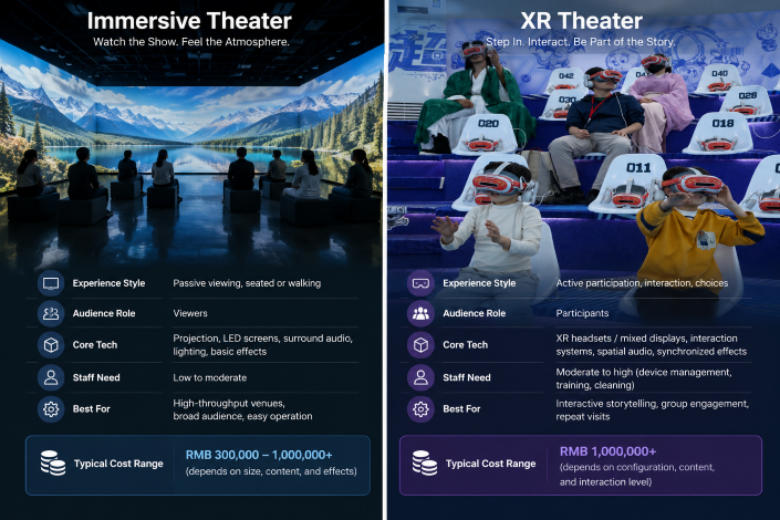
XR Theater is usually more specific. It adds an extended reality layer to the theater experience. Depending on the design, that may include XR viewing devices, mixed display systems, virtual characters, gesture interaction, spatial audio, synchronized seats, or environmental effects.
The audience is not only watching a show. They may be asked to respond, choose, trigger something, or feel as if they are inside a digital scene.
MiXR’s Hyper XR Theater fits this more specialized category. It is relevant for buyers who want theater-style storytelling, but with XR interaction and group participation built into the experience. That is a different goal from simply making a room look immersive.
The value is not just novelty. A good XR Theater gives the operator a repeatable indoor show while giving visitors a more active role in the story.
Cost Is Not Just About Room Size
This is where buyers often compare the wrong numbers.
An immersive theater can be relatively simple if it is built around projection, audio, and a fixed media show. It can also become expensive if the project includes a large room, complex effects, scenic construction, and custom media.
XR Theater has its own cost structure. For a product such as MiXR’s Hyper XR Theater, buyers should usually think in terms of a seven-figure RMB investment. In practical project discussions, this is not a small projection-room budget. The system is typically above RMB 1 million, and the final number depends on configuration, content, room design, interaction level, and installation scope.
The budget may include:
- XR headsets or mixed display systems.
- Interactive software and show content.
- Gesture recognition or another input method.
- Seating, layout, and audience control.
- Spatial audio and environmental effects.
- Show control and synchronization.
- Staff training, cleaning, and equipment maintenance.
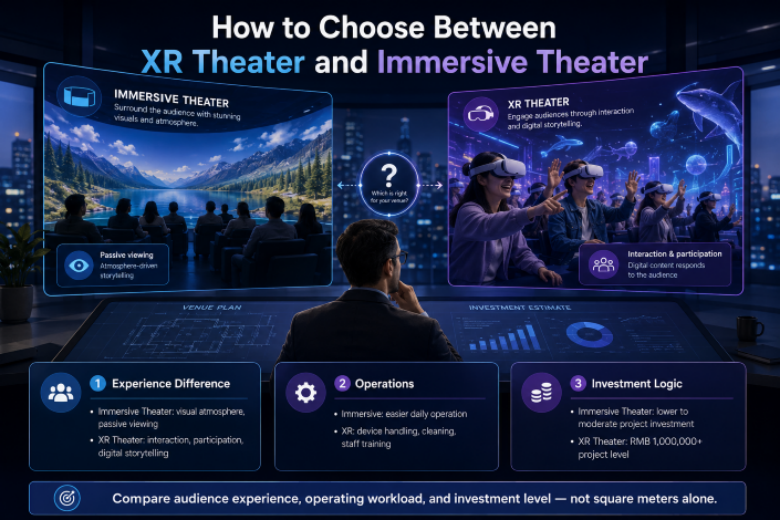
So a buyer should not compare XR Theater and immersive theater by square meters alone. A smaller XR Theater may still cost more than a larger passive projection room because the value is not only in the room shell. It is in the XR devices, interactive content, synchronized system, and operating structure behind the show.
The right comparison is visitor experience plus operating workload, not only construction area.
Which Format Fits Which Venue?
If the venue mainly needs a visually rich show that mixed-age visitors can understand quickly, immersive theater may be the cleaner choice. It can work well when the audience enters, watches, takes in the atmosphere, and leaves without much instruction.
That simplicity is valuable in high-throughput venues.
XR Theater makes more sense when participation is part of the value. If visitors need to make choices, respond with gestures, interact with digital characters, or feel directly involved in the story, then a normal immersive theater may feel too passive.
For theme parks, XR Theater can become a repeatable indoor attraction. For cultural tourism, it can make a local story feel more active. For commercial entertainment venues, it can create a group experience that feels different from a normal cinema or projection show.
The format should follow the job of the attraction.
Operations Are Different Too
XR Theater usually asks more from staff.
If the system uses headsets, someone has to manage fitting, hygiene, comfort, storage, charging, and cleaning. If the show includes interaction, staff need to explain the rules clearly and quickly. Reset time also matters. A show that looks short on paper can become slower in real operation if onboarding takes too long.
For a buyer, this is a serious point. A venue with limited staff may be better served by a simpler immersive theater. A venue that wants a higher-value interactive attraction may accept the extra operational work of XR Theater.
A Practical Buying Rule
I would use this rule before choosing:
- Choose immersive theater when the main goal is atmosphere, visual impact, and broad accessibility.
- Choose XR Theater when participation, interaction, and digital storytelling are central to the experience.
- Be careful with XR Theater if the venue cannot manage equipment, cleaning, staff training, and reset flow.
- Be careful with immersive theater proposals that never explain what visitors actually do.
That last point is important. “Immersive” is easy to write in a proposal. It is harder to design a visitor experience that people will pay for and remember.
Questions That Clear Up the Decision
Before asking for final pricing, ask a few plain questions.
Does the visitor wear equipment? Does the story change when visitors interact? Is the audience participating as individuals, as a group, or only as viewers? How long does one full operating cycle take, including entry, briefing, cleaning, and exit? What happens if one device fails during a session?
These questions quickly separate a visual show from an interactive XR attraction.
They also prevent overbuying. Some venues do not need XR Theater. A beautiful immersive show with strong content may be enough. Other venues need interaction because the story would feel flat if visitors only watched.
For buyers considering MiXR’s Hyper XR Theater, the budget should be understood as part of a higher-value attraction project, not as a low-cost media room. If the venue cannot support a RMB 1 million+ investment level, or if it only needs a passive visual show, a simpler immersive theater may be more suitable.
The first creative brief should make this clear. It should define audience age, session length, story role, interaction level, language needs, capacity target, staff conditions, and realistic investment range. Once those points are written down, XR Theater and immersive theater become much easier to compare.
Procurement should begin with the audience experience, not the label on the brochure.