XR Infinite Space Cost Guide
XR Infinite Space cost should be judged as a commercial attraction budget, not as a headset purchase. That is the first thing I would tell a mall operator, FEC owner, or tourism investor. The system may include headsets, tracking, computers, content, network equipment, safety design, installation, training, and support. If the quote only shows device prices, it is not yet a usable project budget.
In 2026, buyers are more careful because visitors have already seen basic VR. A paid XR Infinite Space attraction has to run smoothly, handle groups, and give people a reason to return. Cost matters, but the wrong low-cost setup can become expensive after opening.
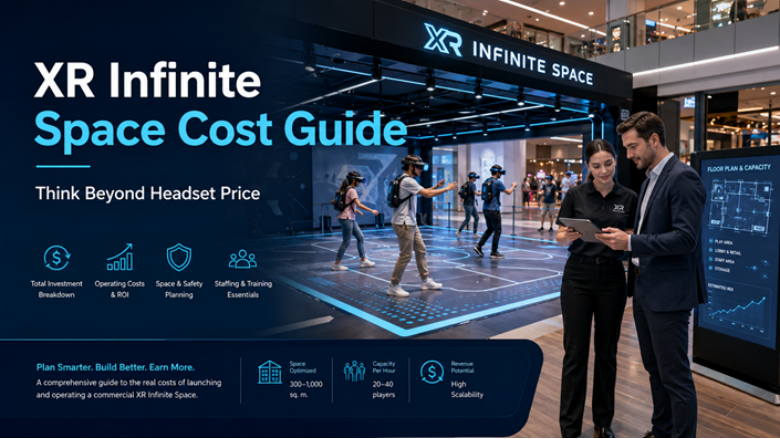
What Usually Drives XR Infinite Space Cost
The biggest cost driver is the attraction format. A small free roam VR room for a few players has a very different budget from a larger multiplayer XR arena built for high-traffic shopping malls or tourist destinations.
Common cost factors include:
- Playable area and safe movement space.
- Number of players per session.
- Headset model and commercial durability.
- Tracking system and calibration method.
- Computers, streaming hardware, routers, and network design.
- Multiplayer content and license scope.
- Decoration, storefront design, queue area, and safety padding.
- Installation, commissioning, training, and after-sales support.
In many projects, buyers focus on headsets first. That is understandable, but it is too narrow. The visitor does not pay for a headset. The visitor pays for a shared mission that feels stable, clear, and worth the ticket.
Typical Budget Ranges to Think About
Exact pricing depends on venue size, player count, content, freight, local installation conditions, and support scope. As a broad planning reference, a compact commercial setup may sit in the mid five-figure USD range, while a larger turnkey XR Infinite Space attraction can move into the six-figure range before decoration and local construction are fully counted.
That is not a quotation. It is a way to avoid unrealistic early planning. If a project budget only covers hardware but leaves no room for installation, safety, staff training, and content updates, the attraction is underfunded before it opens.
Why Cheap Systems Can Be Risky
A low price can be attractive when a buyer is testing the market. For a short-term event, that may be acceptable. For a permanent mall or tourism attraction, the buyer should be more careful.
The weak points usually appear in daily operation:
- Tracking drift during busy sessions.
- Slow reset between groups.
- Limited content that visitors only try once.
- Poor staff tools for starting, pausing, or recovering sessions.
- No clear plan for spare parts.
- Weak storefront design, so visitors do not understand the attraction.
If any of these issues slow turnover, the lower initial cost may not help much.
Where MiXR Fits in the Cost Discussion
MiXR’s XR Infinite Space is better understood as a turnkey multiplayer attraction package rather than a loose equipment bundle. The value is in combining playable space planning, hardware integration, multiplayer content, installation support, and operating guidance. For a buyer without an internal technical team, that package approach can reduce coordination risk.
This does not mean every venue needs the largest version. A good supplier should help the buyer scale the project to the site: small mall unit, FEC zone, tourist commercial block, or larger indoor entertainment space.
A Simple Cost Check Before Buying
Before signing, ask the supplier to separate the budget into:
- Equipment and tracking.
- Content and software license.
- Venue layout and safety design.
- Installation and commissioning.
- Staff training and operation documents.
- Spare parts and warranty.
- Optional content updates.
- Freight, tax, and local construction responsibilities.
If these items are blended into one vague number, comparison becomes difficult. One supplier may include training and content updates. Another may not. The cheaper quote may simply be missing work.
Site Conditions That Change the Budget
Two projects with the same player count can still have different costs. The site often decides the difference. A clean rectangular unit with good power, stable network, and simple queue flow is easier to install than a space with columns, poor ventilation, weak signal, or a narrow entrance.
For overseas projects, buyers should also leave room for shipping, import handling, local electrical work, language adaptation, and remote support. These costs are not always large, but they should not be discovered after the contract is signed.
I would also check how visible the attraction is from the corridor. A hidden unit may need more storefront design and launch marketing. A naturally visible unit can spend more of the budget on content and operations. This is why the same XR Infinite Space system may need a different budget in a mall, a tourist street, or an FEC.