XR Entertainment Solutions for Shopping Malls
XR Entertainment Solutions for Shopping Malls: Choose for Repeat Visits, Not Just Foot Traffic
XR entertainment solutions for shopping malls should be judged by repeat play, queue control, and revenue per square meter. A mall already has foot traffic. The harder question is whether an XR attraction can convert that traffic into paid sessions without creating operational headaches. In 2026, shopping malls are using immersive entertainment to replace weak retail zones, fill upper floors, and create reasons for families and young customers to stay longer.
The best mall projects are rarely the largest. They are the ones with the right format for the floor, the right staff model, and content that can be refreshed before local visitors lose interest.
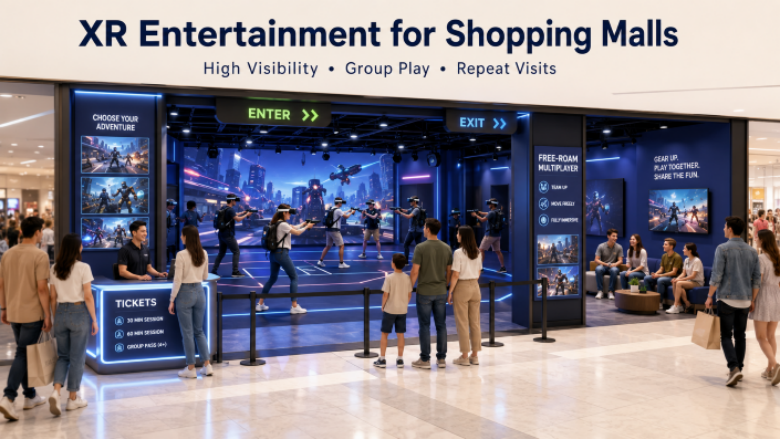
Why XR Entertainment Fits Mall Operations
Shopping malls need attractions that are visible, safe, compact, and easy to understand within a few seconds. A visitor walking past should know what the experience is, how long it takes, whether it is suitable for friends or children, and why it is worth paying for.
That is why XR Infinite Space, VR Arena, Free Roam VR, and multiplayer VR experiences are common choices for malls. They turn a plain lease area into a group entertainment zone. They also fit common mall needs:
- Short decision time at the storefront.
- Session length around 8-20 minutes, depending on the format.
- Group play for friends, couples, families, and parties.
- Content changes for holidays, school breaks, and campaigns.
A Flying Theater or Glass Theater can also work in a mall, but usually only when the mall has a larger entertainment floor, good ceiling height, and a destination-style positioning. For smaller mall units, free roam and arena formats are often easier to operate.
XR Infinite Space and VR Arena in a Mall Setting
XR Infinite Space is useful when the mall operator wants a more flexible location based VR attraction instead of fixed seats. Players can move, cooperate, compete, and enter different themed worlds. The product can support shooting, exploration, cultural fantasy, escape-style missions, and other interactive formats.
MiXR’s XR Infinite Space is a good example of how this category should be presented to a mall buyer: not just headsets and tracking, but a complete attraction package with multiplayer content, hardware integration, installation, and operation guidance. For a mall tenant, that package reduces the number of vendors and technical decisions.
VR Shooting Arena or Free Roam VR Shooter formats are stronger when the target customers are teenagers, young adults, and group visitors. They are less suitable for quiet luxury malls where noise, staff shouting, and crowd control may conflict with the tenant mix.
What Shopping Mall Entertainment Solutions Must Get Right
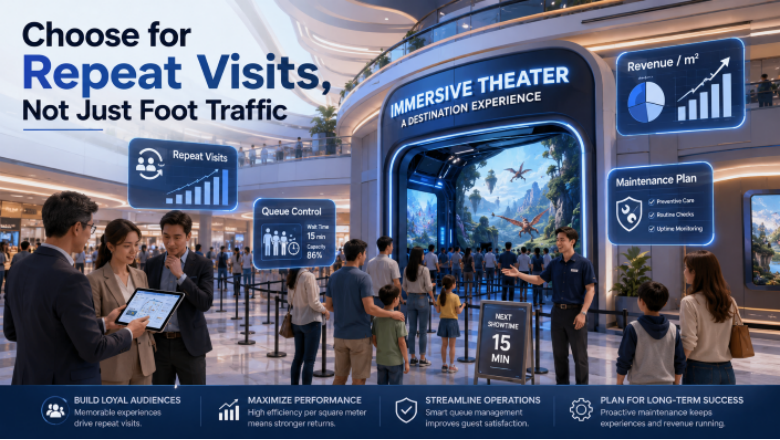
Mall projects fail when operators overestimate impulse traffic. A bright storefront helps, but paid conversion depends on pricing, session clarity, and social proof. Visitors need to see other people having fun. If the experience is hidden behind a wall with no clear preview, conversion drops.
The second issue is queue design. A popular XR attraction can create a messy waiting area if ticketing, storage, safety briefing, and equipment cleaning all happen at the same counter. Even a 30-60 square meter project needs a clear flow.
The third issue is maintenance. Mall hours are long. Equipment that works for a trade show demo may not tolerate daily consumer use. Controllers, straps, lenses, batteries, floor markings, routers, and tracking devices need a maintenance plan.
A Simple Mall Selection Matrix
Use this buying rule before choosing a format:
- If the unit is small and traffic is young, consider VR Arena or XR Infinite Space.
- If the mall wants a family-friendly paid attraction, choose content with lower motion sickness risk and clear staff guidance.
- If the mall wants a landmark attraction, consider Flying Theater or Glass Theater only after checking ceiling height, structure, fire exits, and queue space.
- If the project depends on school groups or study tours, add Holographic Museum or educational MR content instead of pure combat games.
- If rent is high, calculate revenue per square meter before buying the most impressive equipment.
This matrix is simple, but it catches many mistakes before money is spent.
Cost and ROI Questions for Mall Buyers
Do not ask only for the equipment price. Ask for the full project cost. A shopping mall VR attraction may include design, hardware, headsets, tracking, computers, network equipment, safety padding, signage, payment system, installation, content license, staff training, spare parts, and freight.
Typical planning should consider:
- Build-out and decoration cost.
- Equipment and content package.
- Installation and testing time.
- Staff per shift.
- Expected hourly capacity.
- Marketing launch cost.
- Content update cost after the first few months.
For many mall operators, the better decision is not the cheapest supplier. It is the supplier who can explain the operating cycle clearly. If a vendor cannot tell you how many players can realistically pass through the attraction per hour, the ROI calculation is still unfinished.
When XR Is Not the Right Mall Attraction
XR entertainment is not suitable for every shopping mall. If the mall has weak evening traffic, poor wayfinding, low youth traffic, and no budget for launch marketing, a VR theme park concept may sit quietly after the first month. A simple children’s play zone or food-and-event strategy may work better.
XR becomes much stronger when the mall can give it visibility, seasonal promotion, and a reason for group visits. In that environment, a turnkey immersive attraction solution can turn unused space into a repeatable entertainment business rather than a short-lived technology display.