XR Entertainment Center Cost Guide
XR Entertainment Center Cost Guide: What Buyers Should Price Before Signing
An XR entertainment center cost guide should start with one warning: the equipment quote is not the project cost. In 2026, buyers are comparing XR entertainment centers, VR theme park concepts, free roam VR arenas, flying cinema projects, and immersive theater formats. The price gap can be wide because the term “XR center” may mean a small multiplayer VR room or a multi-zone attraction with theaters, motion platforms, content systems, and custom decoration.
The right way to estimate cost is to separate product format, space work, content, installation, and operation. If those items are mixed together, the cheapest quote often becomes expensive later.
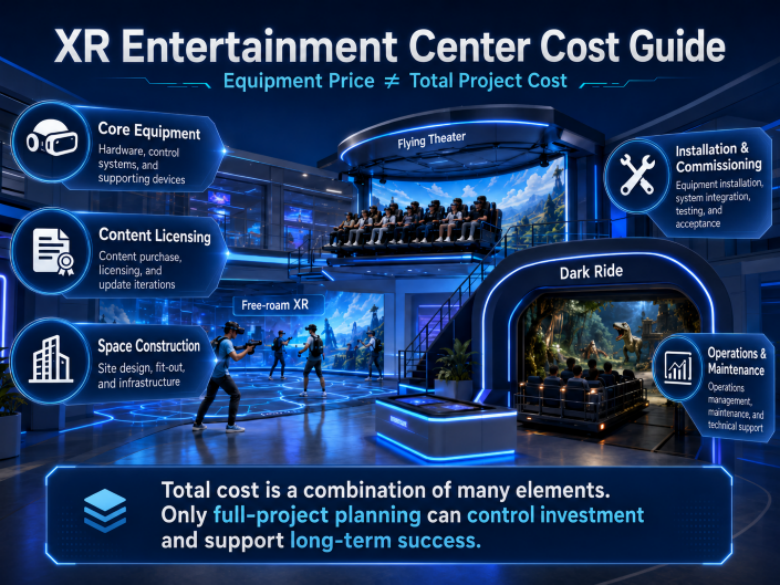
Main Cost Blocks in an XR Entertainment Center
Most projects include five cost blocks:
- Core attraction equipment.
- Digital content and software license.
- Space design, construction, decoration, and safety work.
- Installation, commissioning, training, and acceptance testing.
- Operation, maintenance, content updates, and marketing materials.
XR Infinite Space has different cost drivers from Flying Theater. A Hyper XR Theater has different cost drivers from a Dark Ride. A Holographic Museum depends heavily on content design and interpretation goals. Treating them as one category leads to bad comparisons.
Product Format Changes the Budget
XR Infinite Space and Free Roam VR
XR Infinite Space, VR Large Space, and Free Roam VR are usually priced around playable area, number of players, tracking system, headset model, computers, game content, and safety design. The buyer should confirm whether the package includes multiplayer content, technical installation, staff training, and future content options.
This format is often a good entry point for shopping malls, FECs, and mid-sized tourist areas because the space can be more flexible than a heavy ride system. MiXR’s XR Infinite Space can be introduced as a turnkey option when the buyer wants multiplayer entertainment without managing separate hardware, content, and integration vendors.
Flying Theater and Flying Cinema
Flying Theater cost depends on motion platform, seat count, screen or dome system, projection or LED solution, special effects, audio, show control, and film content. A small flying cinema and a scenic destination-level Flying Theater should not be compared by seat price alone.
Common planning ranges in real projects may include 45-90 days for production, shipping, installation, and testing, depending on customization and site readiness. If civil work is delayed, the equipment supplier cannot magically recover the schedule.
Dark Ride and Interactive Theater
Dark Ride projects are more construction-heavy. Track system, ride vehicles, scenes, media servers, lighting, show control, interactive devices, safety systems, and decoration all affect cost. These projects suit theme parks and larger indoor attractions, not small retail units with short leases.
Holographic Museum and MR Museum
Museum technology solution costs often depend less on hardware count and more on content depth. Digital restoration, 3D models, storytelling, interaction design, and education scripts may take more planning time than the equipment buyer expects.
Hidden Costs Buyers Miss
The most common hidden cost is site readiness. Power supply, air conditioning, network stability, floor load, ceiling height, fire approval, signage, and queue barriers are not glamorous, but they decide whether the project opens smoothly.
Another cost is content refresh. A VR attraction can open well and then lose repeat visitors if the content never changes. For some formats, paid updates every few months may be normal. For others, a stronger initial content library may be enough.
Staff cost also matters. A project that needs six people per shift will perform differently from one that can run with two trained staff. When comparing suppliers, ask for a standard operating procedure, not just a product brochure.
Cost Checklist for Buyers
Before signing, ask the supplier for a cost sheet that separates:
- Equipment list and quantity.
- Software and content license scope.
- Custom content, if any.
- Installation and commissioning.
- Freight, tax, and import-related items.
- Decoration and site work responsibilities.
- Training and launch support.
- Spare parts and warranty terms.
- Optional content updates.
- Remote and on-site technical support.
If the supplier refuses to separate these items, the buyer cannot compare proposals fairly.