XR Entertainment Solutions for Cultural Tourism
The first thing I want to know about a cultural tourism XR project is usually not the device.
It is the route.
Where do visitors enter? Where do they pause? Which part of the story do they skip because nobody explains it well? Is there a dead corner that only looks alive during holidays? Does the site lose half its energy when it rains or after sunset?
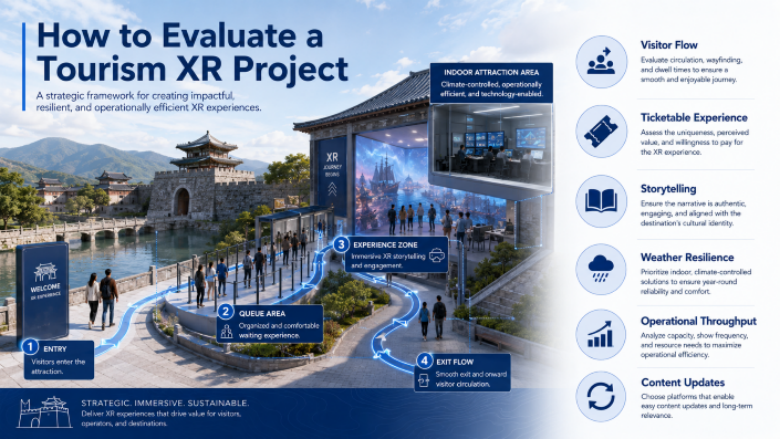
Those questions sound plain, but they are where most XR entertainment decisions should begin. A scenic area does not need technology because technology is new. It needs a paid experience that fits the way people already move through the place.
By 2026, visitors have seen plenty of immersive rooms. LED walls, projection corridors, motion seats, and basic VR games are no longer rare. People may still stop for a photo, but that does not mean they will pay, recommend it, or come back.
So the real question is not, “Do we need XR?” It is closer to this: what job should the attraction do inside the destination?
XR Infinite Space, Flying Theater, Glass Theater, Hyper XR Theater, Dark Ride, and Holographic Museum all belong to the wider immersive entertainment market. For an operator, though, they are not the same product with different names. Each one changes the visitor flow, staffing model, ticket logic, and content plan in a different way.
Cultural Tourism Technology Has to Be More Than a New Look
A few years ago, a digital upgrade could be quite simple. Put a projection wall in an empty room, add some sensors, build a short VR experience, and the space looked fresh enough for a launch event.
That effect wears off faster now.
A useful cultural tourism technology project should add something the operator can actually use. It might create an indoor ticketed stop. It might make a local legend easier to feel without a long guide speech. It might give families something to do while waiting for the next show. It might help a scenic area keep part of its revenue alive during bad weather.
The goal does not need to be huge. Sometimes a focused attraction is better than a proposal that promises everything at once.
This is also where turnkey immersive attraction solutions can help, if the supplier is serious about the less glamorous details. Queue space, ticket checking, cleaning, reset time, spare parts, staff training, and content updates are not side issues. They decide whether the attraction feels smooth after the opening week.
The Site Should Decide the Product
A showroom is easy. A tourism site is messy.
Visitors arrive in waves. Families move slowly. School groups move too loudly. Elderly guests may not want complicated instructions. Some entrances are narrow. Some spaces have poor ventilation. Some operators have good traffic but limited staff.
This is why a good XR attraction has to match the site before it matches the brochure.
Scenic Landmarks and Large Tourist Attractions
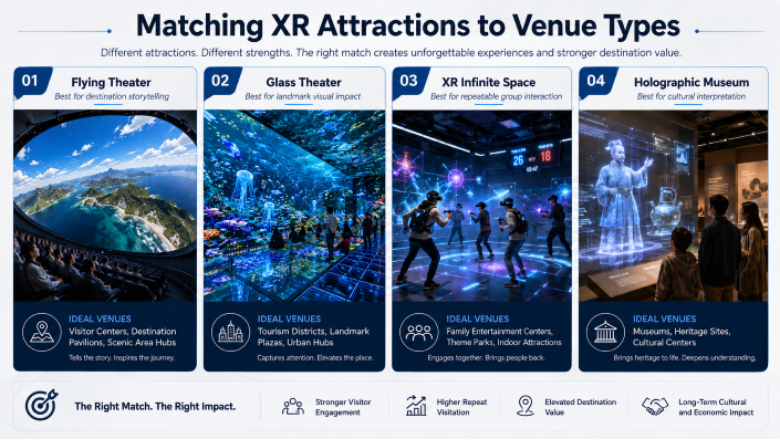
For large scenic destinations, Flying Theater, Glass Theater, and Hyper XR Theater are often easier to sell than a small VR room. They are visible, simple to understand, and more suitable for group traffic.
A Flying Theater works when the destination has something worth turning into a visual journey: a mountain route, a city skyline, a cultural route, an ancient story, or a fantasy world built around the site. The film does not need to be long. It needs to feel like it belongs there.
Glass Theater has a different value. It is useful when the destination needs a strong visual moment, a landmark-style attraction, or a scene people want to share. It is not mainly about gameplay. It is about memory.
MiXR’s Flying Theater and Glass Theater fit this type of project because the delivery can combine content, special effects, equipment integration, and installation support. For tourism operators without a large technical team, that can remove a lot of coordination work.
Museums, Study Tours, and Cultural Education Sites
Museums need more restraint.
A loud thrill attraction may bring attention, but it can also pull the space away from its subject. If visitors remember the headset but forget the exhibit, the technology has taken the wrong role.
A Holographic Museum or MR-based interactive museum works better when the goal is explanation: old buildings, cultural relics, scientific processes, historical scenes, or environments that no longer exist. The technology should make the content clearer. It should not turn the museum into a game arcade with labels on the wall.
Cultural Streets and Tourism Retail Areas
Cultural commercial streets have a faster rhythm. Visitors make quick decisions. They may be with friends, children, or a tour group already moving toward the next stop.
XR Infinite Space or VR Large Space can fit this kind of environment because the format supports multiplayer missions, seasonal themes, group tickets, youth traffic, and repeat play. It also gives the operator more room to update content without rebuilding the whole venue.
For a retail-style tourism block, that flexibility can matter more than a single large spectacle.
The Hard Part Starts After Opening
Before opening, many XR projects look convincing. Renderings look clean. Videos look exciting. The problem is that real visitors do not behave like a proposal deck.
Capacity is usually the first stress point. A busy scenic area may choose an attraction that moves too few people per round. On peak days, staff spend their time controlling the queue instead of selling the experience. On ordinary days, the attraction still needs cleaning, supervision, maintenance, and electricity.
Small venues can make the opposite mistake. They buy a theater that looks strong in presentation, but the daily visitor base cannot support it. The equipment may be fine. The scale is wrong.
Show length also misleads people. A short media experience still needs ticket checking, storage, instructions, seating or headset fitting, exit flow, cleaning, and reset. Once those steps are included, the real hourly capacity may be quite different from the sales number.
That is why I would be careful with any ROI model that looks too clean. Tourism sites rarely operate in clean lines.
Questions Worth Asking Before Pricing
Before asking for a final quote, I would check a few things on site.
Is the entrance naturally visible, or will staff need to pull visitors in all day? Is the usable area still enough after queue space, exits, staff access, and safety margins? Who is most likely to pay: families, students, young adults, tour groups, or corporate guests? Does the content belong to the destination, or could it be dropped into any mall?
Then look at operation. How many visitors can pass through in one real hour? How many staff are needed when the site is busy? Can the content be refreshed later? Can a first-time visitor understand the value before buying a ticket?
If these answers are unclear, the project is not ready for final equipment selection.
Buying Rules for Cultural Tourism Operators
For most cultural tourism projects, I would not design every technical layer from zero. Full customization sounds good in a meeting, but it can add cost, delay, and risk when the site only needs a proven attraction format with strong local content adaptation.
XR Infinite Space fits projects that need multiplayer interaction and flexible content. Flying Theater works better for regional journeys, fantasy routes, and scenic storytelling. Hyper XR Theater suits interactive narrative and group participation. Dark Ride can be powerful in theme park-style projects, but it needs more space planning, construction, scene packaging, and maintenance. Holographic Museum is better when education, culture, and interpretation are the main purpose.
The useful procurement question is simple enough: after the launch traffic fades, why will people still enter?
Warranty is only a small part of that answer. A workable cultural tourism solution needs staff training, launch materials, spare parts planning, content refresh options, and an operating plan that still makes sense on a normal weekday.