How to Compare MR CS and VR Shooting Equipment Manufacturers
MR CS and VR shooting equipment manufacturers should be compared against the same commercial brief, not ranked by the terminology in their brochures. The buyer needs to know what players can do, what the venue can charge for, what the room can support, and how staff keep sessions running.
A system described as MR may not use the same presentation, tracking, or accessories as another MR product. A VR shooting package may be a seated installation or a multiplayer walking experience. Treat the label as the beginning of the enquiry, not evidence that two quotations describe equivalent attractions.
Make the VR shooting equipment manufacturer define the offer
Start by specifying the intended audience and session. Is the venue selling casual family participation, competitive repeat play, booked groups, or a short activity within a larger entertainment mix?
Ask each manufacturer to describe the delivered experience in ordinary language. What does the participant wear or hold? How does the player move? What does the operator prepare? Which modes and result features are included?
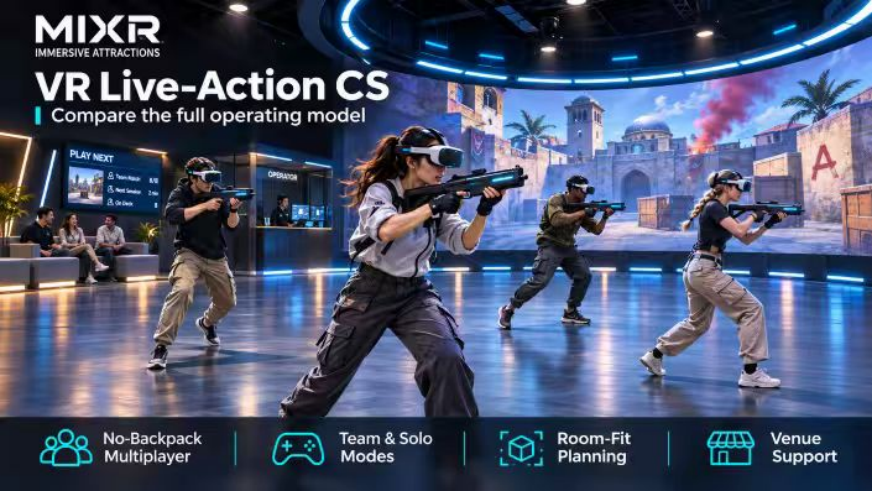
MIXR’s MR CS is described in its product materials as a no-backpack multiplayer format with individual and team-based modes. That can be relevant to an operator seeking a group combat experience without a player-worn backpack computer. It does not remove the need for fitting, charging, equipment checks, or a validated play area.
A museum or educational venue should separately assess whether the combat theme serves its audience and purpose. Entertainment equipment should not be presented as a certified training system without appropriate evidence.
Compare three operating obligations
The obligation to start a full group
Require the VR CS equipment manufacturer to identify active positions, spares, shared hardware, operator software, and content access. Device quantity alone does not establish simultaneous player capacity.
Ask whether replacement units can be assigned under the delivered licensing and operating arrangement. For an illustrative order, 8 active units plus 2 spares should not be marketed internally as a 10-player attraction unless the entire system supports that use.
The obligation to fit the real room
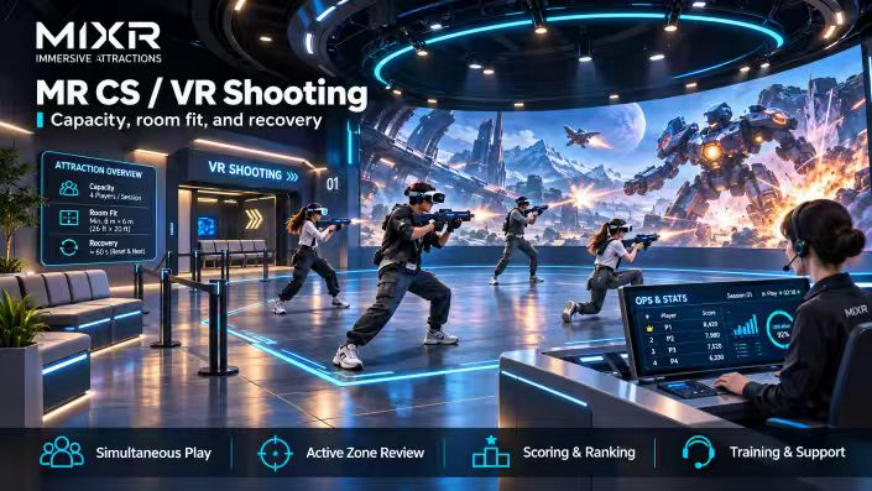
Give every shortlisted supplier the same measured plan, including columns, doors, fixtures, and intended waiting areas. Ask for the supported active zone and the circulation required around it.
Review site requirements against the selected configuration rather than assume every shooting attraction needs either an unusually tall room or no preparation at all. The comparison should reveal any required lighting, surface, network, or layout changes.
Include an arrival and waiting plan in that room review. A competitive group may want to stay together before and after the match, while casual visitors may join separately. Neither should have to stand inside the active zone while staff prepare equipment. The non-playing space belongs in the investment comparison as well as the equipment count.
The obligation to recover from a problem
Request a demonstration of a participant joining late, a unit needing exchange, and an interrupted match where those situations are supported. The manufacturer should explain the approved process and its effect on the remaining group.
The useful question is not whether the system can ever stop. It is whether the venue understands the permitted recovery actions and when supplier assistance is needed.
Put software and content beside the hardware price
A multiplayer VR equipment manufacturer should state included modes, maps, languages, commercial rights, updates, and any recurring charges. A larger demonstration library may contain experiences that are not part of the purchased package.
Ask which features the venue can advertise at opening. Team play, scoring, ranking, and event formats should be confirmed individually where relevant. Do not build a group-sales offer around a function that appears only in a promotional video.
Future updates also need a process. Establish who installs them, what testing is required, and whether staff need new instructions. Content variety is commercially useful only when the venue can introduce and operate it reliably.
Compare the complete operating cost under the same assumptions. Include staffing, replacement equipment, software access, support, and any site work alongside the equipment purchase. The lowest headset subtotal is not necessarily the lowest-cost operating arrangement.
Require evidence matched to the purchase
Use a practical selection screen rather than a long list of marketing scores:
- The proposed system fits the measured room and intended audience.
- All contracted positions run the included experience simultaneously.
- The intended staff can prepare, supervise, and reset a session.
- Licensing, installation, training, and support responsibilities are documented.
A missing answer should remain an open issue in the comparison. Do not compensate for an unresolved room fit with a high score for attractive content.
When assessing MIXR, compare its proposed player configuration, supported content, site setup, installation, and training against the same responsibilities offered by other suppliers. Include what remains with the venue.
These attractions fit venues with a suitable active area and staff able to manage shared equipment. They are a poor fit for unrestricted public circulation or a business plan that assumes no preparation between groups.
Choose the manufacturer whose evidence supports the operation the venue intends to sell. The strongest comparison ends with fewer unresolved responsibilities, not simply a longer list of game titles.