MR Infinite Racing Explained: Mixed-Reality Go-Karting for Indoor Venues
MR Infinite Racing combines a real go-kart driving platform with a virtual or mixed-reality race world. Players steer and accelerate a physical vehicle while the headset presents digital tracks, opponents, targets, and game items. The body receives real steering and movement cues, while the game layer can change the environment without rebuilding the physical course.
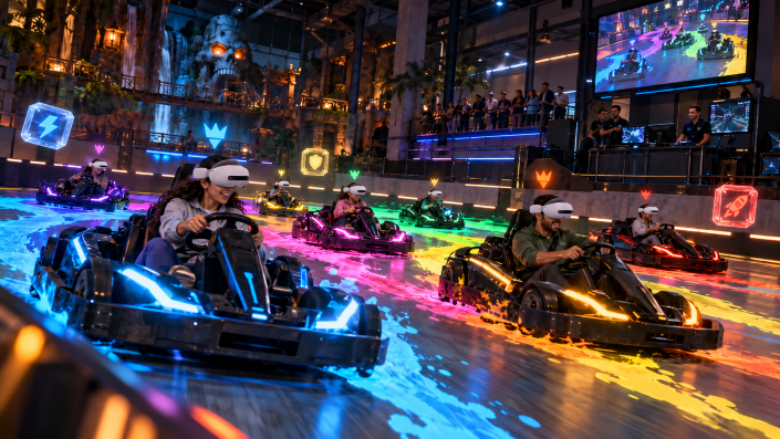
MIXR’s MR Infinite Racing is designed for multiplayer indoor venues. Its supplied content includes boss battles, ice-track racing with attack or defense items, and a color-coverage competition where players leave virtual trails across the arena. The attraction therefore uses the same physical driving base for several game rules rather than repeating one conventional lap race.
For 2026 operators, that content flexibility can support repeat play without changing the physical kart route.
The kart remains the main control device
The attraction should feel like driving before it feels like operating a game menu. Steering angle, throttle response, braking, vehicle speed, and the physical route remain central to the experience.
The headset adds information that does not exist in the room. A straight indoor lane can appear to cross an ice field. A driving line can contain collectible items. A boss target can occupy the far end of the arena. Other players can appear with effects, scores, or virtual weapons attached to their vehicles.
The physical and virtual coordinate systems must stay aligned. If a digital corner does not match the kart’s real direction, the player loses confidence quickly. Calibration should be checked across the entire route and after any change to the floor plan.
Mixed reality changes the race rules
Traditional indoor go-karting usually compares lap times and finishing order. MR racing can score other actions.
In MIXR’s boss-battle mode, players cooperate against a target while still competing for points and useful items. The ice-racing concept adds props that can affect other drivers. The color-coverage mode rewards the player who claims more of the virtual arena rather than the one who simply completes the fastest lap.
Those formats can support repeat visits because the objective changes. They also need clear instructions. A first-time player should understand the main goal before the kart starts moving. Too many weapons, icons, and scoring rules create hesitation at the exact moment the guest should be watching the route.
Venue layout is more than track area
The physical course needs enough width for the selected vehicle and operating model. It also needs a loading zone, equipment-fitting area, operator position, charging or parking space, barriers, and maintenance access.
MIXR’s supplied configurations reference 4, 6, 8, and 10 players. Capacity affects more than the number of karts. More vehicles require additional starting positions, route clearance, headset preparation, staff supervision, and system monitoring.
The room may be enclosed or semi-enclosed depending on the project design. Lighting, reflective surfaces, wireless conditions, and spectator access should be considered with the tracking and headset system. A route that works mechanically may still need changes to support reliable mixed-reality alignment.
The director system supports the operator
Players are busy driving, so staff need a separate view of the session. MIXR’s operator or director system can monitor game images and use a secondary display for venue content or spectator viewing.
The control interface should show which vehicle and headset belong to each player, whether devices are connected, and when the session is ready to start. During operation, staff need a straightforward way to pause or stop the experience if a driver needs help.
Spectator output also affects sales. Friends and waiting guests can understand the game more easily when the display shows the virtual action, rankings, or a useful overview rather than one confusing first-person camera.
Three indoor venue models
A compact FEC may use a smaller player count and shorter sessions, with simple competitive rules that new guests learn quickly. The attraction becomes one product within a wider mix of games.
An indoor theme park can support a larger course, stronger scenery, and several content modes. It may sell repeat rides through different missions rather than one race format.
A tourism or branded venue may use custom content connected to a local story, vehicle theme, or intellectual property. In that case, film and game production, approval, language, and update planning become a larger part of the project.
Each model can work. The commercial plan is stronger when capacity, staffing, and marketing follow the same venue model.
What to confirm before purchasing
The technical proposal should identify the karts, headsets, tracking method, game computer, network, charging, control system, spectator display, barriers, content, installation, calibration, training, and spare equipment.
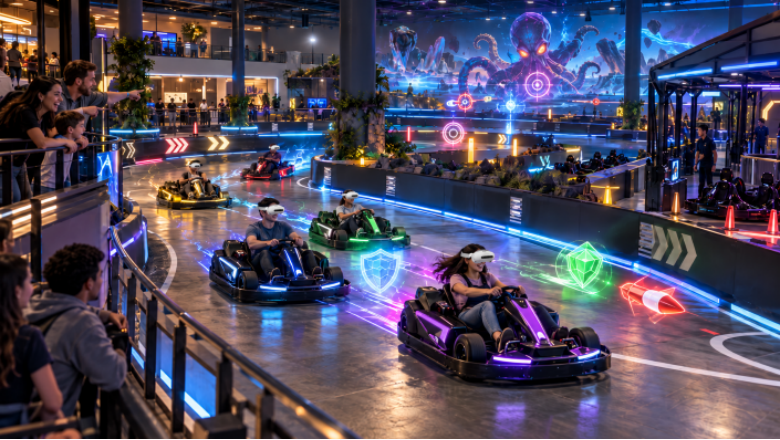
Buyers should ask whether every game mode runs on the same physical route, how the system handles a stopped vehicle, and how long it takes to change from one theme to another. The acceptance test should include a full multiplayer session rather than one vehicle operating alone.
MIXR’s MR Infinite Racing joins real vehicle handling with changeable digital rules. Its value for an indoor venue is not that it turns a kart into a virtual object. The physical kart remains real. The mixed-reality layer gives the operator more ways to use the same driving space, provided the alignment, safety, game clarity, and session workflow are commissioned as one attraction.