Suspended Holographic Glass Theater: How the Walk-In Experience Works
A suspended Holographic Glass Theater is a group attraction in which visitors walk onto a glass-bridge structure and watch a naked-eye 3D film across a five-sided curved LED environment. The bridge, surrounding image, sound, and controlled lighting make the audience feel physically present inside the scene without requiring headsets.
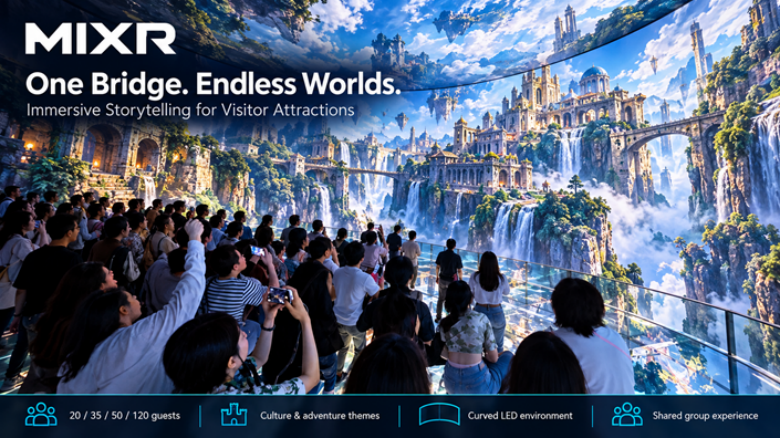
MIXR offers Holographic Glass Theater configurations for 20, 35, 50, and 120 people, with documented layouts of approximately 49-200 square metres. Those options allow the format to serve museums, cultural attractions, scenic destinations, and commercial complexes, but the experience should be planned around the visitor route rather than selected by capacity alone.
In 2026, route planning matters for short visitor attention.
The attraction begins before the glass bridge
Visitors need to understand what they are entering. From outside, the attraction may look like a theater, an LED room, or a glass walkway. Entrance language and staff guidance should make the format clear without explaining every technical detail.
The approach also controls group behavior. Families may pause before stepping onto the glass. School groups arrive together and need a place to gather. Older guests may prefer a slower entry. The queue and threshold should allow those different behaviors without blocking the main venue route.
For commercial projects, visibility from the public area matters. The entrance should reveal enough to create curiosity while keeping the main visual sequence inside the paid experience.
What happens after visitors walk in
The audience moves onto the transparent bridge and faces a visual field extending across the front, sides, ceiling, and lower viewing area. MIXR’s format uses curved LED connections between the five display surfaces to reduce hard visual breaks.
The film can create height, movement, depth, or the impression that the bridge is crossing another world. A canyon sequence may make the floor feel exposed. A cultural film can place the group inside an architectural reconstruction. A science or space theme can use the surrounding surfaces to create scale that a conventional flat screen would struggle to provide.
The audience is standing rather than seated, so the content needs a stable visual logic. Continuous high-speed movement can be uncomfortable. Strong scenes work better when they include clear pauses and reference points, especially for mixed-age groups.
Why the glass structure changes visitor behavior
The bridge makes the body part of the experience. Some visitors step forward confidently. Others test the surface, hold the rail, or follow the person ahead. That behavior creates anticipation before the film reaches its main visual moment.
The structure needs more than a visual review. Buyers should confirm load design, handrails, anti-slip treatment, entry and exit widths, emergency access, cleaning, and protection for the LED surfaces and control equipment.
Staff positioning is easy to overlook. An operator should be able to observe the group without standing in the main visual field. The route should also allow a guest to leave calmly if the height effect feels uncomfortable.
Choosing between 20 and 120 people
The largest capacity is not automatically the best commercial choice. A 120-person Holographic Glass Theater can make sense for a tourism destination receiving coach groups or scheduled waves of visitors. It needs a matching waiting area, disciplined entry, and a clear place for the group to go after the show.
A 20- or 35-person version may fit a museum route, study-tour program, or smaller commercial venue. The room can feel active with ordinary daily traffic, and staff can connect the film more closely to a guided visit. A 50-person configuration sits between those operating models.
Capacity should be based on the arrival pattern rather than total daily attendance. A venue with traffic spread across the day may need a different version from one receiving a few large groups.
Content gives the five-sided display a purpose
The theater can support cultural, science, tourism, fantasy, and adventure films. The content should explain why the audience is standing on the glass bridge.
For museums, the bridge might cross a reconstructed archaeological site or move through a large-scale natural process. For scenic attractions, the film may extend the local landscape or introduce a story that cannot be staged outdoors. In a mall, the content may need a faster premise and stronger visual moments visible in promotional clips.
MIXR’s film and CG production capability can be included in the project discussion. Buyers should confirm whether the quotation includes existing content, localization, or a newly produced film, along with the number of language versions and the content approval process.
The operating cycle after the film
The exit should return visitors to the venue naturally. A museum may lead them back to an artifact or exhibition. A tourism attraction may connect the theater to the next scenic stop. A commercial complex may use a photo point or retail area, provided it does not obstruct the next group.
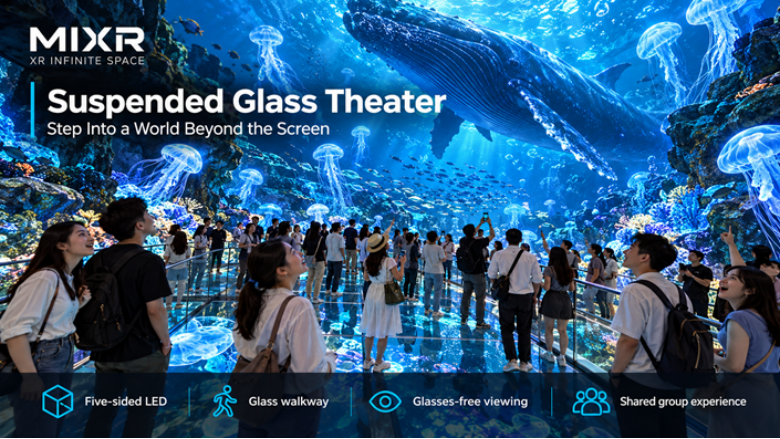
Staff then check the bridge, reset the show, and prepare the next entry. Fingerprints, dust, moisture, and loose items are more visible on glass than on a normal floor. Cleaning access and turnaround time belong in the operating plan.
MIXR’s Holographic Glass Theater works best when the bridge, five-sided curved LED content, group capacity, and visitor route are treated as one system. The visual effect draws people in. A clear entrance, controlled movement, suitable content, and an orderly exit turn that effect into a repeatable attraction.