What Makes an AGV Trackless Dark Ride Different?
An AGV trackless dark ride replaces a fixed rail path with an automated guided vehicle that follows a programmed route. The vehicle can stop, turn, change orientation, and coordinate with digital scenes without being physically locked to a visible track. For a theme park or indoor attraction, that changes both the creative possibilities and the engineering work behind the ride.
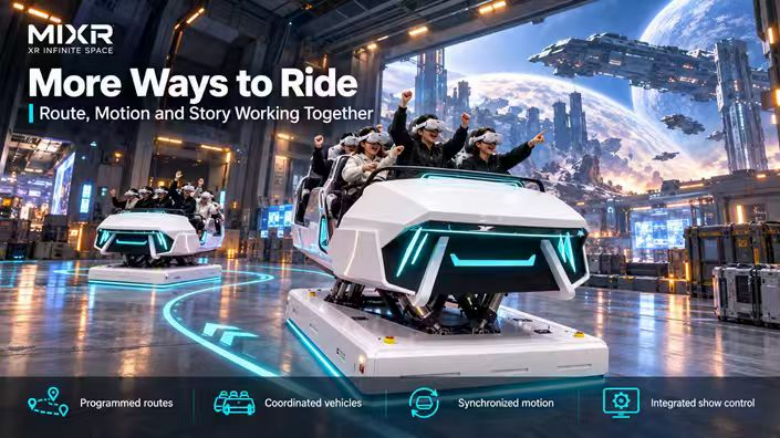
MIXR’s AGV Dark Ride combines an AGV base, a six-axis motion vehicle, XR or naked-eye 3D content, multiplayer interaction, and role-based game tasks. The attraction is not simply a vehicle moving through a room. Route control, positioning, motion, media, safety, and show timing have to operate together.
For 2026 indoor attractions, that programmable route is valuable where operators want replayable scenes without a visible rail system.
Route programming replaces the rail
A traditional dark ride usually follows a fixed mechanical path. The route is easy to understand because the vehicle cannot leave it. A trackless AGV uses positioning and control logic to follow a digital route across the prepared floor.
That allows the vehicle to approach a scene from different angles, rotate toward an event, pause for interaction, or take another programmed sequence. Multiple vehicles may be coordinated so that guests do not see the same scene in exactly the same way.
The flexibility comes with stricter commissioning. The supplier needs accurate floor dimensions, route clearances, stop positions, turning space, and safe distances between vehicles and fixed structures. A small change to a wall, scenic object, or doorway can affect the programmed movement.
The floor becomes part of the ride system
Trackless does not mean the vehicle can run on any finished floor. Surface flatness, load capacity, joints, slopes, traction, and cleanliness influence AGV movement. Cable covers, loose decorative pieces, and temporary equipment cannot be allowed to enter the travel path.
The route also needs maintenance and emergency access. Staff should be able to reach the vehicle at every programmed stop. Doors and evacuation paths must remain usable when a vehicle is in an unexpected position.
These checks belong early in site planning. Leaving them until installation can force route changes after content and scenery have already been designed.
Six-axis motion adds a second layer
The AGV base moves the vehicle through the room. The six-axis motion platform moves the passenger cabin in response to the scene. Those are separate systems with different jobs.
MIXR’s hardware reference shows a customizable vehicle body, AGV platform, six-axis motion base, seats, safety belts, protective door, and control computer. A turn in the room may be reinforced by cabin roll. A virtual impact may use a shorter movement. A launch or drop can be suggested without the AGV traveling far.
The motion profile should respect the vehicle route. Strong cabin movement during a tight AGV turn can create an uncomfortable combined cue. Integrated testing is needed with passengers in different seats and with the final content running.
Interaction changes repeat value
A passive dark ride presents the same sequence to every group. An interactive AGV dark ride can assign roles, targets, tools, or choices. MIXR’s concept supports multiplayer cooperation and different character functions within a shared story.
That gives the attraction more reasons for replay. A guest can choose another role or focus on a different task. The score and interaction should still remain understandable. If players spend the whole ride learning the controls, the story loses momentum.
For family venues, simple target recognition and cooperative goals may work better than complicated competitive rules. A theme park serving older players may use stronger scoring and role differences. The content format should follow the audience rather than a generic game template.
XR mode and naked-eye 3D mode
MIXR describes the AGV Dark Ride as adaptable to XR immersive viewing and naked-eye 3D presentation. These modes create different operational requirements.
XR headsets can give each passenger a personal viewpoint and support virtual worlds that do not depend on built scenery. They add headset fitting, cleaning, charging, and device support. Naked-eye 3D or screen-based scenes can be easier for mixed groups to enter, but they require careful room geometry and media alignment.
The buyer should decide whether the project is primarily a ride, a multiplayer game, or a media journey. Trying to give equal weight to every possibility can produce an attraction with no clear identity.
What to test before acceptance
The acceptance process should cover the full route at normal operating speed. Check vehicle localization, stopping accuracy, door and restraint status, emergency stop behavior, communication with the show-control system, and recovery after an interruption.
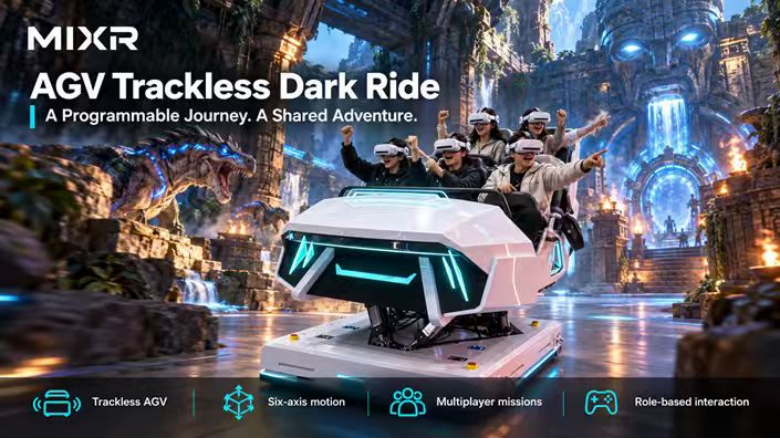
Content tests should include motion timing, role assignment, scoring, audio, and the handoff between scenes. Staff need a clear procedure for starting, pausing, recovering, and closing the ride.
MIXR can integrate the AGV vehicle, motion system, interactive content, and control layer. The venue still needs to coordinate local construction, floor preparation, fire and evacuation review, queue design, and daily operating rules.
An AGV trackless dark ride is different because the path is software-defined and the passenger experience can change with vehicle orientation, role, and interaction. That freedom is valuable when the project team gives equal attention to the less visible work: floor quality, positioning, clearances, safety logic, and integrated commissioning.