XR Infinite Space Explained: Free-Roam Multiplayer Entertainment
XR Infinite Space is a location-based entertainment format where several players walk freely inside a tracked physical area while sharing the same virtual world. The system keeps each person’s digital position aligned with the real floor, allowing the group to explore, cooperate, compete, and interact without remaining beside a fixed seat or simulator.
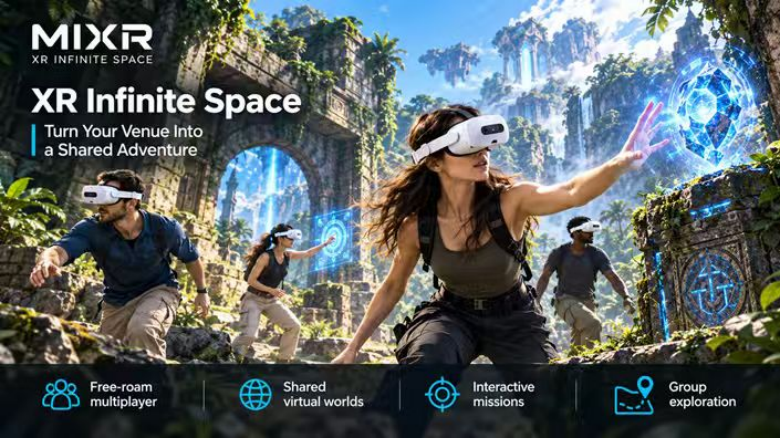
MIXR’s XR Infinite Space combines multiplayer free roaming, headset-based visuals, gesture or hand interaction in selected content, a control computer, positioning setup, device power management, and an operator system. For 2026 venues, its value comes from group participation. Players see one another as virtual characters and respond to the same events in real time.
Free roaming still has a controlled boundary
The player may feel as if the virtual environment continues far beyond the room. The physical area remains fixed. Software redirects movement, changes the path, or uses the story to keep participants inside the safe boundary.
That design depends on tracking and planned content. Virtual walls, corridors, doors, and waiting points should guide movement without repeatedly reminding players that they are inside a rectangular room.
The floor needs to be open, level, and protected from public traffic. Columns, steps, low fixtures, reflective surfaces, and emergency routes should be reviewed during the site survey. A large advertised floor area is not useful if the playable shape is broken into narrow or obstructed sections.
How multiplayer alignment works
Each headset reports its position and orientation to the system. The game server places the corresponding avatar in the shared virtual scene. When one player walks around another person in the room, the virtual relationship should remain believable.
The system also manages game events, scores, roles, and the current content state. Some experiences guide the group through a cultural journey. Others use shooting, puzzle solving, simulation, or team missions.
MIXR’s supplied content references cultural exploration, shooting gameplay, and interactive simulation. That range is useful for venues, but each project still needs a primary audience. A museum group and a birthday party expect different pacing, instructions, and replay value.
Gesture interaction changes the feel of the experience
Hand or gesture recognition can let players point, select, shoot, pick up objects, or trigger actions without holding a separate controller. The advantage is a more natural relationship with the virtual world.
The interaction should be chosen carefully. Large, readable gestures are easier for first-time players than precise finger movements. The system also needs feedback so the player knows the action has been recognized.
In a multiplayer space, one person’s interaction can affect the whole group. Content designers therefore need to decide whether everyone can trigger an event, whether one role has control, or whether the group must complete an action together.
The operator sees a different experience
Players see the virtual world. Staff need a control view that shows session status, device condition, and what is happening inside the game. MIXR’s operator or director system can support monitoring and secondary-screen playback.
That secondary display has two uses. It helps staff follow the group, and it gives waiting customers a view of the action. The spectator image should be selected carefully; a confusing camera angle can make a strong game look difficult to understand.
The operator also manages briefing, headset assignment, fitting, game start, assistance, cleaning, charging, and the transition to the next group. Those steps should be tested as one cycle.
Content length and venue rhythm
Longer experiences can support cultural storytelling and destination content. Shorter sessions may fit a shopping mall or FEC where customers arrive continuously. The correct duration depends on the ticket model, group size, cleaning time, and how much explanation the game requires.
A venue should avoid measuring capacity from game time alone. If a 20-minute experience requires ten minutes of briefing, fitting, and turnover, the full commercial cycle is 30 minutes. The layout can reduce that gap by separating the briefing, play, and equipment-return areas.
What belongs in a free-roam XR quotation
A buyer should receive a defined equipment and service scope. That normally covers headsets, control computer, networking, positioning environment, charging or battery equipment, operator display, software, game content, installation, calibration, training, and support.
Room preparation may remain with the buyer. MIXR’s materials identify items such as electrical work, network, partitions, printed positioning surfaces, entrance decoration, and operating tools as site-side considerations in some configurations. Responsibility should be stated clearly for the actual project.
Content rights and updates also need attention. Ask which themes are included, whether languages can be changed, how content versions are installed, and whether future titles use the same hardware configuration.
Where XR Infinite Space makes commercial sense
The format suits venues that can feed complete groups into a scheduled experience and have enough floor area for safe free movement. Cultural tourism sites can use it to reconstruct places or periods. FECs and malls can use multiplayer missions and competitive themes. Indoor parks can combine it with shorter attractions.
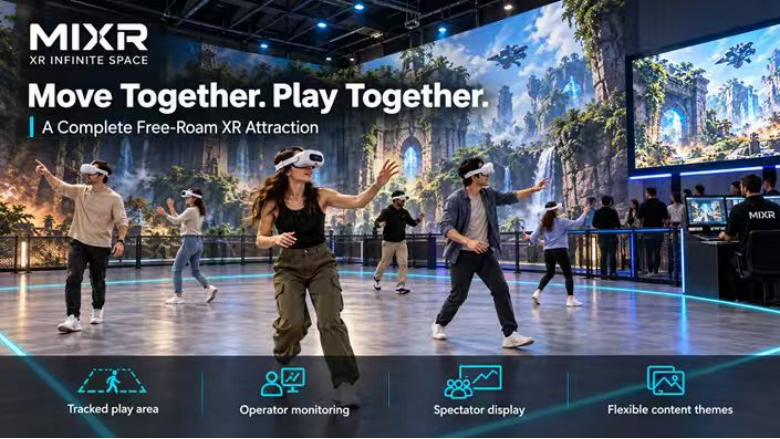
The format performs best in a continuous room with enough staff time for device handling and group briefing. The freedom visible to the customer depends on a controlled operating system behind the scenes.
MIXR’s XR Infinite Space should be evaluated as a multiplayer attraction, not a set of headsets. Tracking, content, operator tools, charging, layout, and session design determine whether the group moves naturally and whether the venue can repeat that experience throughout the day.