XR Infinite Space vs Traditional VR
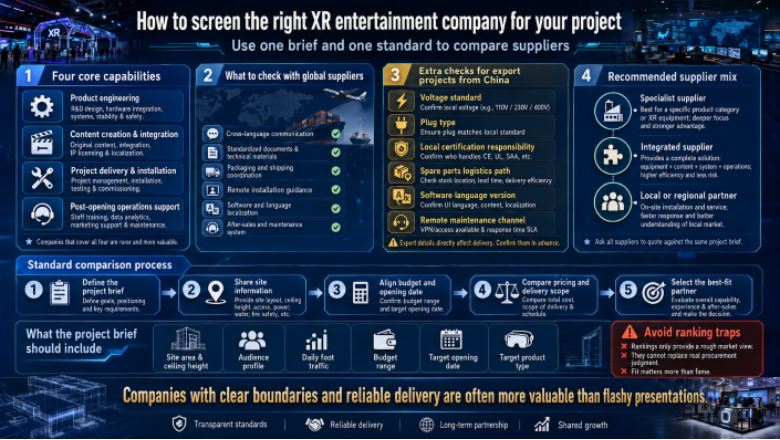
When buyers compare XR Infinite Space with traditional VR, they often start in the wrong place.
They ask about headset specs. Resolution. Tracking. Game library. Floor size.
Those details matter, of course. But the bigger difference is commercial. Traditional VR is usually a compact experience: seated VR, single-player stations, or a small room where movement is limited. XR Infinite Space is closer to a location-based attraction. Multiple players enter the same mapped area, move around, interact, and share one mission.
For shopping malls, FECs, tourist attractions, and VR theme parks, that difference changes the business model. It affects ticket price, staff work, repeat visits, queue flow, and how the attraction is sold from the outside.
Where Traditional VR Still Makes Sense
Traditional VR is not outdated. It still has a useful place.
If the space is small, the budget is tight, or the buyer only needs a simple entertainment corner, traditional VR can be the safer choice. It is easier to install, easier to explain, and usually easier for staff to manage. Seated VR, single-player games, and small-room VR can work for arcades, pop-up events, training demos, and low-cost entertainment areas.
It is often suitable when:
- The site has limited usable space.
- The buyer wants a lower entry cost.
- The experience is short and simple.
- Staff capacity is limited.
- The audience is trying VR for the first time.
The weakness appears when customers have already seen similar headset experiences elsewhere. If they can find something close to it in a cheap arcade, the attraction needs another reason for people to pay.
That is where traditional VR can feel thin.
What XR Infinite Space Changes
XR Infinite Space adds movement, group play, and a stronger sense of presence. Instead of sitting in one place, players walk through a mapped area. They see the virtual world through headsets, but they also share the mission with other players around them.
This format can support shooting games, escape missions, fantasy exploration, cultural adventure, team challenges, and other multiplayer experiences. The attraction feels less like “trying VR” and more like entering a game together.
That distinction is important.
A product such as MiXR’s XR Infinite Space is designed for commercial venues that need a complete multiplayer XR attraction, not a set of separate consumer VR devices. The value is in the full package: playable space planning, hardware integration, tracking, content, installation support, and operating guidance.
Most visitors will not talk about the tracking system after they leave. They will talk about what happened with their friends inside the experience. That shared memory is what gives XR Infinite Space stronger group appeal.
Cost and ROI Are Not Compared the Same Way
XR Infinite Space usually requires a higher investment than a basic traditional VR setup. It needs more space, stable tracking, multiple headsets, computing or streaming systems, multiplayer software, safety planning, content licensing, and trained staff.
There are also costs buyers sometimes forget: decoration, queue space, storage, cleaning tools, battery management, staff training, maintenance, and content updates.
Traditional VR may look cheaper at first. Sometimes it really is the better financial choice. But if local visitors lose interest quickly, utilization can drop after the first curiosity period. A lower investment does not automatically mean stronger ROI.
XR Infinite Space can support higher ticket value and group sessions, but only when the site has enough traffic and the operation is smooth. A mall with young group traffic may benefit from it. A quiet corner with weak visibility may not.
A simple rule helps:
- Choose traditional VR when the space is small, budget is limited, and the goal is simple entertainment.
- Choose XR Infinite Space when group play, repeat visits, and a stronger paid experience are needed.
- Avoid XR Infinite Space if the venue cannot provide safe movement space, trained staff, and clear visitor flow.
The Experience Feels Different
The biggest difference is not only movement. It is memory.
A basic VR ride can be fun for a few minutes, but visitors may not talk about it afterward. A multiplayer VR combat experience or free roam adventure creates small shared moments. Someone misses a target. Someone opens the wrong door. A team finishes a mission just in time. Those moments make the experience easier to remember.
That social layer is valuable for shopping mall entertainment solutions and family entertainment center solutions. People are more willing to pay when the activity is something they can do together.
But bigger does not always mean better.
If tracking is unstable, instructions are confusing, or the game is too difficult for first-time visitors, XR Infinite Space can become frustrating very quickly. A commercial system has to be designed for ordinary customers, not only gamers.
Operations Need More Discipline
XR Infinite Space asks more from the operator.
Staff need to handle onboarding, safety boundaries, headset fitting, cleaning, battery management, troubleshooting, and session reset. The floor has to stay clear. Network and power conditions need to be stable. The attraction also needs a visible storefront or waiting area so visitors understand what is happening before they buy.
Traditional VR can be more forgiving. If one station has a problem, the others may continue running. In a multiplayer arena, one headset issue can affect the whole group.
This is why supplier support matters. The buyer should not only ask what the system can do in a demo. They should ask how it behaves after six sessions in a row on a busy weekend.
A Buyer Checklist
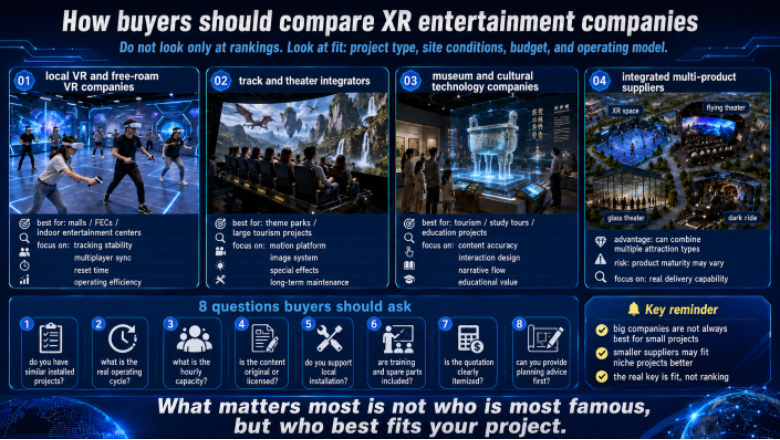
Before choosing XR Infinite Space, check these points:
- Is there enough clear playable area and queue space?
- Can the site support stable network and power conditions?
- Is the target audience interested in group play?
- Can staff handle cleaning, guidance, and reset?
- Is there a content update path?
- Can the supplier explain real hourly capacity?
- Is the attraction visible and understandable from outside?
- Is the ticket price acceptable for local customers?
If most answers are yes, XR Infinite Space may be the stronger commercial product. If several answers are weak, traditional VR may be safer.
The Practical Choice
XR Infinite Space is not a replacement for every traditional VR product. It is a higher-commitment attraction format for venues that need a social, immersive, and repeatable experience.
Traditional VR still works for compact sites, simple entertainment corners, and lower-budget projects. XR Infinite Space becomes more interesting when the goal is to anchor a mall zone, FEC, tourist entertainment area, or VR theme park with a recognizable multiplayer attraction.
The right choice is not the one that sounds more advanced. It is the one the venue can actually sell, operate, and keep useful after the first wave of curiosity.