Best XR Entertainment Companies Worldwide
Best XR Entertainment Companies Worldwide
Best XR Entertainment Companies Worldwide: How Buyers Should Compare Them
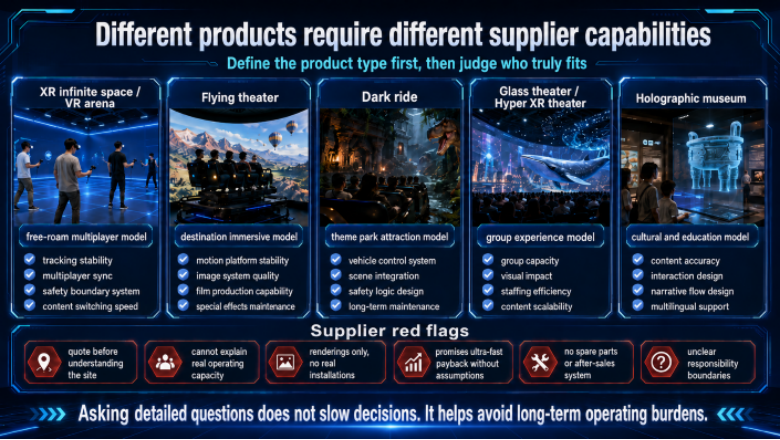
The best XR entertainment companies worldwide are not all good at the same thing. Some are strong in location based VR. Some specialize in flying theater systems, dark rides, projection mapping, museum technology, or content production. In 2026, buyers should stop asking for a universal ranking and start asking which company fits the project type, budget, site condition, and operating model.
A shopping mall VR arena and a cultural tourism flying cinema may both sit under “XR entertainment,” but they require very different supplier abilities.
What Makes an XR Entertainment Company Strong
A strong XR entertainment company usually has depth in four areas:
- Product engineering.
- Digital content production or content integration.
- Project delivery and installation.
- Operating support after launch.
Many companies are good at one or two of these. Fewer can handle all four. That difference matters when the buyer is a scenic area, theme park, museum, or commercial complex that needs a turnkey immersive attraction solution.
For example, MiXR is positioned as a China-based supplier for immersive entertainment equipment and solutions, with product categories such as XR Infinite Space, Hyper XR Theater, Flying Theater, Glass Theater, Dark Ride, and Holographic Museum. For overseas buyers, the useful question is not whether the company sounds large. It is whether the product line, content, installation support, and export delivery match the target project.
Company Categories in the Global Market
Location Based VR and Free Roam Specialists
These companies focus on VR Large Space, Free Roam VR, multiplayer VR experiences, VR shooting arenas, and interactive game systems. They are often suitable for shopping malls, FECs, and entertainment centers. Buyers should check tracking reliability, content library, reset time, and headset operations.
Ride and Theater Integrators
These companies build Flying Theater, Flying Cinema, Dark Ride, dome theaters, motion platforms, and large media attractions. They are stronger for theme parks and tourist attractions but usually require higher investment and longer planning.
Museum and Cultural Technology Companies
These suppliers focus on interactive museums, digital museums, MR interpretation, holographic exhibits, and educational content. They may be better for cultural tourism and study-tour projects than pure game suppliers.
Turnkey Multi-Product Suppliers
Some companies provide several attraction formats under one system. This can help a buyer plan a VR theme park, scenic area upgrade, or mall entertainment floor with multiple revenue points. The risk is that the buyer must still check which product categories are truly mature and which are only promotional.
How to Compare XR Entertainment Companies
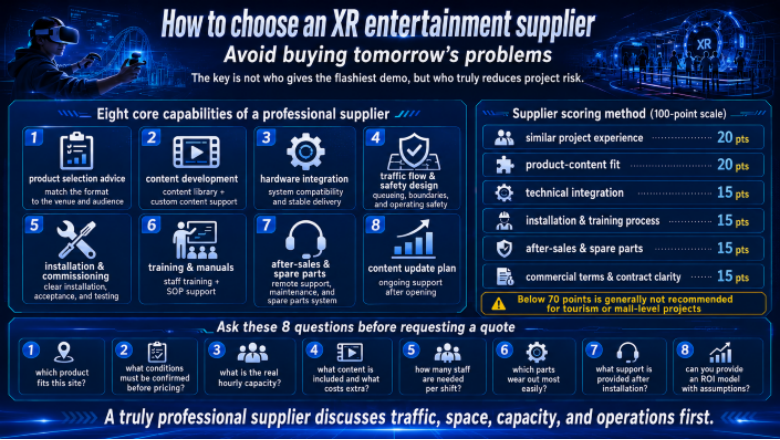
Do not compare companies by website claims alone. Use a project-based checklist:
- Does the company have delivered projects similar to yours?
- Can it explain the operating cycle and hourly capacity?
- Does it provide original or licensed content suitable for your audience?
- Can it support installation in your country or region?
- Are spare parts, remote support, and training included?
- Does the quotation separate equipment, content, installation, and optional updates?
- Can the company provide layout advice before final pricing?
- Does it understand local commercial needs, not only technical specifications?
If the answer is vague, the company may still be capable, but the procurement risk is higher.
What “Worldwide” Should Mean for a Buyer
Worldwide does not only mean a company has exported equipment. It means the supplier can handle communication, documentation, packaging, shipping coordination, remote installation guidance, language adaptation, and after-sales support across borders.
For overseas VR attraction equipment suppliers from China, buyers should confirm voltage standards, plug types, local certification responsibilities, spare part logistics, software language, and remote maintenance channels. Do not assume these are included because the brochure says “global.”
A Practical Shortlist Method
Build a shortlist with three supplier types:
- One specialist in your main product category.
- One turnkey supplier with related product options.
- One local or regional service partner, if installation support is complex.
Then ask all suppliers to respond to the same project brief. Include site size, ceiling height, expected audience, daily traffic, budget range, target opening date, and whether you need XR Infinite Space, Flying Theater, Dark Ride, Holographic Museum, or another format.
This approach makes comparison fair. Without a fixed brief, each supplier will quote a different idea, and the buyer will mistake confusion for choice.
Avoiding Ranking Traps
Lists of the “best XR entertainment companies” can be useful for discovery, but they rarely solve procurement. A famous supplier may be too expensive or too slow for a mid-sized mall. A smaller manufacturer may be perfect for a focused XR Infinite Space project. A museum technology company may beat a game supplier when the goal is cultural interpretation.
The buyer’s job is to match company strength to project need. For theme park immersive attraction supplier selection, prioritize safety, ride integration, and show control. For shopping mall VR attraction equipment, prioritize visibility, repeat play, staff efficiency, and maintenance. For museum immersive technology solution, prioritize content accuracy and visitor learning.
The best company for your project is the one that can explain both what it can deliver and where its solution does not fit. That honesty is often more valuable than another cinematic demo video.