Holographic Glass Theater Project Budget and ROI Guide
The Budget I’d Put in Front of the Owner Before Buying a Holographic Glass Theater
I would not bring a Holographic Glass Theater quote to the owner and say, “This is the project cost.”
That would feel too early.
The quote is important, of course. It tells us what the supplier is offering. But in a real venue, the quote is only one part of the budget. The room has its own opinion. The visitor route has its own problems. Staff will have their own complaints after opening. And if the attraction is inside a museum or scenic area, the content team may slow everything down with perfectly reasonable review requests.
So before I defend the number, I want to see how it behaves on site.
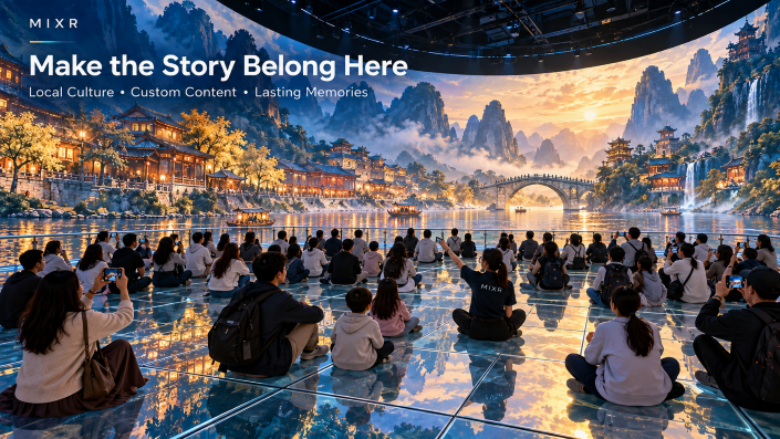
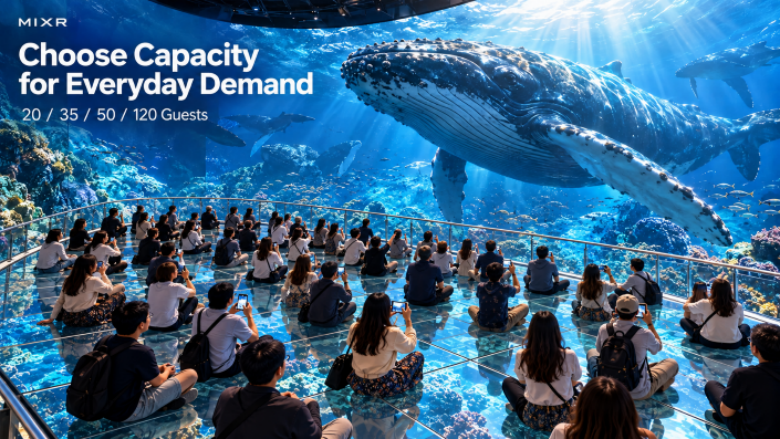
MIXR gives us a fairly clear product starting point. Its Holographic Glass Theater can be planned in 20, 35, 50, and 120-person versions, with documented layouts roughly around 30-200 square metres. The format includes a glass-bridge walk-in structure, five-sided curved LED naked-eye 3D visuals, audio, control, and short film viewing.
Good. That gives the project a shape.
But I still need to know what happens around it.
The Quote Is Not the Whole Job
The first thing I would mark is what the quote actually covers.
Does it include only the core system? Does it include installation guidance? Training? Content? Commissioning? Acceptance? What about the room finish, power, ventilation, entrance design, queue area, fire-route coordination, signage, and local contractor work?
I do not need everything to be inside MIXR’s quote. That is not the point. I just need every item to have an owner.
This is where many budgets become uncomfortable. Nobody argues about the big equipment line. People argue about the things that were “understood” but never written clearly.
A ticket counter.
A darker wall finish.
A guide script.
A waiting area for school groups.
A stronger entrance face for a commercial venue.
Small lines, until the opening date gets close.
I’d Walk the Route Before Talking About ROI
If this were my project, I would walk from the visitor’s first decision point to the exit of the theater.
Slowly.
At a museum, I would check whether the theater feels connected to the exhibition or like a paid room added at the end. At a scenic attraction, I would watch where groups gather and where they get tired. At a commercial complex, I would stand in the corridor and see whether the entrance explains itself fast enough.
That walk tells me whether the attraction can sell naturally.
If visitors need too much explanation, staff will carry the burden every day. If the queue blocks the route, the operation will feel messy. If the exit sends people away from the next part of the venue, we lose the chance to keep them moving through the experience.
None of this shows clearly in a standard price table.
Capacity Is a Feeling After Opening
The 120-person version sounds strong. I would consider it for a busy tourism site with steady group arrivals. It can make sense when guides move visitors in batches and the venue has enough waiting space.
But I would be cautious about choosing it just because it feels ambitious.
For many museums, 35 or 50 people may be the calmer choice. The room can feel active more often. Staff can control entry more easily. Visitors do not walk into a large space that feels half-used.
The 20-person version also has a place. In a smaller cultural route, a tighter group can feel more guided and more intentional.
I would ask one plain question: which version still feels right on an ordinary weekday?
That answer is usually more useful than the peak-day dream.
Content Can’t Be Left Until the End
For a museum or cultural tourism venue, content is not just the film file.
It affects the ticket story, the guide script, the marketing angle, and the visitor’s memory after leaving. A standard film may keep the first investment lighter. A localized version may help the attraction connect better with the place. A custom cultural film costs more, but it may give the operator stronger material for group tours, school visits, and seasonal promotion.
MIXR has film and CG production capability across its immersive attraction products, so I would bring the content discussion forward. I would want to know what is included, what can be localized, and what requires custom production.
If visitors only remember the visual effect, I would feel the venue has not used the product fully. For a cultural site, I want them to remember something that belongs there: a local scene, a landscape, a historical image, a cultural symbol.
That memory is part of the return.
The Budget I’d Actually Defend
The budget I would take seriously is not the neatest one.
It would include the system, the room, the entrance, content work, launch preparation, staff training, maintenance, and a rough first-year operating allowance. Some of those lines may sit with MIXR. Some may sit with the owner. Some may sit with the local contractor.
Fine. Just do not leave them floating.
I would rather present a heavier but honest number than approve a clean number and later discover that the missing work belongs to us.
The moment I would feel comfortable is when I can picture the second month after opening. Staff explain the attraction without sounding unsure. Visitors understand why they should enter. The room feels active enough. The content fits the venue. The queue does not make the operations team tense.
That is the Holographic Glass Theater budget I would defend.
Not the lowest number. The number that has already met the venue.