Flying Theater vs Dark Ride
If you want a clean answer, Flying Theater and Dark Ride are not substitutes. They solve different problems. Flying Theater is usually the better choice when the site needs a high-impact indoor attraction that can tell a big story fast, work with a tight footprint, and keep guest throughput predictable. Dark Ride is stronger when the park wants a physical scene path, close-up props, and more room to layer narrative detail. MiXR sits in both worlds, which is useful because many buyers compare them inside the same master plan.
Different jobs, different economics
Flying Theater sells motion, scale, and screen-driven immersion. It is often easier for a guest to understand in seconds. Dark Ride sells discovery. Guests move through a built environment, and the attraction can carry more scene-by-scene detail. That makes Dark Ride richer in some cases, but also heavier to build and more sensitive to layout and story design.
The cost conversation follows the same pattern. Flying Theater often concentrates budget into the motion platform, screen system, content, and integration. Dark Ride can spread cost into scene construction, ride path, props, effects, and lighting. One is not cheaper by default. One is just more focused on screen-based impact, while the other spends more on physical world-building.
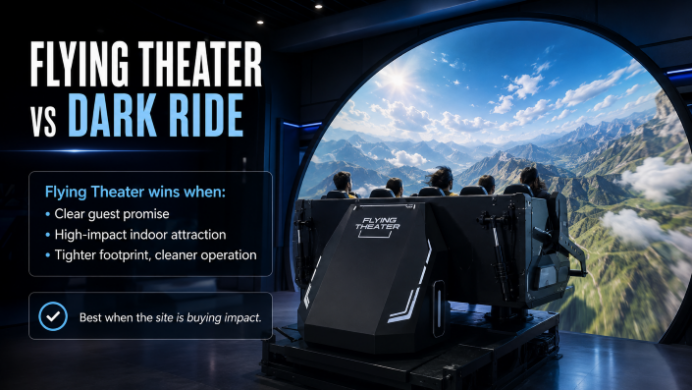
Where Flying Theater wins
Flying Theater is strong when a park needs a clear hero attraction, especially indoors or in a weather-sensitive environment. It works well when the story is big enough to carry a group and the site needs a format that can be understood quickly by families and mixed-age visitors. It also tends to work better when the park has limited floor area but still wants a premium feel.
Another advantage is operational clarity. A good Flying Theater can be easier to package as a ticketed experience because the format is visible and easy to explain. Guests know they are about to “fly” somewhere. That simple promise matters in a busy park where people decide fast.
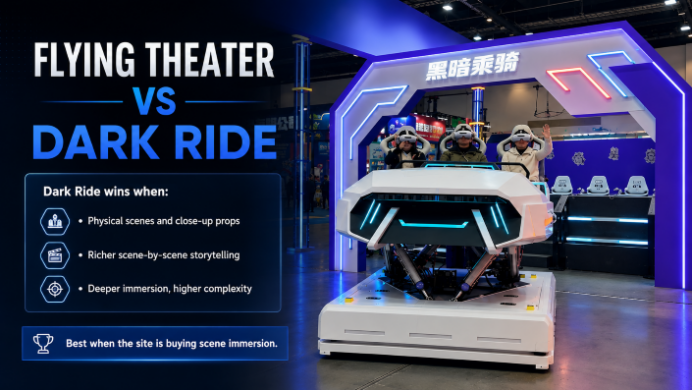
Where Dark Ride wins
Dark Ride is the better answer when the park wants a fully themed path, close character interaction, or a narrative that depends on physical scenes rather than screen scale. If the brand is built around story immersion and the guest is expected to move through multiple environments, Dark Ride can do things Flying Theater cannot. It is more granular and often more emotionally local.
The price is complexity. A Dark Ride asks for more scene engineering, more story coordination, and more maintenance discipline. That is fine if the park is ready for it. It is a bad idea if the site wants a large emotional effect without the construction burden.
A simple selection matrix
1. Need a faster build and a clearer guest promise? Choose Flying Theater.
2. Need physical scenes and deeper walk-through storytelling? Choose Dark Ride.
3. Need to fit a tighter indoor footprint? Flying Theater usually has the edge.
4. Need more narrative texture and set-piece detail? Dark Ride usually wins.
5. Need a format that guests can grasp fast? Flying Theater is easier to sell.
The rule I use
If the site is buying impact, start with Flying Theater. If the site is buying scene immersion, start with Dark Ride. If the answer is still mixed after that, the park should look at how the two might coexist rather than treating one as the universal winner. That is where a supplier like MiXR can help, because the real decision is not “Which is better?” It is “Which one fits this site, this traffic pattern, and this story?”
Why the choice matters before construction starts
This decision should be made before the project gets buried in civil work and show design. Once the park starts paying for structures, ride paths, and fitted scenes, changing direction becomes expensive and awkward. The right answer is the one that matches the site’s traffic pattern, operating team, and story ambition. If those three do not line up, the more attractive-looking option usually becomes the wrong one.
That is also why the park should not treat the two formats as a styling choice. A Flying Theater can carry a broad visual promise with a cleaner operating rhythm, while a Dark Ride asks for more built environment and scene maintenance. If the site needs one hero indoor draw, the first format often feels easier to defend. If it needs slower story movement and physical detail, the second one deserves a harder look.
The maintenance story matters too. A park that wants less scene-by-scene upkeep will usually be happier with the simpler operating pattern of Flying Theater, while a park that accepts more detailed upkeep in exchange for deeper immersion may still prefer Dark Ride. The real comparison is not only about show style. It is about what the team can realistically keep fresh six months after opening.