Future of Free Roam VR Shooting Attractions for
Entertainment Centers
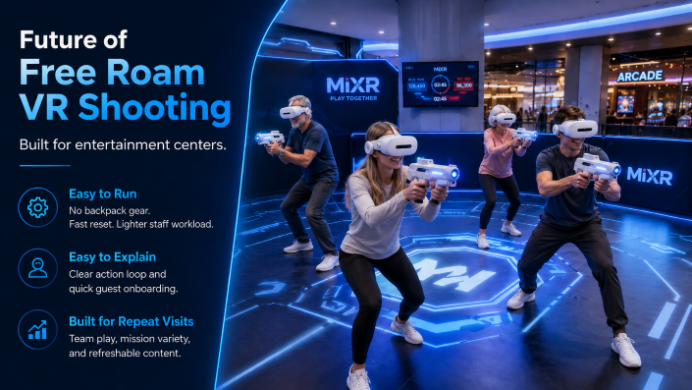
The future of Free Roam VR Shooting in entertainment centers is not about making the hardware look more futuristic. It is about making the attraction easier to run, easier to explain, and better at returning guests. In 2026, operators are not short of flashy content. They are short of attractions that can hold weekday traffic and still make sense on a Saturday. Free Roam VR Shooting fits that need because it gives players movement, teamwork, and a clear action loop without forcing the venue into a heavy build. Normal ceiling height is usually fine, and the format does not need a backpack on every player, which makes the room easier to place inside a mall or FEC.
What changes in 2026
The biggest change is buyer discipline. More operators now ask whether an attraction can survive the ordinary week, not just the opening surge. That means the room has to support short sessions, fast resets, and enough clarity that staff do not spend all day explaining rules. A good Free Roam VR Shooting room behaves like a social game first and a tech demo second.
Content pressure is changing too. Players have seen enough ordinary VR to know when the game loop feels shallow. They want mission variety, cooperative play, and a reason to come back with different friends. The attraction therefore needs a content path, not just a one-off title. That is one reason the better rooms are starting to look more like a platform than a single show.
Where the format is getting better
Free Roam VR Shooting is strong in venues that already know how to sell repeated visits. Family entertainment centers, mall anchors, birthday-heavy sites, and youth-oriented commercial spaces all fit the format if the room is sized sensibly. The attraction works because it can be explained quickly, and because the play style is easy to group. Friends can jump in together, and the format still feels social even when the game is competitive.
The absence of a backpack also matters more than people admit. When the setup gets lighter, the staff workload falls, the guest briefing gets shorter, and the room feels less technical. That does not make the attraction trivial. It makes it usable. Those are very different things.
What will still fail
The first failure mode is overbuilding. Some buyers try to force the attraction into a room that is too elaborate for the traffic they actually have. The result looks good in a render and weak in daily life. The second failure mode is unclear audience fit. If the room is aimed at everyone, it often connects with no one. A better room knows whether it is selling to teenagers, families, birthday groups, or repeat players.
The third failure mode is weak content refresh. If the play loop stays frozen, the attraction gets older faster than the buyer expected. A room like this needs new missions, seasonal changes, or at least a content roadmap that makes the investment feel alive.
A practical buying filter
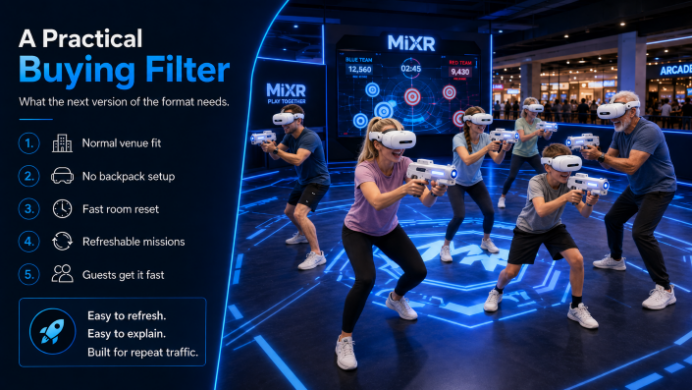
1. Can the room operate in a normal commercial venue without special ceiling demands?
2. Does the experience work without backpack gear or heavy player prep?
3. Can the staff reset the room quickly enough for real traffic?
4. Does the content have a refresh path beyond the launch version?
5. Is the format clear enough that guests understand it in a few seconds?
If those answers are good, the format is still very relevant. If they are weak, the attraction may still look modern, but it will be hard to protect as a business line.
Why MiXR belongs in the conversation
MiXR is relevant here because the company can package Free Roam VR, VR Arena, and VR Shooting Arena as a venue solution rather than a single machine. That matters for entertainment centers that need hardware, content, installation, and support to line up. The future of this category belongs to suppliers who understand operations as much as entertainment.
What the next version of the format needs
The future version does not need to look louder. It needs to be easier to refresh and easier for different venues to own. A strong room should let an operator rotate missions, adjust audience difficulty, and keep the group dynamic fresh without rebuilding the attraction every time the market shifts. That is where repeat traffic comes from. It is also where a lot of weaker installs fall behind.
The same idea applies to audience mix. A room that can serve birthday groups, school visits, and weekend friends without changing the whole setup has a better chance of staying busy. That is why the format should be judged not only by the launch demo, but by how easily the venue can keep it relevant when the first wave of curiosity has already passed.