VR Arena Equipment Budget and ROI Guide
VR Arena equipment budget and ROI should be planned together. If the buyer builds the budget first and thinks about operation later, the project may look affordable on paper and then lose money through slow reset, weak conversion, poor content fit, or staff confusion. A VR arena is a small entertainment business. Equipment is only one part of that business.
For 2026 operators, this matters because location-based VR has to compete with many other entertainment choices. Malls, FECs, indoor parks, and tourism streets want attractions that can attract groups, run safely, and produce repeat visits. MiXR’s VR Arena and VR Large Space solution should be judged by how well the equipment supports that operating model.
Build the Equipment Budget by Function
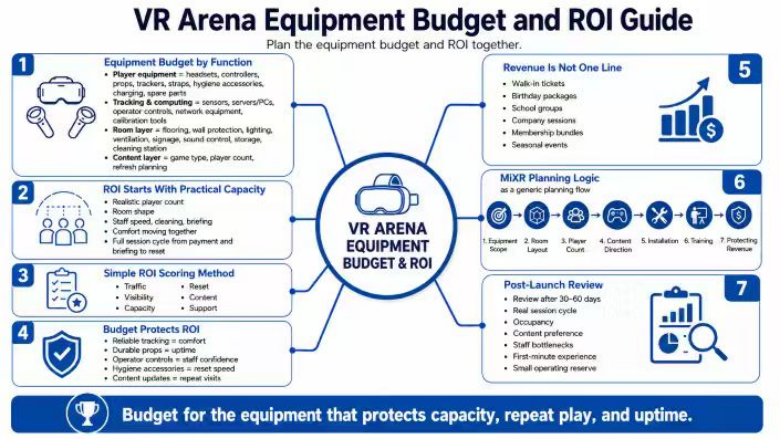
Start with player equipment: headsets, controllers, props, trackers, straps, hygiene accessories, charging, and spare parts. Then add tracking and computing: sensors, local servers or PCs, operator controls, network equipment, and calibration tools. After that, add the room layer: flooring, wall protection, lighting, ventilation, signage, sound control, storage, and cleaning station.
Do not forget content. A VR shooting arena, battlefield mission, family adventure, and cooperative challenge may require different props, player count, and refresh planning. Content is not a decoration layer. It decides why visitors pay and why they return.
ROI Starts With Practical Capacity
A buyer should not use the supplier’s maximum player count as the base model. Practical capacity depends on room shape, staff speed, cleaning, briefing, and how comfortable players feel moving together. A 8-player setup may operate better as 6 players if the room is tight.
The full session cycle should include payment, briefing, headset fitting, gameplay, exit, cleaning, battery check, and reset. If the game lasts 10 minutes, the business cycle may still be 14-18 minutes. That is the number ROI should use.
A Simple ROI Scoring Method
- Traffic score: does nearby foot traffic feed the arena on normal weekdays?
- Visibility score: can passersby understand the offer quickly?
- Capacity score: does player count match realistic demand?
- Reset score: can staff prepare the next session without delay?
- Content score: does the arena have repeat-play value?
- Support score: can equipment issues be solved without long downtime?
Where the Budget Protects ROI
Good equipment budgeting protects the parts of the attraction that make money. Reliable tracking protects player comfort. Durable props protect uptime. Clear operator controls protect staff confidence. Hygiene accessories protect reset time. Content updates protect repeat visits.
Cutting these items may reduce the initial spend, but it can damage ROI later. The buyer should be careful with any package that looks cheap because support, training, or room preparation has been left vague.
Revenue Is Not One Line
A VR arena can earn through walk-in tickets, birthday packages, school groups, company sessions, membership bundles, and seasonal events. Each channel needs a slightly different operating plan. Walk-in traffic needs visible signage. Parties need booking structure. Company groups need reliable scheduling. Repeat players need scores or new content.
The venue should model several revenue channels instead of expecting one perfect ticket stream. It should also test weak periods. If the arena only works at full weekend occupancy, the investment is fragile.
How MiXR Fits the Planning
MiXR can help buyers connect equipment scope with room layout, player count, content direction, installation, and training. This is useful because budget and ROI are tied together. A supplier who only lists devices is not giving the buyer enough information to judge the business.
The buyer should ask for a budget that shows what protects revenue. Tracking protects comfort. Training protects speed. Content protects repeat visits. Spare parts protect uptime. Storefront and signage protect conversion. Once those links are visible, procurement becomes less about cutting lines and more about choosing which risks the venue can accept.
After launch, review the numbers after 30-60 days. By then the team knows the real session cycle, average occupancy, content preference, and staff bottlenecks. That first operating review is often more useful than the original forecast.
A budget should also protect the visitor’s first minute. If the entrance is unclear, the staff script is clumsy, or the waiting area feels closed, conversion suffers before the headset is even worn. Many ROI fixes start outside the game.
The buyer should keep a small operating reserve for wear items and minor adjustments. Straps, face interfaces, props, signage, and staff materials may need changes after real use. Treating those changes as failure is the wrong mindset. They are part of tuning a public attraction.
That reserve also gives the manager room to fix problems quickly instead of waiting for another approval cycle.
The practical rule: budget for the equipment that protects capacity, repeat play, and uptime. Spend carefully, but do not remove the parts that make the arena operable. A smooth attraction usually beats a bigger but messy one.