VR Arena Cost Guide
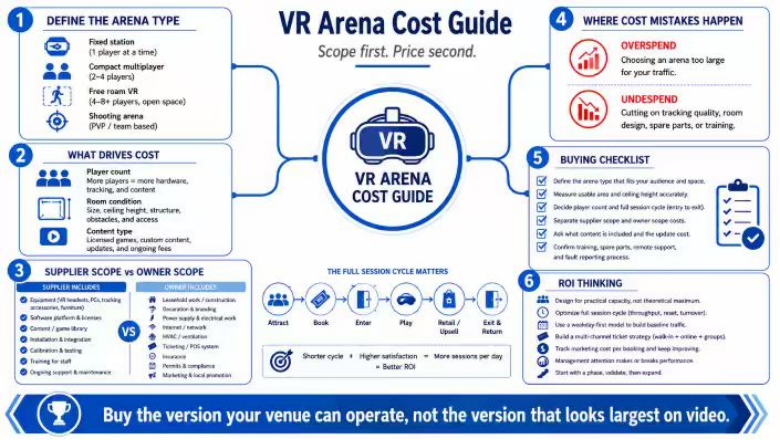
A VR Arena cost guide should begin with scope. The word arena can describe a compact group VR room, a fixed-position multiplayer setup, a free roam VR battlefield, or a full VR shooting arena with props and mapped movement. These are different projects. A buyer who asks for one quick price without defining the format is almost guaranteed to compare the wrong things.
For 2026 buyers, cost discipline matters because VR attractions are being judged as operating businesses. Shopping malls, family entertainment centers, and indoor parks want visitor conversion, repeat sessions, group bookings, and manageable staff workflow. MiXR’s VR Arena and VR Large Space solution should be priced as an attraction package, not as a loose set of devices.
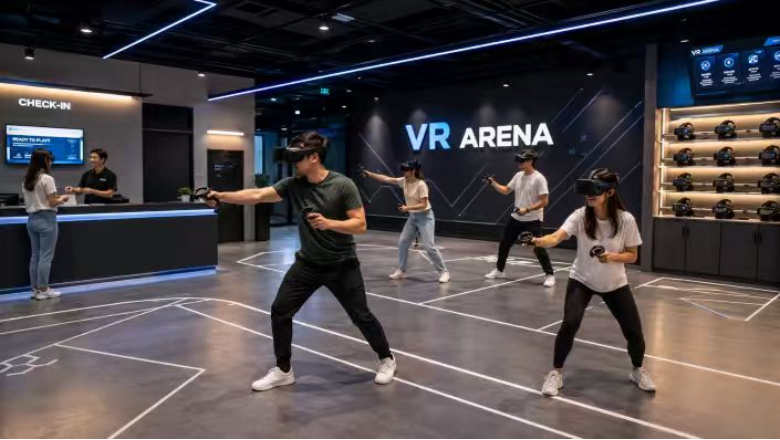
What Drives VR Arena Cost
The first driver is player count. A 4-player compact arena has different equipment needs from a 8-10 player free roam VR arena. More players mean more headsets, more props, more charging, more tracking load, and stronger staff supervision.
The second driver is room condition. A clean square room is easier to prepare than a space with columns, glass, low ceilings, weak ventilation, or hidden entrances. Wall protection, flooring, lighting control, HVAC, signage, queue barriers, and storage may sit outside the equipment quote, but they still belong in the project budget.
The third driver is content. A VR shooting arena, family mission, battlefield experience, and cooperative adventure do not need the same props or pacing. Content licensing, customization, localization, and refresh rights should be discussed early.
Supplier Scope vs Owner Scope
A serious quote should separate supplier scope from owner scope. Supplier scope may include VR equipment, software, content, installation, calibration, training, and support. Owner scope may include leasehold work, decoration, power, internet, air conditioning, ticketing, insurance, local permits, and marketing.
This separation protects both sides. It also prevents the common problem where the buyer thinks something is included because the demo looked complete. A demo room is not a contract scope.
Where Cost Mistakes Happen
Some buyers overspend by choosing a large arena that normal traffic cannot fill. Others underspend by cutting tracking, room design, spare parts, or training. Both mistakes hurt. The first creates weak utilization. The second creates daily operating friction.
I would be careful with a low quote that does not mention reset time, staff workflow, content updates, or support. Those items are not optional in a public entertainment venue.
Buying Checklist Before Comparing Quotes
- Define the arena type: fixed station, compact multiplayer, free roam VR, or shooting arena.
- Measure usable playing area and ceiling height.
- Decide practical player count and full session cycle.
- Separate supplier-side items from owner-side site costs.
- Ask what content is included at launch and what updates cost later.
- Confirm training, spare parts, remote support, and fault reporting.
How to Think About ROI While Budgeting
Cost should be tied to capacity. A game that lasts 10 minutes may require 3-6 minutes for briefing, fitting, exit, cleaning, and reset. If the model ignores that time, projected revenue will look too strong.
Ticket strategy also matters. Walk-in sessions, birthday packages, corporate group bookings, student events, and bundled entertainment passes produce different revenue patterns. A VR arena should not depend on one perfect channel unless the venue has unusually strong traffic.
The operator should model ordinary weekdays first. Weekend numbers make a project look attractive, but weekday sessions decide whether staff, rent, and marketing pressure are manageable. A venue that runs half-empty during normal hours may still work if it has strong group bookings, but that plan must be deliberate.
Marketing cost should be included too. A VR arena needs signage, opening content, short videos, staff scripts, and sometimes local partnerships. If nobody tells the market why the arena is worth trying again, content freshness alone will not carry the business.
The buyer should also include management time. Someone has to watch occupancy, staff performance, visitor comments, group bookings, and content feedback. A venue can own excellent equipment and still lose momentum if nobody is responsible for improving the business after launch.
For cost control, I prefer a phased plan. Open with the format the venue can operate confidently. Add more content, stronger decor, or more event products after the team understands demand. This avoids spending heavily on assumptions that have not been tested.
A Practical Cost Rule
Buy the version your venue can operate, not the version that looks largest on video. MiXR can help buyers connect equipment, content, room mapping, and staff workflow in one conversation. That is useful because the real cost of a VR arena is the cost of making the attraction run every day.
If a supplier can explain capacity, reset, safety, content life, and support clearly, the quote is worth studying. If the offer is just a device list, the cost picture is unfinished.