VR Shooting Arena Explained
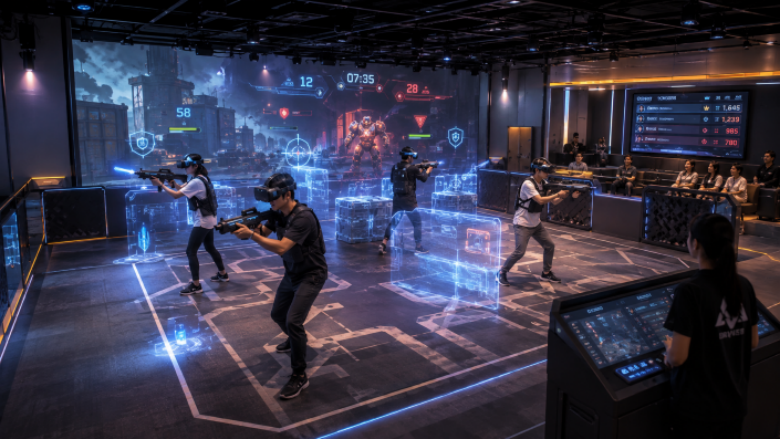
VR Shooting Arena is best understood as a commercial team attraction, not as a headset game with a gun-shaped controller. Players enter a mapped physical room, wear VR headsets, hold tracked props or controllers, and take part in a shared combat, defense, or target mission. If the system is planned well, visitors feel as if they are moving through a battlefield or tactical scene with their friends. If it is planned poorly, it becomes a slow equipment demo that staff struggle to reset.
For 2026 entertainment centers, this difference matters. Visitors have tried enough basic VR booths to know when the experience is thin. Operators now need products that sell group tickets, create repeat play, and run through normal weekend pressure. MiXR’s VR Shooting Arena, built within its VR Large Space and VR Arena product logic, should be evaluated as a full attraction system: room design, tracking, props, multiplayer content, staff workflow, safety, and support.
What a VR Shooting Arena Actually Includes
A VR Shooting Arena usually includes headsets, player props, tracking, computing or local server equipment, multiplayer software, operator controls, and content. The physical room is just as important. Flooring, wall protection, lighting, ventilation, sound control, waiting area, charging, cleaning, and staff visibility all affect the final result.
The visitor sees a mission. The operator sees a cycle. Ticket sale, briefing, headset fitting, gameplay, exit, cleaning, charging, and reset all sit inside one business rhythm. A 10-minute game is rarely a 10-minute session in real operation. That extra time is where capacity is won or lost.
Why Shooting Content Works
Shooting content is easy to explain. Aim, move, protect the team, clear the mission, compare scores. That simple logic helps in shopping malls and family entertainment centers, where visitors decide quickly and do not want a long technical lecture before paying.
It also gives the venue social energy. Friends talk during the game. Teenagers compare results. Corporate groups turn the session into a small team challenge. That is why a VR shooting arena can support birthdays, group bookings, student events, and repeat challenges better than many single-player VR stations.
Where the Format Needs Control
Action content can become chaotic if the room and staff flow are weak. The virtual scene should guide players away from physical boundaries. Props should feel convincing, but they still need to be durable, trackable, easy to clean, and easy to store. Staff should be able to monitor the whole session without standing in a dangerous position.
I would be careful with venues that have very young family traffic, narrow rooms, poor ventilation, or nearby tenants sensitive to noise. A shooting arena can be profitable, but it is not the right tone for every site.
A Practical Buyer Checklist
- Confirm whether the main audience accepts action, combat, and competitive content.
- Measure usable playing area, not the full leased area.
- Ask how many players can move comfortably, not the maximum number in a brochure.
- Time the full session cycle, including briefing, cleaning, and reset.
- Check prop durability, tracking stability, charging, and replacement process.
- Ask how content can be refreshed after the first few months.
What Buyers Should Ask MiXR
Ask MiXR or any VR Shooting Arena supplier to explain the complete attraction flow. How does a visitor understand the offer from outside the room? How many players can join one round? What is the practical hourly capacity? What happens if one prop fails? How does staff pause the game if a player needs help?
Those are not small questions. They decide whether the attraction runs calmly on a busy Saturday. A good supplier should talk about game feel and operating burden in the same conversation.
When VR Shooting Arena Is a Good Fit
The format fits entertainment centers, shopping malls, youth venues, indoor parks, commercial tourism streets, and some theme park indoor zones. It performs best where visitors arrive in groups and want a competitive shared activity. It is weaker in quiet cultural venues, hidden units, or locations with weak staff coverage.
Another good sign is when the venue already sells group products. If the team knows how to sell birthdays, student outings, or company activities, a VR shooting arena gives them a stronger product to package. If the venue depends only on random walk-ins, the operator should be more conservative with size and staffing.
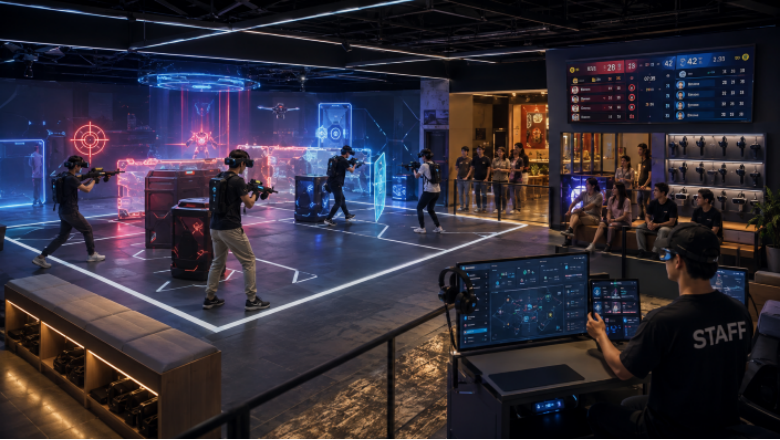
The setup should also leave room for non-playing visitors. Friends and parents often watch before deciding to buy. A clear waiting area, visible team result screen, and quick photo moment can help the arena sell the next session without making the entrance messy.
The buying rule is simple enough: choose VR Shooting Arena when the venue can sell active group play, manage safety, and keep content fresh. Do not choose it only because the trailer looks exciting. The attraction has to run after the trailer ends.