VR Large Space Manufacturer Comparison
A VR Large Space manufacturer comparison should go beyond who can ship headsets and props. A manufacturer for this category is building more than devices. The project may require tracking design, multiplayer synchronization, room mapping, content packaging, operator software, installation support, and after-sales service. If those layers are weak, the visitor will not care how good the equipment looked in the quote.
In 2026, buyers are more cautious because location-based VR attractions have to survive normal daily operation. A mall or FEC cannot depend on an engineer standing beside the system all day. MiXR’s VR Large Space product should be compared as a full attraction system, especially for buyers who need free roam VR or VR arena equipment from China.
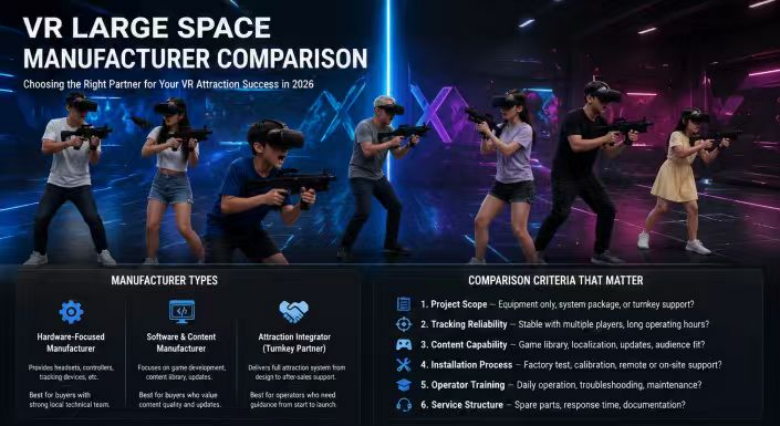
Manufacturer types are not the same
Some manufacturers focus on hardware. They can provide headsets, controllers, props, tracking devices, or cabinets. Some focus on software and content. Some operate as attraction integrators, coordinating hardware, content, installation, and training. The buyer should know which type they are dealing with before comparing prices or promises.
A hardware-focused manufacturer may be right for a buyer with a strong local technical team. A turnkey-style manufacturer is usually better for an operator that needs guidance from floor plan to opening day. Neither model is automatically better. The fit depends on the buyer’s internal capability.
This is where many comparisons go wrong. Buyers put two manufacturers in the same spreadsheet because both say VR Large Space. One may be selling a finished attraction system. The other may be selling parts that require local integration. The spreadsheet looks tidy, but the risk is not the same.
Comparison criteria that matter
- Project scope: equipment only, system package, or turnkey attraction support.
- Tracking reliability: how the system performs with multiple players during long operating hours.
- Content capability: game library, localization, updates, and audience fit.
- Installation process: factory test, room calibration, remote guidance, or on-site support.
- Operator training: daily startup, reset, cleaning, troubleshooting, and shutdown.
- Service structure: spare parts, response time, documentation, and fault reporting.
Factory demos can hide the hard parts
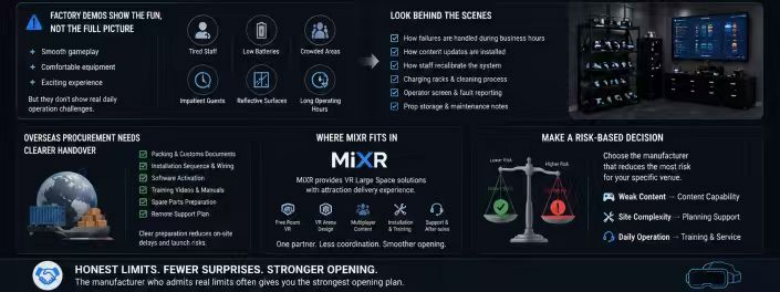
Factory demos are useful. They show whether the game feels smooth and whether the equipment is comfortable. They do not show how the system behaves with tired staff, impatient families, low batteries, a crowded waiting area, or a room with reflective glass. A buyer should ask for practical operating details along with the play test.
Ask how the manufacturer handles a headset failure during business hours. Ask how content updates are installed. Ask whether staff can recalibrate the system after a minor change in the room. The answers reveal whether the manufacturer thinks like an attraction partner.
If possible, ask to see the less polished parts of the system: charging racks, cleaning process, operator screen, prop storage, and maintenance notes. A manufacturer proud of daily operation will show them without turning the conversation back to the trailer.
Overseas procurement needs clearer handover
When buying from overseas, the manufacturer must reduce ambiguity. Packing, customs documents, installation sequence, wiring, software activation, training videos, spare parts, and remote support should be prepared before shipment. If the buyer has to guess, the project will lose time on site.
Where MiXR fits in the comparison
MiXR is worth considering when the buyer wants a VR Large Space equipment manufacturer with attraction delivery experience. The company can discuss free roam VR, VR arena design, multiplayer content, room requirements, installation, and support. That is useful for operators who do not want to stitch together several vendors for one attraction.
For a buyer outside China, this can reduce coordination pressure. The goal is not simply to import equipment; it is to open a venue that staff can run. Documentation, training, and remote support should be judged as part of the manufacturer offer.
The comparison should end with a risk decision. Which manufacturer reduces the most risk for this specific venue? If the main risk is weak content, choose content capability. If the main risk is site complexity, choose planning support. If the main risk is daily operation, choose training and service. The best manufacturer is the one that matches the risk you actually have.
A final comparison call should include the future operator, not just purchasing. The person who will run the attraction may ask about cleaning, opening checks, busy-hour staffing, and visitor complaints. Those questions often reveal more than another discount request.
If two manufacturers look similar on paper, choose the one that explains limitations clearly. Honest limits are easier to manage than vague confidence.
That kind of honesty is not negative. It helps the buyer prepare the room, staff, and launch schedule with fewer surprises.
In attraction projects, fewer surprises are usually worth more than a prettier promise.
The manufacturer who admits real limits often gives the buyer a stronger opening plan.