VR Large Space ROI Analysis
VR Large Space ROI analysis should not try to prove that every free roam VR project pays back quickly. Some do. Some do not. The useful question is narrower: does this venue have the traffic, space, staff, and content plan to turn a multiplayer VR attraction into a repeatable revenue unit?
In 2026, buyers are becoming less patient with vague promises. They want to know how many people can play per hour, how often content needs to change, how much staff time is required, and whether the attraction can bring visitors back. MiXR’s VR Large Space solution should be evaluated through that operating lens.
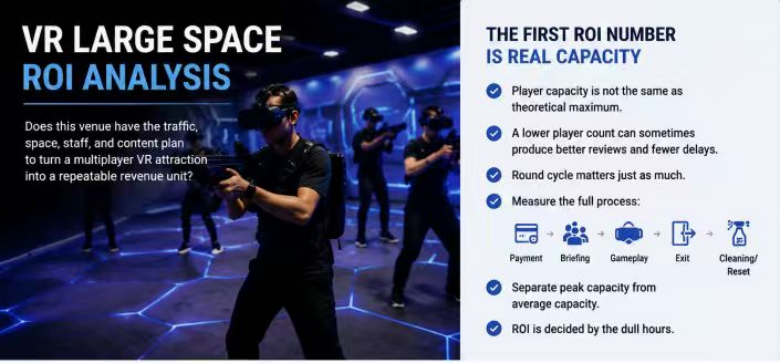
The first ROI number is real capacity
Player capacity is not the same as theoretical maximum. A supplier may say the system supports 8 players, but the venue might run better with 6 because of room shape, staff ability, cleaning speed, or safety comfort. A lower player count can sometimes produce better reviews and fewer delays.
Round cycle matters just as much. A 12-minute game with a 5-minute reset creates a different revenue ceiling from the same game with a 2-minute reset. Buyers should time the full process: payment, briefing, headset fitting, gameplay, exit, cleaning, and preparation for the next group.
I would also separate peak capacity from average capacity. A team may fill every session on Saturday evening, then run half-full on Tuesday afternoon. ROI is rarely decided by the loudest hour. It is decided by the dull hours, the ones that do not appear in promotional videos.
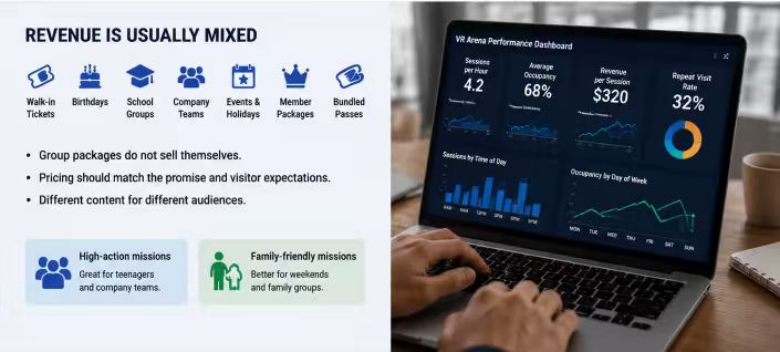
Revenue is usually mixed
Walk-in tickets are only one revenue path. VR Large Space attractions can also support birthdays, school groups, company team sessions, holiday events, member packages, and bundled entertainment passes. The venue should not depend on one channel unless traffic is unusually strong.
That said, group packages do not sell themselves. The operator needs visible booking information, staff who can explain the product, and a content library that fits different audiences. A high-action VR shooting arena may fit teenagers and company teams, while a family-friendly mission may sell better on weekends.
Pricing should match the promise. If the session is sold as a premium team mission, the waiting area, briefing, staff attitude, and exit photo moment should feel organized. If the venue sells it like a quick arcade play, visitors will judge it by arcade expectations. That choice changes ROI more than many spreadsheets admit.
A practical ROI checklist
- Use nearby traffic, not total mall or park attendance, as the conversion base.
- Calculate sessions per hour from full cycle time.
- Model average occupancy, not maximum player count.
- Include staff wages, cleaning supplies, equipment wear, and maintenance allowance.
- Set a weak-season case before approving the project.
- Plan at least one content or marketing refresh path before opening.
Where ROI gets inflated
ROI gets inflated when the model assumes every round is full, every weekday is strong, and every visitor pays the highest ticket price. It also gets inflated when staff time is treated as free. In real venues, staff are part of the attraction. If they are slow, confused, or stretched too thin, revenue falls.
Another inflated assumption is perfect uptime. A headset, prop, charger, network device, or tracking element may need attention. The buyer should ask how the system continues operating when one item is temporarily out of service. A resilient setup protects ROI better than a fragile setup with a bigger headline player count.
Content fatigue is the quieter inflation. The first mission may sell well because it is new. Three months later, regular visitors ask what has changed. A practical ROI model should include refresh planning, even if the first update is small.
The venue should also watch refund reasons and staff notes. If players complain about dizziness, confusion, waiting, or equipment comfort, those comments are ROI data. They show where revenue is being lost before the finance report catches up.
Where VR Large Space performs well
The format performs best where visitors arrive in groups and want a shared activity. Shopping malls, family entertainment centers, youth venues, commercial tourism streets, and some indoor park zones are good candidates when the storefront is visible and staff are trained. It is weaker in hidden rooms, narrow spaces, or locations with casual foot traffic that does not stop.
A good ROI analysis leaves room for judgment. It does not promise magic. It asks whether MiXR’s VR Large Space attraction can create enough paid sessions, repeat visits, and group bookings to justify the project. If the answer depends on perfect attendance, the plan needs another pass.
I would review the numbers again after the first 30-60 days of operation. By then, the team usually knows the real cycle time, popular content, weak time slots, and staff bottlenecks. That review is where the attraction becomes sharper.